What is the correct angle between T and U in the cross product?

Click For Summary

Homework Help Overview

The discussion revolves around finding the angle between two vectors T and U in the context of their cross product. The vectors are given in a three-dimensional space, but participants explore the possibility of simplifying the problem to two dimensions due to the z-component being zero.

Discussion Character

  • Exploratory, Conceptual clarification, Mathematical reasoning

Approaches and Questions Raised

  • Participants discuss the calculation of the angle using the sine function and the relationship between the cross product and the sine of the angle. There is also mention of using trigonometric identities to find the angle.

Discussion Status

There is a divergence in understanding regarding the interpretation of the angle and its calculation. Some participants assert that 45 degrees is the correct answer, while others question the validity of this conclusion and seek clarification on whether they are finding the angle or the sine of the angle.

Contextual Notes

Some participants express uncertainty about their understanding of three-dimensional vectors and consider simplifying the problem to two dimensions. There is also a mention of potential confusion regarding the distinction between finding the angle and finding its sine.

Linus Pauling
Messages
187
Reaction score
0
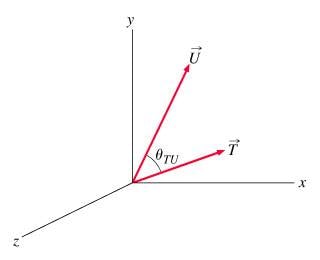
1. Find the sine of the angle between and .
NV_vp.jpg


2. AxB = ABsin(alpha)


3. I know T = (3,1,0) and U = (2,4,0), and I calculated that V = TxU = (0,0,10), so the magnitude of V is 10.

Then I did 10 = sqrt(10)*sqrt(20)*sin(alpha)

Divided 10 by sqrt(10)*sqrt(20), took the inverse sine, and obtained 45 degrees, which is incorrect.
 
Physics news on Phys.org
I haven't studied 3-D vectors, but this problem can be simplified into a 2-D diagram, and quite easily since z=0 for both vectors.
I also got the answer of 45o by answering it with trigonometry.

But the question does say find the sine of the angle, correct? So are we looking for the answer [itex]1/\sqrt{2}[/itex] ?
 
We are not finding sine(theta), we are finding theta, which is what I calculated.
 
You have already been told that 45 degrees ([itex]\pi/4[/itex] radians) is the correct answer. What makes you say it is incorrect?

As a check, use the fact that [itex]\vec{u}\cdot\vec{v}= |\vec{u}||\vec{v}|cos(\theta)[/itex]. Since, here, [itex]|\vec{u}\times\vec{v}|= \vec{u}\cdot\vec{v}[/itex], [itex]sin(\theta)= cos(\theta)[/itex] and the angle, being in the first quadrant must be [itex]\pi/4[/itex].
 

Similar threads

  • · Replies 6 ·
Replies
6
Views
3K
  • · Replies 7 ·
Replies
7
Views
3K
  • · Replies 9 ·
Replies
9
Views
8K
  • · Replies 2 ·
Replies
2
Views
2K
  • · Replies 1 ·
Replies
1
Views
2K
  • · Replies 13 ·
Replies
13
Views
2K
  • · Replies 3 ·
Replies
3
Views
2K
Replies
1
Views
2K
Replies
3
Views
2K