What is the correct answer for the electric charge question?

Click For Summary

Homework Help Overview

The discussion revolves around electric charge problems, specifically involving the behavior of charged objects and the forces between them. Participants are exploring concepts related to charge distribution, electric fields, and the differences between solid spheres and hollow shells in the context of electrostatics.

Discussion Character

  • Mixed

Approaches and Questions Raised

  • Participants are attempting to derive expressions for forces between charged objects and questioning the correctness of their answers compared to provided solutions. Some express confusion about charge distribution when objects come into contact, while others are exploring the implications of different geometries (solid vs. hollow) on electric fields.

Discussion Status

There is ongoing exploration of various interpretations of the problems, with some participants providing guidance on the principles of charge distribution. However, there is no explicit consensus on the correct answers, and multiple interpretations are being discussed.

Contextual Notes

Some participants mention difficulties due to language barriers and the complexity of the problems, while others express concern about the clarity of the textbook explanations. There are also reminders about the forum's guidelines regarding posting multiple questions in a single thread.

cuongbui1702
Messages
31
Reaction score
0
Electric charge question[Updating...]

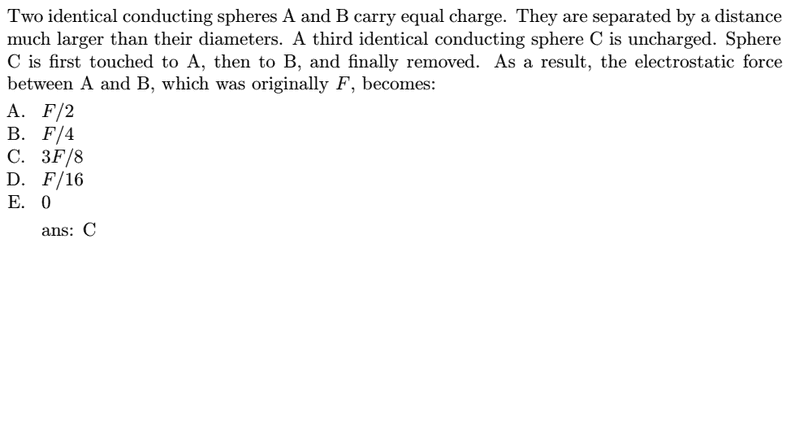
1)
testbank-28-chap21_zps8fb3ad78.png

I tried to do this homework, but my answer is all , of course it is not as same as this question's answer. That is my procedure:
+) First, 2 charged have a same chagre Q, after these also have a same charge q=(Q-Q').
+) F'/F=[(Q-Q')/Q]^2.
+) I substituting all answer, and it is correct all, i can have 1 Q'.
Why the answer is C.

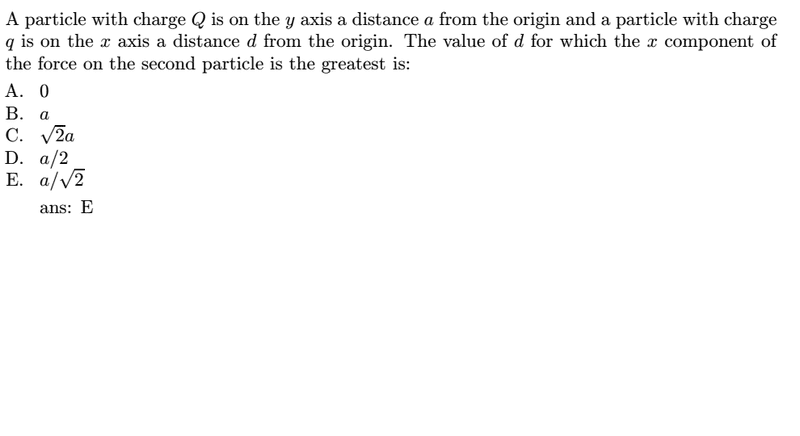
2)
testbank-28-chap21_zps9b70a217.png

F=Q.q/4piE(a^2+d^2)
F max when a^2+d^2 min=> d^2 min when d=0 why the answer is E, i think a true answer is A

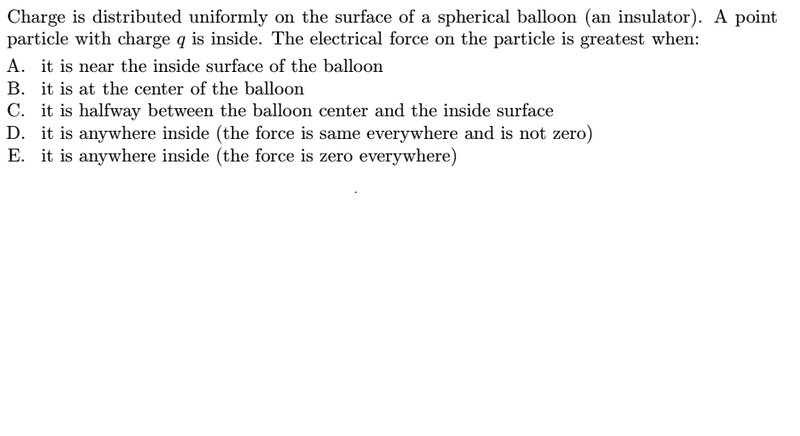
3)
testbank-44-chap21_zps5e707e6d.png

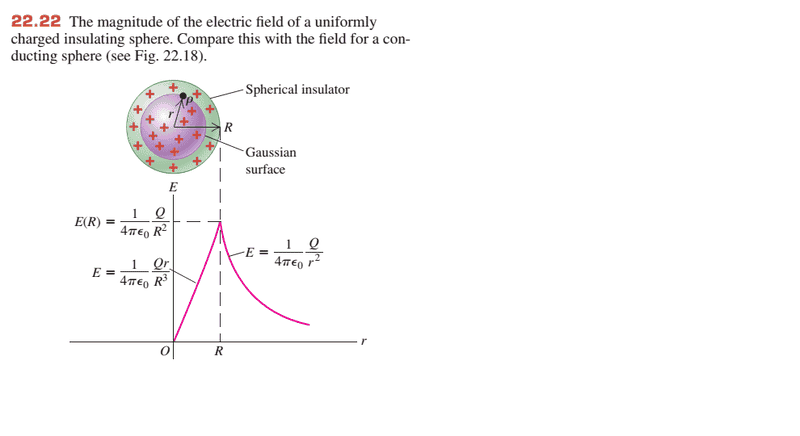
Following my textbook:
testbank-44-chap21_zps07104445.png

it is also existing an electric field inside a insulator. So the answer E is not correct, because it still have Electric force. I think A is true. Am I right?
 
Last edited:
Physics news on Phys.org
cuongbui1702 said:
1)
I tried to do this homework, but my answer is all , of course it is not as same as this question's answer. That is my procedure:
+) First, 2 charged have a same chagre Q, after these also have a same charge q=(Q-Q').
+) F'/F=[(Q-Q')/Q]^2.
+) I substituting all answer, and it is correct all, i can have 1 Q'.
Why the answer is C.
Let Q be the initial charge on A and B. (Express the initial force F in terms of Q.) When C touches A, what are the resulting charges on A and C? Then when C touches B, what are the resulting charges on C and B? Once you have the final charges on A and B expressed in terms of Q, then find an expression for the new force between A and B.
 
To get a resulting charges on A and C or B and C i think it is quite hard, or i don't know to calculate it
 
cuongbui1702 said:
To get a resulting charges on A and C or B and C i think it is quite hard, or i don't know to calculate it
No, it's easy. And unless you know how it works, you cannot solve the problem.

Here's how it works: When two identical conducting spheres are touched, the total charge distributes uniformly between the two of them.
 
Oh thank you, that is amazing thing i have learned today, i got the answer, it is as same as with this( sorry about my terrible English). Why i can't see this in my textbook University Physics with Modern Physics, 13th Edition of Young and Freeman
 
Who can help me Question2 and 3, please
 
cuongbui1702 said:
2)
F=Q.q/4piE(a^2+d^2)
F max when a^2+d^2 min=> d^2 min when d=0 why the answer is E, i think a true answer is A
You need an expression for x-component of the force, not the total force.

(Don't keep adding problems to the original post. That makes things confusing to follow and respond to. Best to solve one problem before starting another; usually best to have one problem per thread, unless they are very related.)
 
cuongbui1702 said:
3)
Following my textbook:

it is also existing an electric field inside a insulator. So the answer E is not correct, because it still have Electric force. I think A is true. Am I right?
No, you are not right. The illustration from the book describes a uniformly charged sphere, but the problem is about a spherical shell (a balloon).
 
Doc Al said:
You need an expression for x-component of the force, not the total force.

(Don't keep adding problems to the original post. That makes things confusing to follow and respond to. Best to solve one problem before starting another; usually best to have one problem per thread, unless they are very related.)
- Oh, I read wrong problem :(. But, when i did it again, my process is long(i use derivatives), maybe in this question, i substituting all answers is faster than my process.
- I am scared, admin delete my post when i make a lot of question :(
 
  • #10
Doc Al said:
No, you are not right. The illustration from the book describes a uniformly charged sphere, but the problem is about a spherical shell (a balloon).

What is the difference between them??
 
  • #11
cuongbui1702 said:
What is the difference between them??
A balloon is hollow shell with nothing inside. The text from your book describes a solid sphere of charge, not just a shell.
 
  • #12
cuongbui1702 said:
- Oh, I read wrong problem :(. But, when i did it again, my process is long(i use derivatives), maybe in this question, i substituting all answers is faster than my process.
I suggest you actually work it out with derivatives; it's not that bad and it simplifies quickly.
 
  • #13
Doc Al said:
A balloon is hollow shell with nothing inside. The text from your book describes a solid sphere of charge, not just a shell.
Because English is my second language, so that it is hard for me to recognize what it is, if i don't have pictures :D
 
  • #14
Doc Al said:
No, it's easy. And unless you know how it works, you cannot solve the problem.

Here's how it works: When two identical conducting spheres are touched, the total charge distributes uniformly between the two of them.

Doc AI, i have a same problem but my answer is not as same as question's answer. Following you, it must be A.
testbank-27-chap23_zps1c18ff99.png
 
  • #15
cuongbui1702 said:
Doc AI, i have a same problem but my answer is not as same as question's answer. Following you, it must be A.
In this example, the conducting spheres are not identical. (The more general principle is that the potential will be the same after they touch.)
 

Similar threads

Replies
23
Views
5K
  • · Replies 6 ·
Replies
6
Views
1K
  • · Replies 3 ·
Replies
3
Views
2K
  • · Replies 2 ·
Replies
2
Views
2K
Replies
9
Views
2K
Replies
3
Views
1K
  • · Replies 2 ·
Replies
2
Views
1K
  • · Replies 23 ·
Replies
23
Views
2K
  • · Replies 13 ·
Replies
13
Views
3K