Undergrad What Is the Correct Sign for the Quadratic Form in Margenau's Proof?

  • Thread starter Thread starter fsonnichsen
  • Start date Start date
  • Tags Tags
    Form Quadratic
Click For Summary
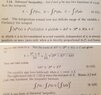
The discussion centers on a potential error in Margenau and Murphy's proof of the Schwarz inequality, specifically regarding the sign of the quadratic form. The assertion that Gamma is positive is accepted, but the expression "-(B+B*)" appears incorrect, as B+B* equals 2Re(B), which should be positive. Despite this, it is noted that the values of lambda do not affect the argument, indicating it may be a minor oversight. The proof of the Cauchy-Schwarz inequality for complex numbers in N dimensions is acknowledged as complex and not intuitively obvious. Overall, the conversation highlights the importance of careful evaluation of assumptions in mathematical proofs.
fsonnichsen
Messages
61
Reaction score
5
TL;DR
From Margenau and Murphy--quadratic form use not clear
Looking at the proof of the Schwarz inequality in Margenau and Murphy, you will see what I attached. Gamma is asserted to be positive (OK). Given that the usual "quadratic form" solution would read "-(B+B*) .....". The sign does not seem correct to me as shown. In a fact B+B* = 2Re(B) and would be positive in this case given the integrals shown.
What am I missing here?

Thanks
Fritz
 

Attachments

  • Margenau .jpg
    Margenau .jpg
    33.2 KB · Views: 136
Physics news on Phys.org
I think you found an error in the book. However, the values of ##\lambda## don't play a role in the argument (only the sign of the expression under the square root does), so I would call it a small error.

##\ ##
 
OK and thanks! The authors assumptions make sense but they must be evaluated carefully so I thought I may have missed something 49 years ago when I read the book the 1st time-it was quite a famous book back then.

I find the Cauchy-Schwarz ineq. for complex numbers in N dimensions somewhat tricky-the proof is not intuitively obvious to me upon brief examination.

Take care
Fritz
 
  • Like
Likes WWGD and BvU
Writing
$$\langle f|g \rangle=\int_{\mathbb{R}} \mathrm{d} x f^*(x) g(x),$$
you have from positive definiteness of the scalar product in ##L^2##
$$\langle f+\lambda g|f+\lambda g \rangle \geq 0,$$
and thus for all ##\lambda \in \mathbb{C}##
$$\langle f|f \rangle + \lambda^* \langle g|f \rangle+\lambda \langle f|g \rangle + |\lambda|^2 \langle g|g \rangle \geq 0.$$
Now set ##\lambda=-\langle g|f \rangle/\langle g|g \rangle,##
where we assume that ##g \neq 0## (otherwise the Schwarz inequality holds with the equality sign anyway). With this ##\lambda## the inequality reads
$$\langle f|f \rangle-\frac{|\langle f|g \rangle|^2}{\langle{g} | g\rangle} \geq 0.$$
This obviously is equivalent to
$$|\langle f|g \rangle| \leq \|f \| \|g \|, \quad \text{where} \quad \|f \|=\sqrt{\langle f|f \rangle}.$$
Further, due to the positive definiteness the equality sign holds if and only if there's a ##\lambda## such that ##|f \rangle+\lambda g \rangle=0##, i.e., if ##f \rangle## and ##|g \rangle## are linearly dependent.
 
There are probably loads of proofs of this online, but I do not want to cheat. Here is my attempt: Convexity says that $$f(\lambda a + (1-\lambda)b) \leq \lambda f(a) + (1-\lambda) f(b)$$ $$f(b + \lambda(a-b)) \leq f(b) + \lambda (f(a) - f(b))$$ We know from the intermediate value theorem that there exists a ##c \in (b,a)## such that $$\frac{f(a) - f(b)}{a-b} = f'(c).$$ Hence $$f(b + \lambda(a-b)) \leq f(b) + \lambda (a - b) f'(c))$$ $$\frac{f(b + \lambda(a-b)) - f(b)}{\lambda(a-b)}...

Similar threads

  • · Replies 4 ·
Replies
4
Views
1K
  • · Replies 5 ·
Replies
5
Views
3K
  • · Replies 2 ·
Replies
2
Views
2K
  • · Replies 20 ·
Replies
20
Views
2K
  • · Replies 4 ·
Replies
4
Views
1K
  • · Replies 11 ·
Replies
11
Views
2K
  • · Replies 21 ·
Replies
21
Views
4K
  • · Replies 3 ·
Replies
3
Views
3K
  • · Replies 1 ·
Replies
1
Views
3K
  • · Replies 6 ·
Replies
6
Views
2K