What is the derivative of a matrix transpose?
Join the discussion
Registration is free. Start your own thread to ask a follow-up.
2 replies · 15K views
dynamicskillingme
Messages
26
Reaction score
0
Hi! As the title says, what is the derivative of a matrix transpose?

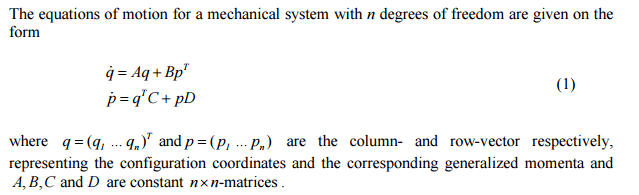
e0105b10b69da68fd563eb3008f2319c.png

I am attempting to take the derivative of \dot{q} and \dot{p} with respect to p and q (on each one).

Any advice?
 
Physics news on Phys.org
dynamicskillingme said:
Hi! As the title says, what is the derivative of a matrix transpose?

e0105b10b69da68fd563eb3008f2319c.png

I am attempting to take the derivative of \dot{q} and \dot{p} with respect to p and q (on each one).

Any advice?
Your question doesn't make sense to me. You don't take the derivative of a matrix (or a matrix transpose) -- you take the derivative of the functions that make up a vector (or its transpose).

You have ##\vec{q} = \begin{bmatrix} q_1 \\ q_2 \\ \vdots\\ q_n \end{bmatrix}##. ##\dot{q}## usually means the derivative with respect to t of ##\vec{q}##: ##\frac{d\vec{q}}{dt}##.

Without knowing more about this problem, I would guess that ##\dot{q}## is a vector that contains the derivatives (with respect to time) of ##q_1, q_2, \dots, q_n##.

In your second post, they are taking partials of H with respect to p and q, not the partials of p or q with respect to each other.