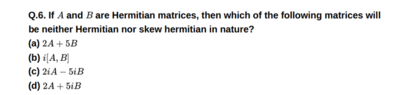
What is the transpose of a matrix $i[A,B]$?

  • Thread starter Thread starter Slimy0233
  • Start date Start date
Join the discussion
Ask a follow-up here, or get your own question answered by working scientists, mathematicians and engineers — people, not an autocomplete.
Real named experts · corrections over time · the nuance an AI answer skips
17 replies · 2K views
Slimy0233
Messages
167
Reaction score
48
Homework Statement
Q.6. If A and B are Hermitian matrices, then which of the following matrices will
be neither Hermitian nor skew hermitian in nature?
Relevant Equations
For a Hermitian Matrix A,
1. $A^{\dagger} = A$
2. $iA$ is a skew-Hermitian Matrix
1693057590678.png

I don't know how to simplify option b)

I mean, I don't know how to take the transpose of a matrix which exists as a product of $\iota$, how can I solve this further?

I need help only with option c. I have attempted this previously and have gotten what seems to be the right answer, but I don't know how I did that now
DocScanner 26-Aug-2023 19-12.jpg
 

Attachments

  • 1693057606307.png
    1693057606307.png
    10.8 KB · Views: 128
on Phys.org
PeroK said:
In general your solutions have a step missing. It's not a major problem, but you leave a bit of work for the reader.

You also need to assume that ##A, B \ne 0##.
except for opt B and opt D you don't need extra steps as you can use property
The sum of two Hermitian Matrices is also a Hermitian matrix. But, I still get how to solve c though. I want to take the transpose of i[A,B], how can I do this?
 
PeroK said:
I thought you ready did in your OP.
I didn't unfortunately, I did try and do it now which is attached, but I am pretty sure there's an easier way as I am not supposed to do this in the exams.
DocScanner 26-Aug-2023 22-28.jpg
 
Reply
  • Like
Likes   Reactions: vanhees71
PeroK said:
For example, you could first show that ##[A,B]## is skew-Hermitian, hence ##i[A, B]## is Hermitian.
Thank you! of c! I forgot the fact that [A, B] can also be treated like a matrix (even though it doesn't look like a conventional matrix)
This is what I was looking for
 
Reply
  • Like
Likes   Reactions: vanhees71
PeroK said:
For example, you could first show that ##[A,B]## is skew-Hermitian, hence ##i[A, B]## is Hermitian.
if A is skew-Hermitian then ##(iA)^{\dagger} = iA## making ##iA## skew-Hermitian$$(iA)^\dagger = i^*A^\dagger = -iA^\dagger = -i (-A) = iA$$
edit: I corrected something stupid I said
 
WWGD said:
If i may ask what the i stands for in
i[a,b]? I guess [a,b] is the conmutator?
I'd be willing to bet it's the imaginary unit...
 
Reply
  • Like
Likes   Reactions: vanhees71
WWGD said:
So you're multiplying the conmutator by the imaginary unit?
Commutators are a topic I've never studied, but from the work shown, i is multiplying the result of the commutator action.