What is the difference between friction and rolling resistance?

Join the discussion
Ask a follow-up here, or get your own question answered by working scientists, mathematicians and engineers — people, not an autocomplete.
Real named experts · corrections over time · the nuance an AI answer skips
7 replies · 2K views
paulimerci
Messages
287
Reaction score
47
Poster has been reminded to always show their work when posting schoolwork problems
Homework Statement
A 65 kg cyclist on a 10 kg bicycle is moving uphill on a 9° slope. How much force does he provide
if the bicycle slows at a rate of 0.3 m/s2?
Relevant Equations
Applied force - frictional force - parallel force component due to gravity = ma
How to find frictional force when coefficient of friction is not given?
 

Attachments
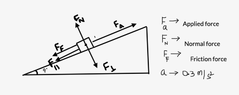
  • Screen Shot 2022-11-09 at 1.43.06 PM.png
    Screen Shot 2022-11-09 at 1.43.06 PM.png
    9.9 KB · Views: 137
Physics news on Phys.org
So you mean there is no frictional force acting on the system?
 
SammyS said:
Not what he means.

He said that you don't need to know the frictional force to solve this problem.
But it’s asking for the force the rider provides, not the net force.

I feel like “ignore friction” should be right in the problem statement on this one?
 
Last edited:
paulimerci said:
Homework Statement:: A 65 kg cyclist on a 10 kg bicycle is moving uphill on a 9° slope. How much force does he provide
if the bicycle slows at a rate of 0.3 m/s2?
Relevant Equations:: Applied force - frictional force - parallel force component due to gravity = ma

How to find frictional force when coefficient of friction is not given?
@paulimerci -- Please post a new thread with this problem and show your work.

As you can see from the replies, this is most likely not a problem of something sliding up or down an inclined plane with sliding friction coming into play. If a bicyclist is pedaling up a slope and slowing down, there is a force that the bicyclist is applying by pedaling but it's not enough force to keep them from slowing down on the slope. So in your FBD, you should leave off any retarding force due to sliding friction, and focus on what force the bicyclist needs to exert to result in the motion specified in the problem.
 
  • Like
Likes   Reactions: SammyS
Disregard post #5. I think I see what @kuruman was driving at now that I've written it down.
 
paulimerci said:
Homework Statement:: A 65 kg cyclist on a 10 kg bicycle is moving uphill on a 9° slope. How much force does he provide
if the bicycle slows at a rate of 0.3 m/s2?
Relevant Equations:: Applied force - frictional force - parallel force component due to gravity = ma

How to find frictional force when coefficient of friction is not given?
You are suffering from a common confusion between friction and rolling resistance. The relevant equation posted takes friction as always something opposing motion, which is incorrect.
Please read https://www.physicsforums.com/insights/frequently-made-errors-mechanics-friction/ before reposting the thread .
 
  • Like
Likes   Reactions: paulimerci, berkeman and SammyS