What is the difference between static friction and rolling resistance?

  • Thread starter Thread starter googly_eyes
  • Start date Start date
  • Tags Tags
    Motor Torque
Click For Summary
SUMMARY

The discussion clarifies the distinction between static friction and rolling resistance in the context of vehicle design. The torque required by a motor is influenced by both the friction force (Fr) and the gravitational component (mg*sin(theta)*R) when climbing a slope. Fr is identified as the traction force, while rolling resistance is a dynamic force not applicable in static analysis. The conversation emphasizes that static friction prevents slipping, whereas rolling resistance pertains to energy loss during rolling.

PREREQUISITES
  • Understanding of vehicle dynamics and torque calculations
  • Familiarity with static friction and rolling resistance concepts
  • Knowledge of Free Body Diagrams (FBD) in mechanical analysis
  • Basic principles of physics related to forces and motion
NEXT STEPS
  • Research the role of static friction in vehicle traction and stability
  • Explore the calculations for torque in inclined plane scenarios
  • Study the differences between static and dynamic friction in mechanical systems
  • Investigate online calculators for vehicle torque analysis and their underlying equations
USEFUL FOR

Engineers, vehicle designers, and students studying mechanical engineering who seek to understand the forces at play in vehicle dynamics and the implications of friction in design calculations.

googly_eyes
Messages
3
Reaction score
1
Hi, it's probably a frequent question, but I can't seem to wrap my hear around. I'm trying to understand how I reach that value, not just how to get the value.
I'm designing a vehicle with 4 wheels. It'll climb a surface with a slope theta (in degrees).
This is the FBD that I've come up with of a wheel. Following my analysis, the torque M that the motor needs to provide is simply Fr*R, where Fr is the friction force.
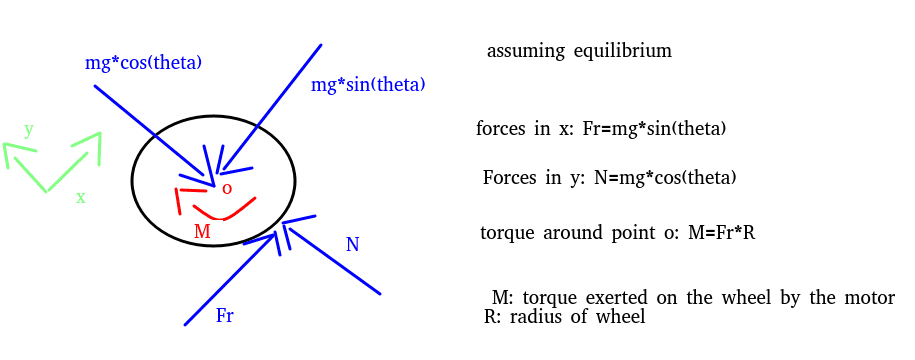
gaa.png

However, I've seen docs on the internet (page 35/60) that instead considers that the required torque includes an extra force (let's forget about the acceleration and wind force), which is mg*sin(theta)*R. This completely changes the torque analysis, and I don't know why it's like that (not explanation/analysis is given, just that). And I've seen the same equation on other places, including this extra member to the equation force. But alas, I'm clueless as to why it's like that. If you could please enlighten me, an explanation/FBD, whatever fits you, to explain this to me.
Many thanks
 
Engineering news on Phys.org
If you had a rack railway which can't slip at all (infinite friction?) then you would only have the mg*sin(theta)*R term.
The friction force term corresponds to the maximum torque without slipping.
 
Keith_McClary said:
If you had a rack railway which can't slip at all (infinite friction?) then you would only have the mg*sin(theta)*R term.
I'm sorry, I fail to see how that term appears if you take momentum with respect to the center of mass.
Keith_McClary said:
The friction force term corresponds to the maximum torque without slipping.
The worst case scenario, correct?
 
Your 'Fr*R' and 'mg*sin(theta)*R ' are the same (as you define Fr). The paper that you cited defines Fr as 'rolling resistance' - that's a dynamic force - not relevant in a static analysis.

I would call your Fr the 'traction' (not 'friction') force.
 
Dullard said:
Your 'Fr*R' and 'mg*sin(theta)*R ' are the same (as you define Fr). The paper that you cited defines Fr as 'rolling resistance' - that's a dynamic force - not relevant in a static analysis.

I would call your Fr the 'traction' (not 'friction') force.

Now that you mention it, that's true. But for example, in this page make an analysis and turns out that M=mg*(sinθ+cosθ*μr)*R - the maximum static friction is added. This analysis only considers forces, and then derives the motor torque. Shouldn't I reach the same result?

And you can also find this similar equation in this online calculator. They consider other factors such as number of wheels (n1) and the weight of each wheel (md1), but it's basically the total mass of the system. The other term doesn't matter because it's all zero, so it doesn't affect.
1587745773560.png
 
You're confusing static friction and rolling resistance. Static friction is what keeps the tire from slipping. As long as it is not exceeded, it doesn't matter to your calculations. 'Rolling friction' is (mostly) the effort wasted into changing the shape of the tire as it rolls. Rolling friction is not relevant to a static analysis (which is what you appear to be attempting).
 
  • Like
Likes Keith_McClary
I have encountered a vertically oriented hydraulic cylinder that is designed to actuate and slice heavy cabling into sections with a blade. The cylinder is quite small (around 1.5 inches in diameter) and has an equally small stroke. The cylinder is single acting (i.e. it is pressurized from the bottom, and vented to atmosphere with a spring return, roughly 200lbs of force on the spring). The system operates at roughly 2500 psi. Interestingly, the cylinder has a pin that passes through its...

Similar threads

Replies
3
Views
4K
  • · Replies 8 ·
Replies
8
Views
7K
  • · Replies 6 ·
Replies
6
Views
3K
  • · Replies 23 ·
Replies
23
Views
5K
Replies
5
Views
5K
  • · Replies 14 ·
Replies
14
Views
2K
  • · Replies 4 ·
Replies
4
Views
2K
  • · Replies 25 ·
Replies
25
Views
2K
Replies
1
Views
4K
  • · Replies 6 ·
Replies
6
Views
3K