What is the dipole moment of this surface charge distribution?

Click For Summary
SUMMARY

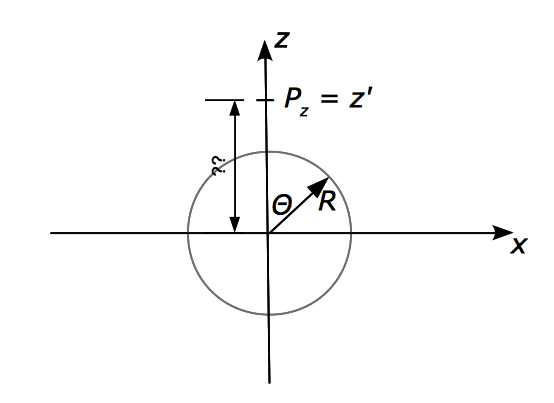
The discussion centers on calculating the dipole moment of a surface charge distribution on a spherical shell with radius R and surface charge density σ = k cos θ. The participants clarify that the z-coordinate of point P, denoted as z', can be expressed as R cos θ, which represents the z-component of the distance from the origin to a point on the surface. The dipole moment is derived using the integral p = ∫ (R cos θ)(k cos θ) R² sin θ dφ dθ, emphasizing that the dipole moment only has a z-component due to the symmetry of the charge distribution.

PREREQUISITES
  • Understanding of dipole moments in electrostatics
  • Familiarity with spherical coordinates and their applications
  • Knowledge of surface charge density concepts
  • Experience with integral calculus in physics
NEXT STEPS
  • Study Griffiths' "Introduction to Electrodynamics" for a deeper understanding of dipole moments
  • Learn about spherical harmonics and their role in electrostatics
  • Explore the derivation of electric fields from dipole moments
  • Investigate the implications of charge symmetry on electric fields and potentials
USEFUL FOR

Physics students, electrical engineers, and researchers focusing on electrostatics and electromagnetic theory will benefit from this discussion.
mzh
Messages
61
Reaction score
0
In the below figure, I'm supposed to express the z-coordinate of the point P, z', by the angle \theta

9007238.png


Does this work out as z' = R\cdot \cos \theta? If so, I can't see why...

Please give me a hint on this.
 
Physics news on Phys.org


It pretty clearly says P_z = z'. Where is P?


Muphrid said:
It pretty clearly says P_z = z'. Where is P?

Sorry, P "is" at [¡tex]P_z[/itex]. Its the z-component of the point.


If this is exactly the information you were given, then I see no way to solve the problem. z' could be R + 1 or R+1000 and it wouldn't affect anything. Is this diagram the only information you were given, or is it constructed to match some sort of word problem?

Edit: most often, the angle is supposed to tell you the angle between the z-axis and the vector point P. It's unusual to say P_z = z' and then to say P lies on the z-axis.


Muphrid said:
If this is exactly the information you were given, then I see no way to solve the problem. z' could be R + 1 or R+1000 and it wouldn't affect anything. Is this diagram the only information you were given, or is it constructed to match some sort of word problem?

Edit: most often, the angle is supposed to tell you the angle between the z-axis and the vector point P. It's unusual to say P_z = z' and then to say P lies on the z-axis.

yes, I'm trying to picture the problem. P lies on the z-axis because the charge distribution is symmetric around z, and I indicated its z-component as P_z and set it arbitrarily to z'.

It comes from Griffiths, Electrodynamics prob. 3.28a, where one is supposed to calculate the dipole moment of a surface of radius R, carrying surface charge density \sigma=k \cos \theta, the ansatz should be that \vec{p} = \int (R \cos \theta) (k \cos \theta) R^2 \sin \theta d\theta d\phi but I can't figure out how to get the factor (R \cos \theta). How do I get this factor?


Usually one computes the dipole moment at the center of a neutral charge distribution. Are you being asked for the dipole field at the point P?


This thread seems to be more about physics than the math. So I'm moving it.


Muphrid said:
Usually one computes the dipole moment at the center of a neutral charge distribution. Are you being asked for the dipole field at the point P?

the dipole moment for that matter...
apparently, by symmetry (which i do can see), the dipole moment p only has z-component:

\vec{p} = p \hat{\vec{z}}, p=\int z \rho d\tau \rightarrow p = \int z \sigma da.

Which, considering the surface charge density i wrote previously, can be written as
p= \int (R \cos \theta) (k\cos \theta) R^2 \sin \theta d\phi d\theta. Where does the factor (R \cos \theta) come from? It must be z, but I can't see how it relates to z.
 
I said specifically dipole field instead of dipole moment because the dipole moment is the same everywhere when there's no net charge in the system. So you can find the dipole moment about the origin, and that's all you need. Hence, R \cos \theta is just the z-component of the distance from the origin to a point on the surface. You use the origin as the reference point because it's easier and because you know the dipole moment should be the same everywhere.

Still, I think you would be best served typing out the whole question. I feel very uncertain about what you're actually being asked.
 
  • #10
Muphrid said:
I said specifically dipole field instead of dipole moment because the dipole moment is the same everywhere when there's no net charge in the system. So you can find the dipole moment about the origin, and that's all you need. Hence, R \cos \theta is just the z-component of the distance from the origin to a point on the surface. You use the origin as the reference point because it's easier and because you know the dipole moment should be the same everywhere.

Still, I think you would be best served typing out the whole question. I feel very uncertain about what you're actually being asked.


Thanks for your comment. I'm still in the process of appreciating the subtilities of these points...

the exact wording is as:
[For a spherical shell] of radius R, which carries a surface charge \sigma = k \cos \theta, calculate the dipole moment of this surface charge distribution.
 

Similar threads

  • · Replies 1 ·
Replies
1
Views
2K
  • · Replies 1 ·
Replies
1
Views
2K
  • · Replies 4 ·
Replies
4
Views
1K
  • · Replies 21 ·
Replies
21
Views
2K
  • · Replies 1 ·
Replies
1
Views
2K
  • · Replies 6 ·
Replies
6
Views
2K
  • · Replies 1 ·
Replies
1
Views
2K
  • · Replies 6 ·
Replies
6
Views
2K
  • · Replies 2 ·
Replies
2
Views
3K
  • · Replies 1 ·
Replies
1
Views
1K