SUMMARY
Region 4 is identified as Rayleigh flow due to the absence of friction and the presence of heat addition, as outlined in the discussion. The flow characteristics are defined by the transition from an oblique shock to a normal shock, followed by isentropic expansion, leading to Rayleigh flow conditions. The key indicators include the frictionless nature of the flow and the thermal effects described in the provided references.
PREREQUISITES
- Understanding of oblique and normal shock waves
- Knowledge of isentropic processes in fluid dynamics
- Familiarity with Rayleigh flow and its characteristics
- Basic principles of thermodynamics related to heat addition and frictionless flow
NEXT STEPS
- Study the principles of Rayleigh flow in detail
- Explore the differences between Rayleigh flow and Fanno flow
- Investigate the impact of heat addition on flow characteristics
- Review the equations governing shock waves and isentropic processes
USEFUL FOR
Aerospace engineers, fluid dynamics researchers, and students studying thermodynamics and compressible flow will benefit from this discussion.
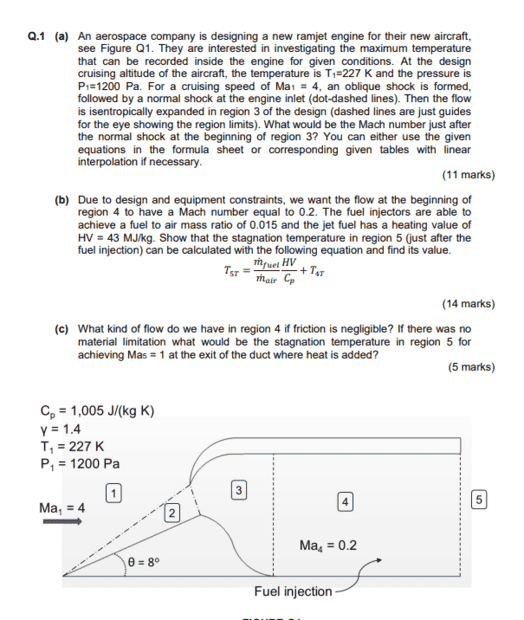 could someone explain each region of diagram. thanks. I've got parts a and b correct