What is the Initial Angular Acceleration of a Disk Released from Rest?

Click For Summary
SUMMARY

The initial angular acceleration of a 5.0 kg disk with a diameter of 60 cm, released from rest, requires the application of torque and the moment of inertia. The torque is calculated as 14.7 N·m, derived from the weight of the disk (49 N) and the radius (0.3 m). The moment of inertia must be adjusted using the Parallel Axis Theorem, resulting in I = I_{CM} + MD^2. The correct calculation for the moment of inertia leads to an accurate determination of angular acceleration.

PREREQUISITES
  • Understanding of torque and its calculation
  • Familiarity with moment of inertia and its formulas
  • Knowledge of the Parallel Axis Theorem
  • Basic principles of rotational dynamics
NEXT STEPS
  • Study the application of the Parallel Axis Theorem in rotational mechanics
  • Learn how to derive the moment of inertia for various shapes
  • Explore the relationship between linear and angular acceleration
  • Investigate the effects of different axis of rotation on angular motion
USEFUL FOR

Physics students, mechanical engineers, and anyone studying rotational dynamics and torque calculations.

klm
Messages
165
Reaction score
0
A 5.0 kg, 60-cm-diameter disk rotates on an axle passing through one edge. The axle is parallel to the floor. The cylinder is held with the center of mass at the same height as the axle, then released.

What is the cylinder's initial angular acceleration?
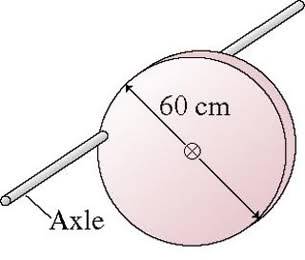
7x2f413.jpg


ok so this is what i think i should do:

Torque= I [tex]\alpha[/tex]

and i need to find the F(weight)= mg = (5)(9.8) = 49 N
radius = .5(.6)= .3
Torque= Fd = 49(.3) = 14.7
14.7 = I [tex]\alpha[/tex]
this is the part which i am not sure on, does I = .5 m r^2 = .5(5)(.3^2) = .225
14.7 .225 [tex]\alpha[/tex]
[tex]\alpha[/tex] = 65.33
but this answer is incorrect, and i do not know where i am making the mistake.
 
Physics news on Phys.org
please can someone help
 
Try using the Parallel Axis theorem to find the moment of inertia. This is needed because the axis of rotation is not through the centre of mass of the disk.

[tex]I = I_{CM} + MD^2[/tex]

where [tex]I_{CM}[/tex] is the moment of inertia for a solid disk, M is the mass of the disk and D is the distance from the centre of mass to the new axis.
 

Similar threads

Replies
15
Views
2K
  • · Replies 33 ·
2
Replies
33
Views
3K
  • · Replies 7 ·
Replies
7
Views
2K
  • · Replies 5 ·
Replies
5
Views
3K
Replies
10
Views
3K
Replies
3
Views
2K
  • · Replies 18 ·
Replies
18
Views
2K
  • · Replies 8 ·
Replies
8
Views
4K
  • · Replies 25 ·
Replies
25
Views
12K
  • · Replies 11 ·
Replies
11
Views
3K