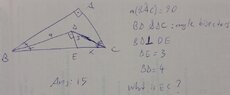
MHB What is the length of x in this triangle?

  • Thread starter Thread starter ketanco
  • Start date Start date
  • Tags Tags
    Angle Triangle
Click For Summary
SUMMARY

The discussion centers on determining the length of side x in a triangle using geometric principles without the aid of rulers or calculators. Participants emphasize the importance of understanding similar triangles and angle relationships to solve the problem efficiently. The expected answer for x is 15, derived through geometric reasoning rather than scaled diagrams. Key steps include extending line BD to point F, expressing angles, and identifying similar triangles.

PREREQUISITES
  • Understanding of triangle similarity and properties
  • Knowledge of angle bisector theorem
  • Familiarity with geometric constructions
  • Ability to solve equations involving triangle side ratios
NEXT STEPS
  • Study the properties of similar triangles in geometry
  • Learn the angle bisector theorem and its applications
  • Practice geometric constructions without tools
  • Explore methods for solving geometric problems quickly under timed conditions
USEFUL FOR

Students preparing for geometry tests, educators teaching geometric principles, and anyone interested in improving their problem-solving skills in geometry.

ketanco
Messages
15
Reaction score
0
Hello,
what is the length of x in the attached?
I tried the following:
of course BE = 5, and also the point D must be the center of internal circle that is tangent to triangle and from there i came up with some equations together with the side ratio formulas of angle bisectors but it didnt work...

answer supposed to be 15

View attachment 8588
 

Attachments

  • 03-04.jpg
    03-04.jpg
    22.4 KB · Views: 168
Mathematics news on Phys.org
Your diagram is way out of scale.
Suggest you redraw it, making CE approx. 3 times BE.
Then extend BD to F (F on AC).
 
i know my diagram is out of scale. and that is not the question here.

we are supposed to solve this question in a test by knowledge of geometry, without using any rulers or calculators or anything, in 1-2 minutes. so we do not have the means or time to draw this to scale and solve it like that. everybody can do that. i would not take the time and effort to post it here, if i was allowed to do that. i can draw it in autocad and measure it too then... but this is not what is wanted, or something we can do during the test. we need to solve this by our knowledge of geometry, even if it is out of scale. . we will have only a pencil and a paper and an eraser when solving this.
 
1. Extend BD to F on AC as Wilmer suggested.
2. Express all angles in ${}_{{}^\times}$ and ${}_{{}^\times}\!{}_{{}^\times}$.
3. Deduce which triangles are similar.
4. Deduce the lengths of all sides, including $x$.
 
i extended the line to new point F
DF = DE = 3 as they are similar triangles with one side equal
also EC = FC now
after that ABC = DBE and i get some equations with really high numbers which also didnt give the result so either i made the equation wrong or something else... anyway, this is the way to go then...
 
ketanco said:
i extended the line to new point F
DF = DE = 3 as they are similar triangles with one side equal
also EC = FC now
after that ABC = DBE and i get some equations with really high numbers which also didnt give the result so either i made the equation wrong or something else... anyway, this is the way to go then...

Looks good!
But ABC is not similar to DBE...
 
It looks like this, doesn't it?
[TIKZ]
\coordinate[label=above:A] (A) at ({2*atan2(3,4)}:{4*7/5});
\coordinate[label=left:B] (B) at (0,0);
\coordinate[label=right:C] (C) at (20,0);
\coordinate[label=above left:D] (D) at ({atan2(3,4)}:4);
\coordinate[label=below:E] (E) at (5,0);
\coordinate[label=above right:F] (F) at ({atan2(3,4)}:7);

\draw[rotate={180+2*atan2(3,4)}] (A) +(0.4,0) -- +(0.4,0.4) -- +(0,0.4);
\draw[rotate={atan2(-3,-4)}] (D) +(0.4,0) -- +(0.4,0.4) -- +(0,0.4);
\path (B) node at +({atan2(3,4)/2}:0.7) {$\times$};
\path (B) node at +({atan2(3,4)*3/2}:0.7) {$\times$};
\path (C) node at +({180-atan2(4*7/5,15+3*7/5)/4}:3) {$\times\!\times$};
\path (C) node at +({180-atan2(4*7/5,15+3*7/5)*3/4}:3) {$\times\!\times$};

\draw (B) -- node
{4} (D) -- node
{3} (E) -- node[above] {5} cycle;
\draw (C) -- (D) -- node[below right] {3} (F);
\draw[blue, ultra thick] (A) -- (B) -- (C) -- cycle;
\path (A) -- node
{$4\cdot\frac 75$} (B) (E) -- node[below] {$x$} (C) -- node[above right] {$x$} (F);
\path (A) -- node[above] {$3\cdot\frac 75$} (F);
[/TIKZ]
Perhaps it's easier to see the similar triangles now. (Thinking)​
 
ketanco said:
i know my diagram is out of scale. and that is not the question here.

we are supposed to solve this question in a test by knowledge of geometry, without using any rulers or calculators or anything, in 1-2 minutes. so we do not have the means or time to draw this to scale and solve it like that. everybody can do that. i would not take the time and effort to post it here, if i was allowed to do that. i can draw it in autocad and measure it too then... but this is not what is wanted, or something we can do during the test. we need to solve this by our knowledge of geometry, even if it is out of scale. . we will have only a pencil and a paper and an eraser when solving this.
That's all ok, buddy, but beside the point:
what I meant was making a diagram that's easier "to follow".
We're not taking "the test"...
 

Similar threads

  • · Replies 4 ·
Replies
4
Views
2K
  • · Replies 2 ·
Replies
2
Views
2K
  • · Replies 59 ·
2
Replies
59
Views
53K
Replies
2
Views
1K
Replies
4
Views
2K
  • · Replies 1 ·
Replies
1
Views
1K
  • · Replies 4 ·
Replies
4
Views
1K
  • · Replies 4 ·
Replies
4
Views
2K
Replies
1
Views
1K
  • · Replies 2 ·
Replies
2
Views
2K