What is the Limit of the Sequence Defined by \( z_{n+1}=\sqrt{a+z_n} \)?

  • Context: MHB 
  • Thread starter Thread starter issacnewton
  • Start date Start date
  • Tags Tags
    Section
Click For Summary
SUMMARY

The sequence defined by \( z_{n+1}=\sqrt{a+z_n} \) converges to the attractive fixed point \( x_{+}=\frac{1+\sqrt{1+4a}}{2} \) for \( a>0 \) and \( z_1>0 \). The sequence is bounded below by 0 and can be shown to be bounded above by \( x_{+} \) through induction. Depending on the initial value \( z_1 \), the sequence can be monotonically increasing if \( z_1 < x_{+} \), constant if \( z_1 = x_{+} \), or monotonically decreasing if \( z_1 > x_{+} \).

PREREQUISITES
  • Understanding of recursive sequences
  • Familiarity with fixed points in functions
  • Knowledge of the Monotone Convergence Theorem
  • Basic algebraic manipulation of inequalities
NEXT STEPS
  • Study the Monotone Convergence Theorem in detail
  • Explore fixed point theory and its applications
  • Learn about the behavior of recursive sequences
  • Investigate the implications of initial conditions on convergence
USEFUL FOR

Mathematicians, students studying real analysis, and anyone interested in the convergence properties of recursive sequences.

issacnewton
Messages
1,035
Reaction score
37
here is the problem.
Let \( a>0\) and \( z_1 > 0\) . define \( z_{n+1}=\sqrt{a+z_n} \) for all \( n\in \mathbb{N} \). Show that \( (z_n) \) converges and find the limit.
I am supposed to use monotone convergence theorem. For that I need to prove that the sequence is bounded and monotone. I can prove that its bounded below by \( 0 \), but I am having trouble about the upper bound. Also sequence can be increasing or decreasing, depending upon the values
of \( a\) and \( z_1 \) . Any hints ?
 
Physics news on Phys.org
IssacNewton said:
here is the problem.
Let \( a>0\) and \( z_1 > 0\) . define \( z_{n+1}=\sqrt{a+z_n} \) for all \( n\in \mathbb{N} \). Show that \( (z_n) \) converges and find the limit.
I am supposed to use monotone convergence theorem. For that I need to prove that the sequence is bounded and monotone. I can prove that its bounded below by \( 0 \), but I am having trouble about the upper bound. Also sequence can be increasing or decreasing, depending upon the values
of \( a\) and \( z_1 \) . Any hints ?

Let's suppose that z is real and let's write the recursive relation as...

$\displaystyle \Delta_{n+1}= z_{n+1}-z_{n}= \sqrt{a+z_{n}}-z_{n}= f(z_{n})\ ,\ a>0\ ,\ z_{0}>0$ (1)

In this case f(x) has two 'fixed points' [points where is f(x)=0...], an 'attractive fixed point' at $\displaystyle x_{+}= \frac{1+\sqrt{1+4 a}}{2}$ and a 'repulsive fixed point' at $\displaystyle x_{-}= \frac{1-\sqrt{1+4 a}}{2}$. The combined conditions $a>0$ and $z_{0}>0$ imply that in any case the sequence converges to $x_{+}$, if $0<z_{0}<x_{+}$ the sequence will be 'monotonically increasing', if $z_{0}=x_{+}$ the sequence will be constant, if $z_{0}>x_{+}$ the sequence will be 'monotonically decreasing'...

Kind regards

$\chi$ $\sigma$
 
Last edited:
Let us first consider the case when $\displaystyle z_1<\frac{1+\sqrt{1+4a}}{2}$.

Step 1: Assume $\displaystyle z_n<\frac{1+\sqrt{1+4a}}{2}$ and show that $\displaystyle z_{n+1}<\frac{1+\sqrt{1+4a}}{2}$. This will prove (by induction) that $\displaystyle \{z_n\}$ is bounded above.

Step 2: $\displaystyle \frac{z_{n+1}}{z_n}=\sqrt{\frac{a+z_n}{z_n^2}}= \sqrt{\frac{a}{z_n^2}+\frac{1}{z_n}}$

Using $\displaystyle z_n<\frac{1+\sqrt{1+4a}}{2}$ (proved in step 1), show that $\displaystyle \frac{z_{n+1}}{z_n}>1$. This will prove that $\displaystyle \{z_n\}$ is increasing.
 
Last edited:
This is chapter on sequences and the book has not done functions yet. I just want to assume the things which the book assumes at this point.
So with the information given, I think its better to split the problem in 3 cases, depending upon where \( z_1 \) is with respect to \( x_{+} \).
 
Alexmahone said:
Let us first consider the case when $\displaystyle z_1<\frac{1+\sqrt{1+4a}}{2}$.

Step 1: Assume $\displaystyle z_n<\frac{1+\sqrt{1+4a}}{2}$ and show that $\displaystyle z_{n+1}<\frac{1+\sqrt{1+4a}}{2}$. This will prove (by induction) that $\displaystyle \{z_n\}$ is bounded above.

Step 2: $\displaystyle \frac{z_{n+1}}{z_n}=\sqrt{\frac{a+z_n}{z_n^2}}=sqrt\left(\frac{a}{z_n^2}+\frac{1}{z_n}\right)$

Using $\displaystyle z_n<\frac{1+\sqrt{1+4a}}{2}$ (proved in step 1), show that $\displaystyle \frac{z_{n+1}}{z_n}>1$. This will prove that $\displaystyle \{z_n\}$ is increasing.
Step 2*:

True(induction hypothesis) : $z_{n+1}>z_{n}$

Need to prove:

$$ z_{n+2}>z_{n+1}$$$$z_{n+2}=\sqrt{a+z_{n+1}}>\sqrt{a+z_n}=z_{n+1}$$
 
Also sprach Zarathustra said:
Step 2*:

True(induction hypothesis) : $z_{n+1}>z_{n}$

Need to prove:

$$ z_{n+2}>z_{n+1}$$$$z_{n+2}=\sqrt{a+z_{n+1}}>\sqrt{a+z_n}=z_{n+1}$$

What about the base case?
 
Let's write again the recursive relation in term of difference equation...

$\displaystyle \Delta_{n}=z_{n+1}-z_{n}= \sqrt{a+z_{n}}-z_{n}= f(z_{n})\ ,\ a>0\ ,\ z_{0}>0$ (1)

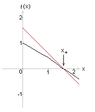
In order to have a simple description of the problem the function $\displaystyle f(x)=\sqrt{a+x}-x$ for $a=1$ is represented here...

View attachment 51

The f(x) has only one 'attractive fixed point' [a point where is f(x)=0 and the function crosses the x axes with negative slope...] in $\displaystyle x_{+}= \frac{1+\sqrt{5}}{2}$ and it is evident that, because is $\displaystyle |f(x)|< |x-x_{+}|$ [see 'red line'...], any $0<z_{0}< x_{+}$ will generate an increasing sequence with limit $x_{+}$ and any $z_{0}> x_{+}$ will generate a decreasing sequence with limit $x_{+}$...

Kind regards

$\chi$ $\sigma$
 

Attachments

  • MHB02.PNG
    MHB02.PNG
    722 bytes · Views: 103
Last edited:
Thanks all. Solved the problem as suggested.
 

Similar threads

  • · Replies 6 ·
Replies
6
Views
2K
  • · Replies 3 ·
Replies
3
Views
2K
  • · Replies 17 ·
Replies
17
Views
2K
Replies
1
Views
2K
  • · Replies 2 ·
Replies
2
Views
2K
  • · Replies 1 ·
Replies
1
Views
1K
Replies
1
Views
2K
  • · Replies 1 ·
Replies
1
Views
3K
  • · Replies 2 ·
Replies
2
Views
2K
Replies
2
Views
2K