PhysicsTest
- 254
- 27
- TL;DR
- The Clarke transform equation does not match with my calculations
The standard Clarke Transform is
##
i_{alpha} = i_a; -> 1
i_{beta} = \frac {(i_a + 2i_b)} {\sqrt3} ->2
##
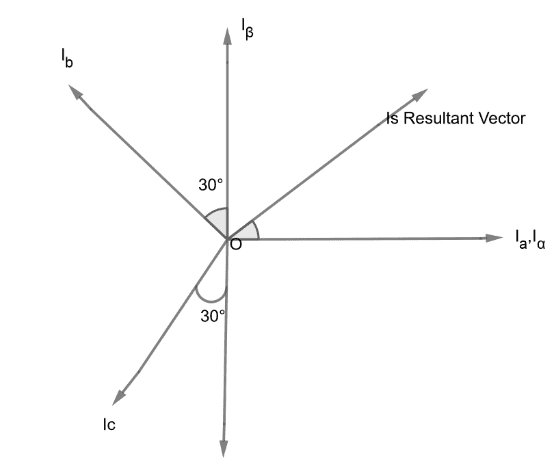
I am trying to derive it, but missing a factor. Basically converting the 3 phase currents ## I_a, I_b, I_c ## into the 2 axis ##I_{\alpha}, I_{\beta} ##
resolving along the x-axis
##I_{\alpha} = I_a - I_b \sin(30) - I_c\sin(30) = \frac {3I_a} 2; ## since ##I_a+I_b+I_c=0## -->3
resolving along y-axis
##
I_{\beta} = I_b\cos30 - I_c\cos30; = \frac{\sqrt3(I_a+ 2I_b)} 2 --> 4
##
Now the derived 3 and 4 if i compare with original equations 1, 2, there is a factor ##\frac 2 3## is missing. What is this factor? Why should i include it?
##
i_{alpha} = i_a; -> 1
i_{beta} = \frac {(i_a + 2i_b)} {\sqrt3} ->2
##
I am trying to derive it, but missing a factor. Basically converting the 3 phase currents ## I_a, I_b, I_c ## into the 2 axis ##I_{\alpha}, I_{\beta} ##
resolving along the x-axis
##I_{\alpha} = I_a - I_b \sin(30) - I_c\sin(30) = \frac {3I_a} 2; ## since ##I_a+I_b+I_c=0## -->3
resolving along y-axis
##
I_{\beta} = I_b\cos30 - I_c\cos30; = \frac{\sqrt3(I_a+ 2I_b)} 2 --> 4
##
Now the derived 3 and 4 if i compare with original equations 1, 2, there is a factor ##\frac 2 3## is missing. What is this factor? Why should i include it?