yrjosmiel73
I mean aerodynamic as in least air resistance.
Just curious.
Just curious.
The most aerodynamic shape for minimizing air resistance is generally recognized as the teardrop shape, particularly when considering constraints such as cross-sectional area and volume. The Hindenburg Zeppelin hull, with an elongated tail cone, offers a low drag coefficient-to-volume ratio, although it is not the absolute ideal. In supersonic applications, the shape of the nose cone significantly influences drag, with the optimal design varying across different speeds. Practical challenges in bullet design, such as maintaining gyroscopic stability and managing drag at varying speeds, further complicate the pursuit of the most efficient aerodynamic shape.
PREREQUISITESAerospace engineers, automotive designers, and anyone involved in optimizing aerodynamic performance in vehicles or projectiles will benefit from this discussion.
Let's say lowest drag for a given volume.cjl said:Most aerodynamic given what constraint? Lowest drag for a given cross sectional area? Lowest drag for a given volume? In general, the shape will tend to be somewhat similar to a teardrop, but it will vary depending on your constraints.
cjl said:It's not bad, though it would be better with a more complete boat tail (which it does not have because of the requirements of barrel launching as well as spin stability concerns).
256bits said:Nose cone shape is of importance.
As usual wiki is a primer.
https://en.wikipedia.org/wiki/Nose_cone_design
which gives the mathematical equations for several types.
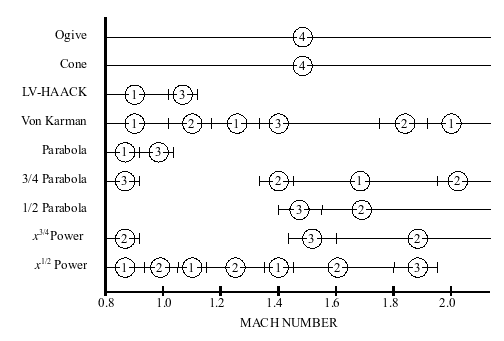
Above graph shows the drag with 1 being favourable to 4 unfavourable versus speed.
Take a look at the graph in this wiki article:WiseGreatTrixie said:Some of these appear to flux, like a sine wave. Ie. at Mach 0.9 it has low drag, then at Mach 1 it has high drag, but at mach 1.1 it has low drag again. Is this the natural order of things.
Whoops. I can see why you'd draw that conclusion from the sample set I typed in my post. (The article talks about the effects of subsonic vs. supersonic.)rcgldr said:Take a look at the graph in this wiki article:
http://en.wikipedia.org/wiki/External_ballistics#Doppler_radar-measurements
WiseGreatTrixie said:Whoops. I can see why you'd draw that conclusion from the sample set I typed in my post. (The article talks about the effects of subsonic vs. supersonic.)
But if you look at the chart it seems to continue even after sonic boom...it goes 0.9 low then 1 high then 1.1 low then 1.25 high then 1.4 low and so forth.
The von Karman almost seem to be symetrrical, with drag highest at 1.5 and then low drag at 1.0 and 2.0. Which the possibilities in my mind makes this seem to be some kind of phase timbre effect, being analogous to sound theory, or the results in the chart are inaccurate.
What I am trying to say is Wikipedia provides a chart like this, implying a simple drag related to the sonic boom.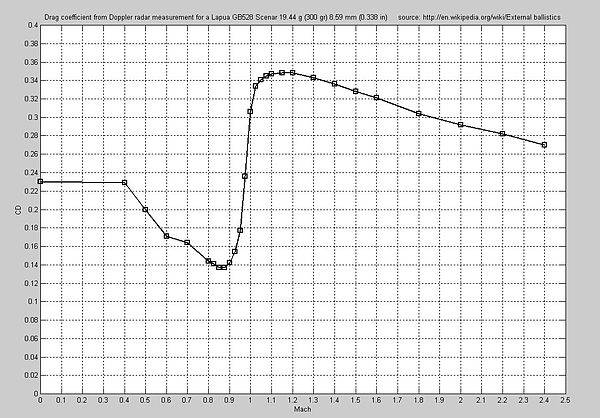
I'm saying its not so simple, I think its more analogous to this video below.
(can't find it just think of a crazy looking video with sine waves and eq frequencies and such.)
Welcome to the PF.Levi Partridge said:known as the teardrop - it's the shape water forms when it runs down a window because it's been pushed into that position by the air flowing over it on the way down
USGS said:The common raindrop is actually shaped more like a hamburger bun

berkeman said:Welcome to the PF.
I think you may have made a typo here, and also have a misconception about raindrop shapes. When you said the teardrop shape is formed by airflow as the water runs down a window, there is no airflow when water is running down a window. I think you meant to say that the teardrop shape develops because of airflow when in freefall (like rain). However, that also turns out to be a popular misconception...
http://water.usgs.gov/edu/raindropshape.html
Did you read the USGS article about raindrops?Levi Partridge said:I've probably misunderstood your point again- tell me how if I did
cjl said:The most aerodynamic shape does happen to be fairly close to a stereotypical "teardrop" shape though (with a longer nose - see the paper I linked in my earlier post for a full analysis), despite the fact that raindrops arrange themselves into a very different shape.
boneh3ad said:Unless, of course, said object is moving transonically or supersonically, in which case a teardrop would be pretty awful and the Whitcomb area rule applies.