What is the optimized angle for maximum intensity in lighting?

  • Context: MHB 
  • Thread starter Thread starter mathman2
  • Start date Start date
  • Tags Tags
    Lighting Optimization
Click For Summary
SUMMARY

The optimized angle for maximum intensity in lighting is determined by the equation I(φ, φMax) = Sin(φ * π/φMax)/(Sin(x)² + 1). In this context, φ is treated as a variable while φMax is a constant, which can be set between 0 to 90 degrees. The distance to the point of interest is defined as d(φ) = h/cos(φ), leading to the intensity equation I(φ) = constant * (Sin(πφ/φMax)/d(φ)²). With specific values assigned to the constants, the optimized angle is found to be approximately 0.41 radians (23.49 degrees).

PREREQUISITES
  • Understanding of trigonometric functions and their properties
  • Familiarity with optimization problems in calculus
  • Knowledge of variables and constants in mathematical equations
  • Basic understanding of lighting intensity and its dependence on angle
NEXT STEPS
  • Research the application of trigonometric identities in optimization problems
  • Learn about the principles of light intensity and its mathematical modeling
  • Explore calculus techniques for finding derivatives of complex functions
  • Investigate the impact of varying constants on optimization outcomes
USEFUL FOR

Mathematicians, lighting designers, engineers, and anyone involved in optimizing lighting intensity through mathematical modeling.

mathman2
Messages
5
Reaction score
0
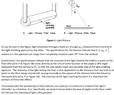
View attachment 3492

I really need help creating an optimization problem for this, I have this so far..
I(φ, φMax) = Sin(φ * π/φMax)/(Sin(x)2 + 1)

With that said, I don't really understand how to enter values into that equation, "Phi" is really throwing me off, is it a constant or should I treat it as a variable like "theta"??
 

Attachments

  • math.png
    math.png
    23.9 KB · Views: 126
Physics news on Phys.org
mathman said:
View attachment 3492

I really need help creating an optimization problem for this, I have this so far..
I(φ, φMax) = Sin(φ * π/φMax)/(Sin(x)2 + 1)

With that said, I don't really understand how to enter values into that equation, "Phi" is really throwing me off, is it a constant or should I treat it as a variable like "theta"??

Hi mathman! Welcome to MHB! :)

Conventionally "phi" and "theta" are both used as variables.
So yes, you should treat $\phi$ as a variable.
In contrast, $\phi_m$ is given to be fixed, and therefore a constant.

How did you find (Sin(x)2 + 1)?

Suppose the fixture is at height $h$ above the floor.
Then the distance to point P as a function of $\phi$ is:
$$d(\phi) = \frac{h}{\cos\phi}$$

The intensity on the floor at angle $\phi$ is:
$$I(\phi) = \text{constant} \cdot \frac{\sin(\pi\phi/\phi_m)}{d(\phi)^2}$$
 
I like Serena said:
Hi mathman! Welcome to MHB! :)

Conventionally "phi" and "theta" are both used as variables.
So yes, you should treat $\phi$ as a variable.
In contrast, $\phi_m$ is given to be fixed, and therefore a constant.

How did you find (Sin(x)2 + 1)?

Suppose the fixture is at height $h$ above the floor.
Then the distance to point P as a function of $\phi$ is:
$$d(\phi) = \frac{h}{\cos\phi}$$

The intensity on the floor at angle $\phi$ is:
$$I(\phi) = \text{constant} \cdot \frac{\sin(\pi\phi/\phi_m)}{d(\phi)^2}$$
Wow! thanks, I knew the distance formula was off. As far as this "constant" you referred too in the final problem what is that? Also should phi max be set to any value between 0-90?
 
mathman said:
Wow! thanks, I knew the distance formula was off. As far as this "constant" you referred too in the final problem what is that? Also should phi max be set to any value between 0-90?

It's an unknown constant.
We only know how the intensity varies with angle and with distance.
We do not know what the actual intensity is.
That's why we multiply with an unknown constant.

$\phi_m$ could be set to any value between 0 to 90 degrees, but for the calculation we treat it as a constant.
If you want, you can substitute a number, say 80 degrees.
That may help to remember it's a constant.
Just remember that in the final solution, it should say $\phi_m$ again instead of that number.
The same applies to $h$, which is also a constant.
 
I like Serena said:
It's an unknown constant.
We only know how the intensity varies with angle and with distance.
We do not know what the actual intensity is.
That's why we multiply with an unknown constant.

$\phi_m$ could be set to any value between 0 to 90 degrees, but for the calculation we treat it as a constant.
If you want, you can substitute a number, say 80 degrees.
That may help to remember it's a constant.
Just remember that in the final solution, it should say $\phi_m$ again instead of that number.
The same applies to $h$, which is also a constant.
Okay, thanks. Should I define a relationship between phi max and phi? How would I do that algebraically?

0<phi<phi max

0<phi max<90
 
mathman said:
Okay, thanks. Should I define a relationship between phi max and phi? How would I do that algebraically?

That does not seem necessary.
You need a relationship between the intensity and $\phi$.
The relationship can contain any constants, like $\phi_m$ and $h$.
0<phi<phi max

0<phi max<90

This is not a relationship, but an inequality - or condition.
As such it is correct.
 
Hmmm okay, how then would I solve this optimization problem? how can I find the derivative of this equation when there are so many undefined constants
 
mathman said:
Hmmm okay, how then would I solve this optimization problem? how can I find the derivative of this equation when there are so many undefined constants

Let's give the constants values.
Suppose we pick:
$$h=1\text{ m},\quad \phi_m = 1\text{ rad},\quad \text{constant}=1$$
Then we have:
$$d(\phi) = \frac{1}{\cos\phi}$$
and
$$I(\phi)=\frac{\sin(\pi\phi)}{d(\phi)^2}$$
What do you get if you substitute the first in the second? (Wondering)
 
I like Serena said:
Let's give the constants values.
Suppose we pick:
$$h=1\text{ m},\quad \phi_m = 1\text{ rad},\quad \text{constant}=1$$
Then we have:
$$d(\phi) = \frac{1}{\cos\phi}$$
and
$$I(\phi)=\frac{\sin(\pi\phi)}{d(\phi)^2}$$
What do you get if you substitute the first in the second? (Wondering)

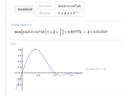
$I(\phi)=sin(\phi\pi)cos(\phi)^2$

View attachment 3506

so it seems .41 radians or (23.49 degrees) is the optimized angle for the highest intensity possible, given those constants.

Thank you, I am seriously blown away with this website and will be sure to tell all my friends to use this in the future
 

Attachments

  • Screen Shot 2014-11-10 at 1.38.11 PM.png
    Screen Shot 2014-11-10 at 1.38.11 PM.png
    25.2 KB · Views: 106
Last edited:

Similar threads

  • · Replies 18 ·
Replies
18
Views
3K
  • · Replies 16 ·
Replies
16
Views
3K
  • · Replies 0 ·
Replies
0
Views
861
  • · Replies 5 ·
Replies
5
Views
2K
  • · Replies 2 ·
Replies
2
Views
2K
  • · Replies 1 ·
Replies
1
Views
2K
Replies
3
Views
2K
  • · Replies 17 ·
Replies
17
Views
5K
Replies
2
Views
2K
  • · Replies 25 ·
Replies
25
Views
995