Discussion Overview
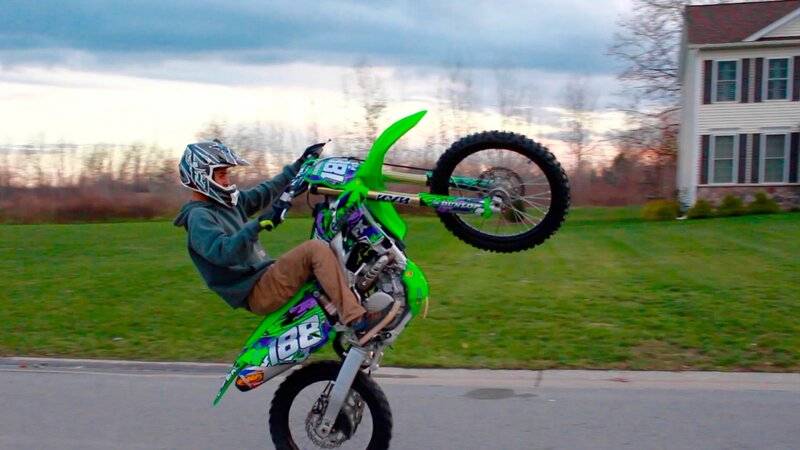
The discussion focuses on the mechanics and physics involved in performing a wheelie on a motorcycle. Participants explore concepts such as free-body diagrams, forces acting on the motorcycle, and the dynamics of balancing during the maneuver.
Discussion Character
- Exploratory
- Technical explanation
- Debate/contested
- Mathematical reasoning
Main Points Raised
- Some participants describe the physical actions a rider takes to perform a wheelie, such as squatting low, pushing down on the bike, and throttling forward.
- There are anecdotes shared about the dangers of performing wheelies, including a story about a rider who fell off a motorcycle after attempting a wheelie without experience.
- Participants express a need to analyze the situation using free-body diagrams to understand the forces and moments acting on the motorcycle during a wheelie.
- One participant suggests considering the gravitational force and frictional force in relation to the moments applied on the free body to understand the dynamics of lifting the front wheel.
- Another participant questions the accuracy of a free-body diagram presented and asks for clarification on the dynamics involved in maintaining a wheelie versus lifting the front wheel.
- There are requests for further explanation of the free-body diagram concept and how to balance the forces involved in the system.
Areas of Agreement / Disagreement
Participants generally agree on the importance of understanding the mechanics of a wheelie through free-body diagrams, but there are multiple competing views on the specifics of the forces and moments involved. The discussion remains unresolved regarding the precise dynamics and the correct application of free-body diagrams.
Contextual Notes
Some participants express uncertainty about the definitions and assumptions related to the forces and moments in the free-body diagrams. There are also indications that the discussion may be influenced by personal experiences and varying levels of expertise among participants.
Who May Find This Useful
This discussion may be useful for individuals interested in motorcycle dynamics, physics students exploring real-world applications of mechanics, and motorcycle enthusiasts looking to understand the physics behind performing stunts.