What Is the Potential Between Semi-Infinite Conducting Planes at a 30º Angle?

Click For Summary
SUMMARY

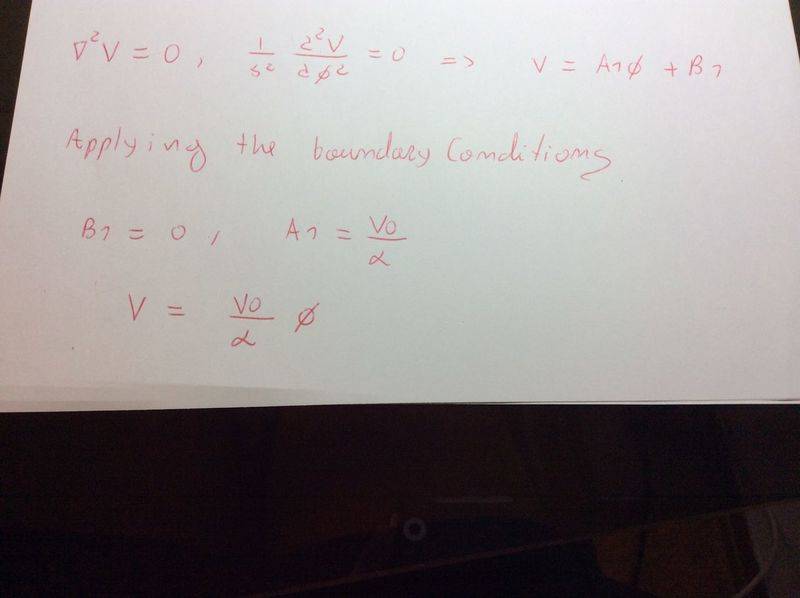
The discussion centers on solving the potential between two semi-infinite conducting planes at a 30º angle, with one plane at ground potential and the other at V0. The boundary conditions established are V=0 at φ=0 and V=V0 at φ=30º. The solution is derived using Laplace's equation in cylindrical coordinates, confirming that the potential V is given by V(φ) = (V0/30º)φ, satisfying both the boundary conditions and Laplace's equation. The First Uniqueness Theorem of Laplace's Equation is invoked to assert that this solution is unique.

PREREQUISITES
  • Understanding of Laplace's equation in cylindrical coordinates
  • Familiarity with boundary value problems in electrostatics
  • Knowledge of the First Uniqueness Theorem of Laplace's Equation
  • Basic concepts of potential theory in electrostatics
NEXT STEPS
  • Study the application of Laplace's equation in cylindrical coordinates
  • Explore boundary value problems in electrostatics
  • Learn about the First Uniqueness Theorem and its implications
  • Investigate the separation of variables technique in solving partial differential equations
USEFUL FOR

Students and professionals in physics and electrical engineering, particularly those focusing on electrostatics and potential theory, will benefit from this discussion.

OhNoYaDidn't
Messages
25
Reaction score
0
This problem was on my exam last week, and I've been having some troubles coming up with a solution.

1. Homework Statement

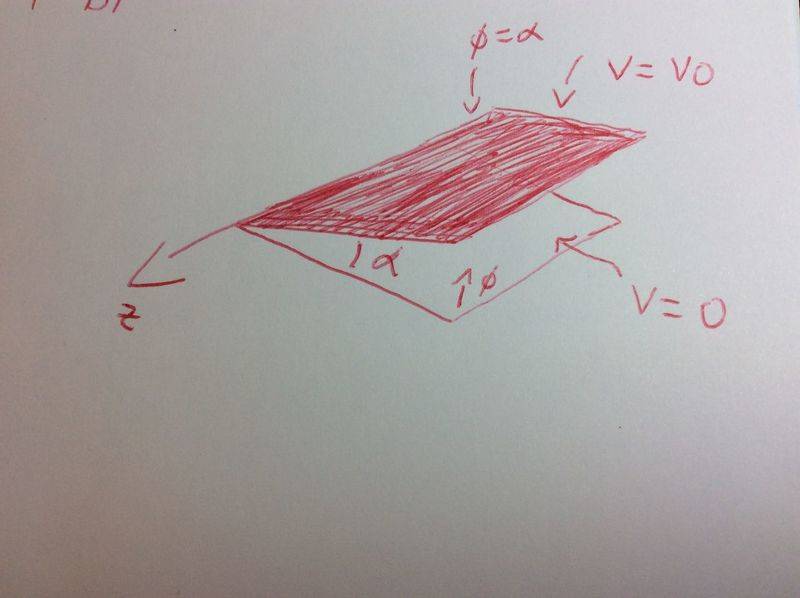
Two semi-infinite conducting planes are connected by insulating glue, they make a 30º angle with each other. One of them is at ground potential, and the other one at V0. Find the potential between the conductors.
Note: There might be solutions, in which the potential has logarithmic dependence on the distance to the axis, or even independent of this distance.

Homework Equations


Laplace's equation in cylindrical coordinates.
3. The Attempt at a Solution [/B]
IMG_1212.jpg


IMG_1216.jpg

The boundary conditions i came up with are:
1- V=0 at phi=0
2- V=V0 at phi=alpha

But I'm note sure if this is right.
Can you guys please help me out?
 
Physics news on Phys.org
Your work looks correct to me. But you might be required to justify ignoring the parts of the Laplacian that involve derivatives of the radial variable ##s## and derivatives of the variable ##z##.

Of course, you can make your answer more specific by substituting the given value for ##\alpha##.
 
Last edited:
  • Like
Likes   Reactions: OhNoYaDidn't
I'm assuming i can justify ignoring the z part by saying we have cylindrical symmetry. But what would the justification be for the s radial variable?
 
Use the fact that the potential for ##\alpha = 0## or ##\alpha = 30^0## is independent of ##s## along with the general form of the solution for ##V## using separation of variables: ##V(s, \alpha, z) = f(s)g(\alpha)h(z)##.
 
  • Like
Likes   Reactions: PhDeezNutz, OhNoYaDidn't and (deleted member)
TSny said:
Use the fact that the potential for ##\alpha = 0## or ##\alpha = 30^0## is independent of ##s## along with the general form of the solution for ##V## using separation of variables: ##V(s, \alpha, z) = f(s)g(\alpha)h(z)##.
I understand that but i have a question : if you moved radially outward the distance between you and the planes changes differently i mean if the angle between the planes is 30 degrees and you started to move at an angle of 10 degrees your distance from each plane will increase but at a different rate so why it doesnt depend on r .
 
phyahmad said:
I understand that but i have a question : if you moved radially outward the distance between you and the planes changes differently i mean if the angle between the planes is 30 degrees and you started to move at an angle of 10 degrees your distance from each plane will increase but at a different rate so why it doesnt depend on r .

Instead of relying on intuition I think you should appeal to the "First Uniqueness Theorem" of Laplace's Equation which states

"The solution to Laplace's equation in some volume ##\mathcal{V}## is uniquely determined if ##V## is specified on the boundary surface ##S##"

We have ##V = \frac{V_0}{\alpha} \phi##

Clearly
##V \left( 0 \right) = 0##

and

##V\left( \alpha \right) = V_0##

So the boundary conditions are satisfied

and since the Laplacian in Spherical coordinates is

## \nabla^2 V = \frac{1}{r} \frac{\partial }{\partial r} \left(r \frac{\partial V}{\partial r} \right) + \frac{1}{r^2} \frac{\partial^2 V}{\partial \phi^2 } + \frac{\partial^2 V}{\partial z^2}##

##\nabla^2 \left(\frac{V_0}{\alpha} \phi \right) = 0##

and it satisfies laplaces equation in the interior

Because it is satisfied on the boundary and in the interior by the Uniqueness Theorem it is the ONLY solution.
 

Similar threads

  • · Replies 3 ·
Replies
3
Views
3K
  • · Replies 3 ·
Replies
3
Views
2K
Replies
11
Views
3K
  • · Replies 14 ·
Replies
14
Views
4K
  • · Replies 7 ·
Replies
7
Views
5K
  • · Replies 6 ·
Replies
6
Views
3K
  • · Replies 7 ·
Replies
7
Views
6K
  • · Replies 2 ·
Replies
2
Views
2K
  • · Replies 9 ·
Replies
9
Views
8K
  • · Replies 25 ·
Replies
25
Views
4K