What is the proper format for solving this ODE using an Excel add-in calculator?

  • Context: Undergrad 
  • Thread starter Thread starter jknight291
  • Start date Start date
  • Tags Tags
    Calculus Excel Ode
Click For Summary

Discussion Overview

The discussion revolves around the proper format for solving a specific ordinary differential equation (ODE) using an Excel add-in calculator. Participants are exploring the transformation of the ODE to match the expected format of the solver, as well as clarifying the role of additional variables in the equation.

Discussion Character

  • Technical explanation
  • Debate/contested
  • Mathematical reasoning

Main Points Raised

  • One participant is attempting to solve an ODE using an Excel add-in but is unsure if the solver is interpreting the equation correctly, suggesting a potential mismatch in formats.
  • Another participant questions the nature of the variable ##x_2##, asking if it is a constant, a known function of time, or governed by another ODE.
  • A further response indicates that ##x_2## is a nonlinear algebraic equation and that the participant is solving the problem as a system of equations.
  • There is a suggestion that the ODE needs to be reformulated into the form \dot y = f(t,y) for compatibility with the solver, along with a mathematical transformation involving the chain rule.

Areas of Agreement / Disagreement

Participants express uncertainty regarding the definition and role of ##x_2##, indicating a lack of consensus on its nature and how it affects the ODE being solved. The discussion remains unresolved as participants explore different interpretations and approaches.

Contextual Notes

There are limitations regarding the assumptions about the variables involved, particularly ##x_2##, and the specific form required by the ODE solver. The mathematical steps for transforming the ODE are not fully resolved, leaving open questions about the correct approach.

jknight291
Messages
4
Reaction score
0
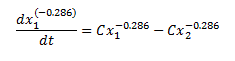
I am attempting to solve an ODE using a Calculus add-in for Excel. I am an industry professional and I have not even thought about Differential Equations in 8 years. The equation that I am attempting to solve is in the form:
244011
(1)

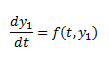
The ODE solver that I am using solves equations of the form:
244012
(2)

The results that I get by solving equation 1 above using my Excel Add-in for ODEs is a sinusoidal type reaction. However, when I solve numerically I get the expected result.

I think my ODE solver may be solving for
244013
and not just x`1. I tried to transform the results using algebra but the results were still obscure.

I think I may need to transform equation 1 to match the format of equation 2 before solving, but I am not sure. Like I said, it has been several years since taking a DE course so I am little rusty.

Can anyone offer some help?

Thanks!
 
Physics news on Phys.org
What is ##x_2##?
 
A nonlinear algebraic equation. I am solving this as a system of equations.
 
To echo @Gaussian97,

What is x_2? Is it a constant? Is it a known function of time? Is there another ODE which governs its evolution over time?

If the ODE solver expects an equation of the form \dot y = f(t,y) then you will need to put your ODE into that form before solving. Now by the chain rule <br /> \frac{dx_1^{-0.286}}{dt} = -{0.286}x_1^{-1.286}\frac{dx_1}{dt} so <br /> \frac{dx_1}{dt} = -\frac{x_1^{1.286}}{0.286}C(x_1^{-0.286} - x_2^{-0.286}).
 

Similar threads

  • · Replies 3 ·
Replies
3
Views
3K
  • · Replies 2 ·
Replies
2
Views
3K
  • · Replies 5 ·
Replies
5
Views
2K
  • · Replies 4 ·
Replies
4
Views
2K
  • · Replies 3 ·
Replies
3
Views
2K
  • · Replies 8 ·
Replies
8
Views
3K
  • · Replies 2 ·
Replies
2
Views
3K
  • · Replies 36 ·
2
Replies
36
Views
6K
  • · Replies 2 ·
Replies
2
Views
2K
  • · Replies 11 ·
Replies
11
Views
4K