What is the recommended maximum deflection for a bicycle frame test using FEA?

Join the discussion
Ask a follow-up here, or get your own question answered by working scientists, mathematicians and engineers — people, not an autocomplete.
Real named experts · corrections over time · the nuance an AI answer skips
4 replies · 4K views
An1MuS
Messages
38
Reaction score
0
I'm working on a group project where we test a bicycle frame on ABAQUS.

The test is as follow
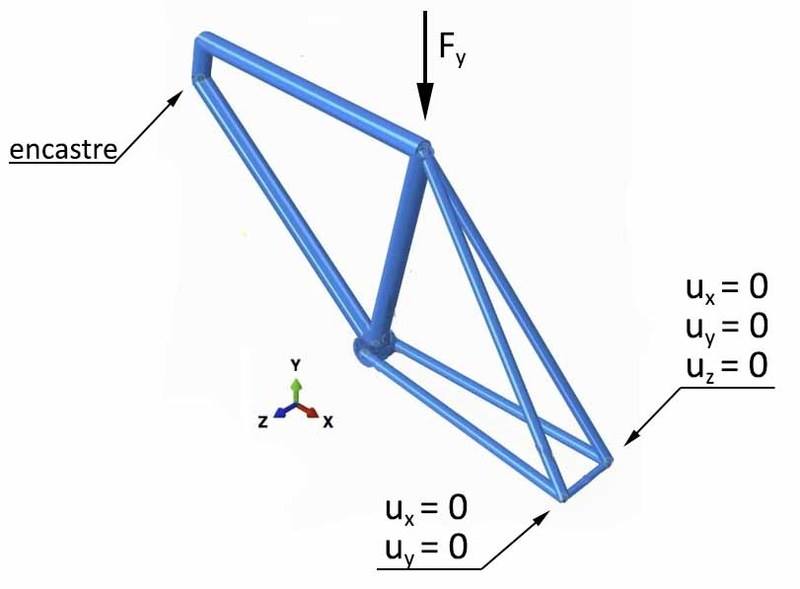
mEy4ro1.jpg


Where F is a static load. It was suggested for us to consider it as 4G*120kg to simulate a laboratory test. We're having a hard time knowing what is the maximum deflection (or stifness) we should allow.

I can't find any tests like this, or websites where i could get that information. Does anyone have any idea?
 
on Phys.org
I did and i won't get any of use for this case, but thanks for the suggestion. :)
 
An1MuS: I currently would guess the vertical deflection in your above frame test will be quite low, perhaps less than 2 mm. I currently would guess, initially use 1.5 mm as your current maximum allowable vertical deflection criterion, and see how it goes. My current guess for the range of good values would be 0.15 to 1.5 mm (?). I.e., in this current guess, the maximum allowable vertical deflection would be ymax = 1.5 mm.

And then if someone with expertise in this particular vertical deflection load case sees this thread, then they could advise whether my guessed maximum allowable vertical deflection value (ymax), or allowable deflection range, should be modified.

How would the 1.5 mm criterion, or the proposed range I stated above (0.15 to 1.5 mm), compare to some of your current deflection results? Also, you could, e.g., make your frame like a good, existing frame, and then see what vertical deflection value you obtain. And then post the results, so we can start comparing it to the proposed deflection criterion, to see if we are in the correct ball park. Do this for a good, known, stiff frame, to establish the lower allowable deflection (ymin) bound. Then do it again for a good, known, very flexible frame, to establish the upper allowable deflection (ymax) bound.
 
Last edited:
http://www.justinreina.com/portfolio/ME%20354%20-%20Bicycle%20lab.pdf
 
Last edited by a moderator: