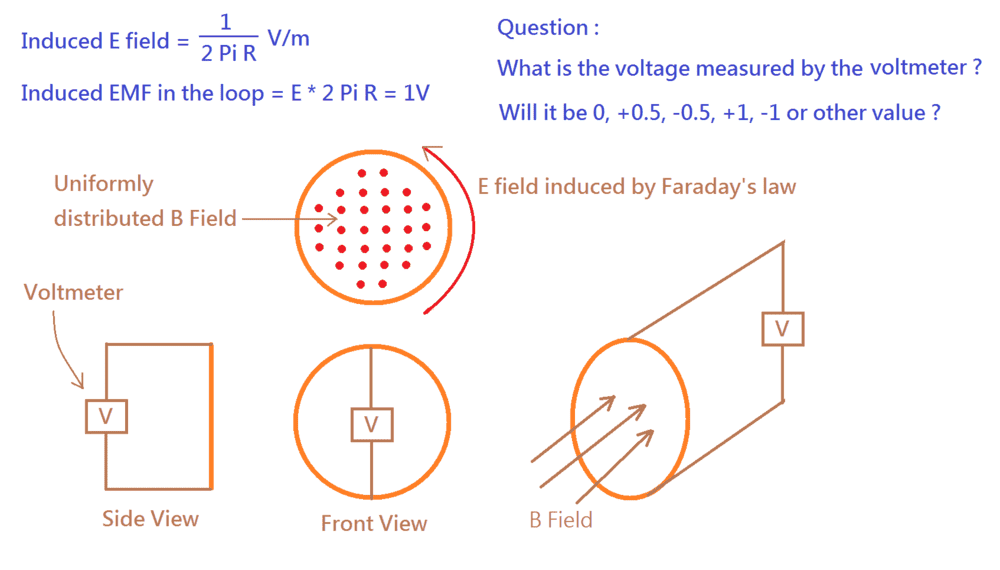
After rethinking this issue, I think that there is no paradox.
We should not treat a and b are exactly same, even if there is no voltage drop due to Ohm's law, there does exist an induced electric field between them, so they are indeed two different points.
As long as we define the Electromotive force (EMF) and PD (potential difference) as follows,
Electromotive force, ##~EMF_{ab} =−\int_a^b E \cdot dl ##
Potential difference, ##~PD_{ab} = \int_a^b E \cdot dl ##
and put the EMF (created by the induced electric field) into the equations, the correct calculation result can be obtained.
For example, we can easily prove that if the resistance of each point of the circular conductor is the same, there is indeed no potential difference along the circumference of the conductor.
Total length ## ~ L=\sum L_i ##
Total EMF ## ~ \mathcal E=\sum \mathcal E_i=\sum C_1L_i##
Total Resistance ## ~R= \sum R_i= \sum C_2L_i ##
where ## ~C_1## and ## C_2 ~## are constants
For any arc length ##~ L_i ~## on the circumference, the actual potential difference should be : -
$$ \mathcal E_i - \frac {\sum \mathcal E_i} {\sum R_i} R_i$$
$$ C_1 Li - \frac {\sum C_1L_i} { \sum C_2L_i } ~ C_2L_i ~~ = ~ C_1 Li - \frac {C_1} { C_2 } ~ C_2L_i =~0 $$