What is the required piston force for a crane boom with specific dimensions?

Click For Summary

Discussion Overview

The discussion revolves around calculating the required piston force for a crane boom with specific dimensions. Participants explore various approaches to derive the force needed, considering factors such as load, angles, and mechanical configurations. The conversation includes technical reasoning and attempts to clarify the geometry involved in the problem.

Discussion Character

  • Technical explanation
  • Debate/contested
  • Mathematical reasoning

Main Points Raised

  • Some participants provide a formula for estimating piston force based on load and geometry, specifically F = 0.15 kN * ( 5500 / 500 ) / Sin( 12°), while noting the importance of including the weight of the jib.
  • Others express a need for clarification on the derivation of the formula and the assumptions made, indicating a lack of sufficient information for precise calculations.
  • A participant suggests that the crane boom can be in various orientations, and the current configuration may not represent an optimized design.
  • There is a discussion about the dimensions of the triangle formed by the crane components, with conflicting interpretations of the angles and lengths involved.
  • Some participants challenge the accuracy of the provided dimensions and calculations, questioning the validity of the angles derived from the triangle's sides.
  • Concerns are raised about the design limitations, particularly regarding the hydraulic cylinder's range of motion and the angle at which it operates most effectively.
  • A telescoping cylinder is mentioned as a possible solution for achieving the required range, although it is noted that this is not a common design.

Areas of Agreement / Disagreement

Participants do not reach a consensus on the correct approach to calculating the piston force, with multiple competing views on the geometry and assumptions involved. Disagreements persist regarding the accuracy of the dimensions and the implications for the crane's design.

Contextual Notes

Limitations include unclear definitions of dimensions, unresolved mathematical steps regarding angle calculations, and varying interpretations of the crane's configuration. The discussion reflects a range of assumptions that may affect the outcomes.

kraub
Messages
5
Reaction score
0
TL;DR
Calculating rotation force
Hello,

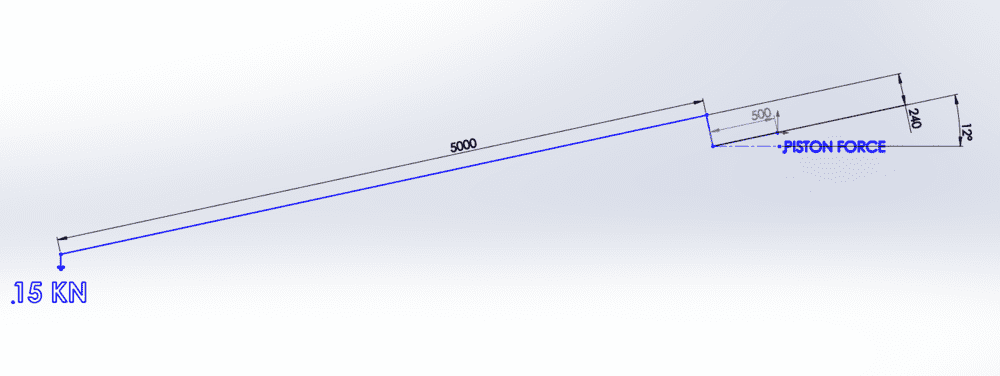
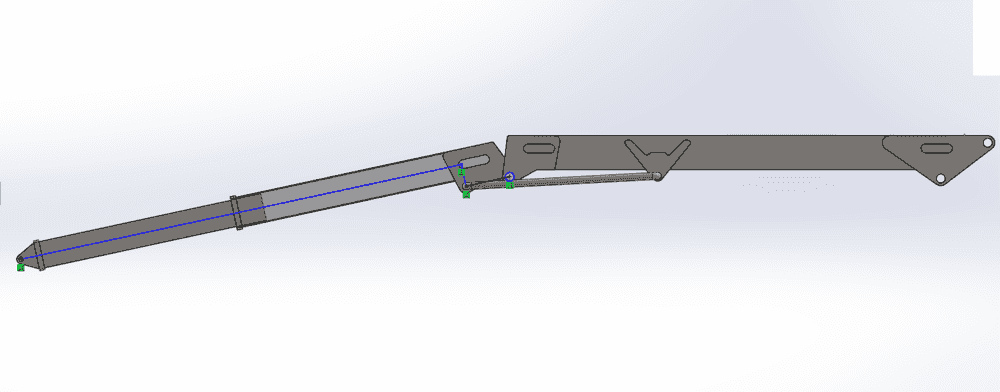
I have 2 pics about my case, I has designed crane boom and the problem has occurred when i came this point. As you see the pics, i want to find piston force. Could you help me about this ? (Dimensions=mm )
boom.png
boom-1.png
 
Last edited:
Engineering news on Phys.org
Welcome to PF.
A very quick estimate of piston force due to load is;
0.15 kN * ( 5500 / 500 ) / Sin( 12 deg) = 7.93 kN
Remember to add the weight of the jib to the problem.
 
  • Like
Likes   Reactions: kraub
Baluncore said:
Welcome to PF.
A very quick estimate of piston force due to load is;
0.15 kN * ( 5500 / 500 ) / Sin( 12 deg) = 7.93 kN
Remember to add the weight of the jib to the problem.

Could you share a simple scheme or derivation ? I'm curious how you got to this equation.
 
FEAnalyst said:
Could you share a simple scheme or derivation ?
I'm curious how you got to this equation.
The OP waited for 12 hours before getting any reply.
I think you should stake your bid before asking me to explain or justify mine.
 
Baluncore said:
The OP waited for 12 hours before getting any reply.
I think you should stake your bid before asking me to explain or justify mine.

If I had an idea how to calculate this force I would definitely share it. But I don’t know how to do and since I’m curious about this topic, I’m asking for additional explanation regarding your solution.
 
  • Like
Likes   Reactions: kraub
FEAnalyst said:
I’m asking for additional explanation regarding your solution.
There is insufficient information to be certain of any precise numerical result.

We do not need to chase the OP away with a shower of questions.
We just need an approximate answer, ignoring wind forces.

A crane boom and jib can be manipulated into many orientations. This is a student's concept, not an optimised design. It is shown in what is a "close to worst case position”. The following four steps appeared fundamental to my first approximation.

1. The 240 mm sidestep in the jib is irrelevant in the first analysis, so I ignore it.

2. The load is 150 N, so the crane can be a very light weight structure, probably a composite tube.

3. The jib is a lever that is 5500 mm long, with hydraulic force applied at 500 mm. That provides the ( 5500 / 500 ) term.

4. The hydraulic cylinder applies a force between the boom and jib. Model the elbow as two links with a 180° sweep. Then at 90° (between jib and cylinder) the cylinder will apply force directly with factor of 1.0; At 0° and 180° the points of attachment will be in line so the force will be infinite. The appropriate first order approximation is therefore the reciprocal of the sine function.

That explains the three terms of my approximation. F = 0.15 kN * ( 5500 / 500 ) / Sin( 12° ).
 
  • Like
Likes   Reactions: berkeman
Hello everyone,

Thanks your ideas and solutions. I think that mistake, when i give you this basic diagram . Because i separated the system with chasis. But the piston force is providing stabilizing in the system, in this case i have to draw like this picture. The line that new drawing is 1600 mm. My opinion that moment of this point take by there. What do you think about it ? Is that true way ? Thank you again your ideas and interests.
boom-1.png
 

Attachments

  • boom-1.png
    boom-1.png
    30 KB · Views: 292
Last edited:
I do not understand.
Problem with translation.
Which line is 1600 mm?
 
Baluncore said:
I do not understand.
Problem with translation.
Which line is 1600 mm?
 

Attachments

  • boom-1.png
    boom-1.png
    27.7 KB · Views: 306
  • #10
Insufficient information.
To solve the triangle you must specify three lengths between pins, or two lengths and one angle.

What is the distance along the boom from the jib hinge pin to the cylinder end pin on the boom?

You have not made it clear if the 1600 mm is the extended length of the ram from eye to eye measured diagonally, or if it is the separation of the cylinder eyes measured horizontally?
 
  • #11
The dimensions of triangle that 500,1200 and 1600 mm. The 1600 mm of cylinder is extended dimension. It is stabilization position.
 
  • #12
The triangle has sides: a = 5; b = 12; c = 16.
The internal angles are: A = 12.429°; B = 31.102°; C =136.469°
The angle between the jib and the horizontal (boom) is therefore; 180° - 136.469° = 43.531°

That is much steeper than your drawing so I assume there is something wrong with your numbers, diagram or my computation. Can you please solve for the angles of the triangle.
 
  • #13
You miss something there, angle of extended line and boom is different as you see, the drawing is clearly true because it is drew by computer programming, even i am asking about way of solution that share of force and moment.
 
  • #14
Measuring the image in a graphics program, using 1600 as the 'standard ruler', gives these results:

The Right-Most arm is Horizontal, its top edge measured as 0.0°

Pivot to left end of Cylinder: 364.4
Pivot to right end of Cylinder 1229
Cylinder Extension: 1600
Angle of Boom to Horiz.: 12.1° Counter Clock Wise
Angle of Cylinder to Horiz: 3.3° CCW
Length of Blue line on Boom: 3688

These are point-to-point measurements, not horizontal projections.

Cheers,
Tom
 
Last edited:
  • #15
kraub said:
You miss something there, angle of extended line and boom is different as you see, the drawing is clearly true because it is drew by computer programming, even i am asking about way of solution that share of force and moment.
I do not trust your computer.
When the triangle has dimensions 500, 1200, 1600 mm, what is the angle between the horizontal boom and the hinged jib?
I believe it is 43.531°
 
  • #16
When the jib hangs vertical there is zero moment due to supported end load plus jib weight.
The jib has a maximum moment due to weight and end load when the jib is horizontal.
At that point, the optimum angle between jib pins and hydraulic cylinder is 90°.
A fundamental problem with your design as that the angle is 0°, when it needs to be 90°.

Another limitation is the hydraulic cylinder pin attachment points.
The length of a standard hydraulic ram cannot change by a factor of two.
1200–500 = 700; 1200+500 = 1700; That full range is impossible.
There must be physical stops to prevent the piston hitting the internal ends of the cylinder.
 
  • #17
Baluncore said:
The length of a standard hydraulic ram cannot change by a factor of two.
1200–500 = 700; 1200+500 = 1700; That full range is impossible.

Actually, this is possible with a telescoping cylinder, but that is not very common.
 
  • #18
Attached is cylinder force table and BASIC code used for computation.
 

Attachments

  • #19
kraub said:
The dimensions of triangle that 500,1200 and 1600 mm. The 1600 mm of cylinder is extended dimension. It is stabilization position.
Focusing in on my computed data shows that, when the jib dips at an angle of 43.5°; the cylinder will have a length of 1600 mm; and the hydraulic force required will be 1.445 kN.
Dr.D said:
Actually, this is possible with a telescoping cylinder, but that is not very common.
A telescoping cylinder cannot be hydraulically retracted because it has no piston. It must be closed by the weight of the load.
A cylinder having a pintle mount, somewhere along the cylinder rather than an eye at the end, does make it possible to retract by more than a factor of two between the mountings.
 

Similar threads

  • · Replies 2 ·
Replies
2
Views
2K
  • · Replies 4 ·
Replies
4
Views
4K
Replies
3
Views
3K
  • · Replies 18 ·
Replies
18
Views
2K
Replies
4
Views
4K
  • · Replies 8 ·
Replies
8
Views
3K
  • · Replies 5 ·
Replies
5
Views
2K
  • · Replies 28 ·
Replies
28
Views
3K
  • · Replies 1 ·
Replies
1
Views
3K
  • · Replies 1 ·
Replies
1
Views
2K