What is the Role of Convective Heat Transfer in Cavitation of Cryogenic Fluids?

  • Context: Undergrad 
  • Thread starter Thread starter JD_PM
  • Start date Start date
Click For Summary

Discussion Overview

The discussion centers on the role of convective heat transfer in the phenomenon of cavitation within cryogenic fluids, particularly liquid nitrogen. Participants explore thermal models related to cavitation, focusing on the interplay between convective heat transfer and latent heat during vaporization processes in two-phase mixtures.

Discussion Character

  • Exploratory
  • Technical explanation
  • Conceptual clarification
  • Debate/contested

Main Points Raised

  • One participant describes cavitation as occurring when local static pressure drops below vapor pressure, leading to bubble formation in liquids.
  • Another participant seeks clarification on why the convective heat transfer term is subtracted from the latent heat source term in the context of total heat transfer during vaporization.
  • A participant suggests that the convective term represents heat removal from the cavity, while the latent heat term represents heat added due to condensation, leading to a net heat source that influences cavity temperature and pressure.
  • Some participants express uncertainty about specific values related to the thermal model, indicating a lack of clarity in the original papers referenced.
  • There is a mention of a strong coupling between condensation and convective heat transfer at the liquid-vapor interface, suggesting a complex interaction that may justify modeling mass transfer similarly to latent heat.

Areas of Agreement / Disagreement

Participants do not reach a consensus on the specific thermal interactions involved in cavitation. Multiple viewpoints and interpretations of the thermal models are presented, indicating ongoing debate and exploration of the topic.

Contextual Notes

Participants note the absence of certain values in the referenced papers, which may limit the discussion. There is also mention of the need for further exploration of the Rayleigh-Plesset equation to derive source terms, indicating that some mathematical steps remain unresolved.

JD_PM
Messages
1,125
Reaction score
156
Cavitation is a phenomena that occurs in liquids when the local static pressure drops below the vapor pressure; bubbles form within the liquid.

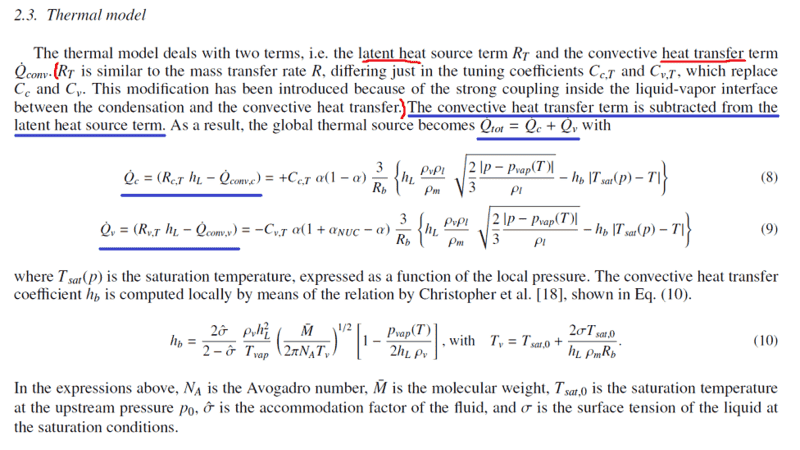
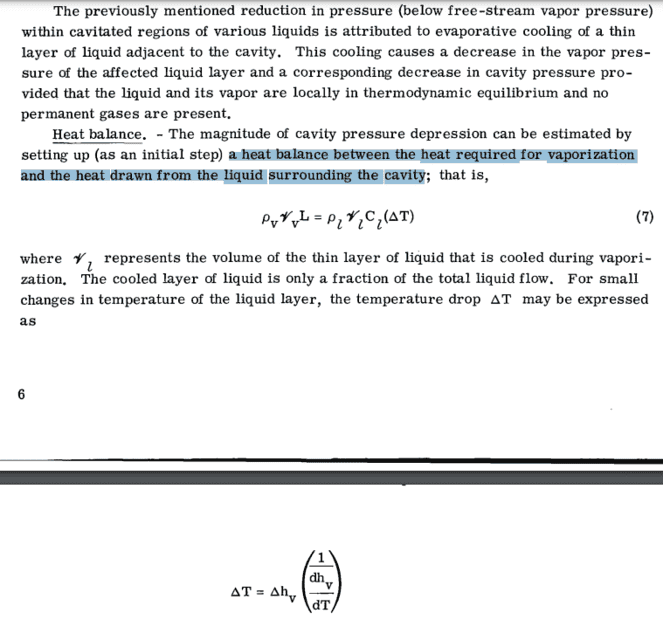
I am studying cavitation in incompressible, two-phase (liquid & gas), homogeneous mixture of cryogenic fluids (liquid nitrogen in particular) within pipes and would like to understand the thermal effects involved. My main sources are: 1) "Implementation and validation of an extended Schnerr-Sauer cavitation model for non-isothermal flows in OpenFOAM" (section 2.3: Thermal model, picture below; it's open source so no issues) and 2) "Method for prediction of pump cavitation performance for various liquids, liquid temperatures, and rotative speeds" (section: Determination of Cavity Pressure Depressions, picture below; it's open source so no issues).

I would like to understand and discuss the thermal models they propose and see if they are applicable to my particular case.

When referring to heat transfer I mean convective heat transfer (which I assume to be a combination of conduction and advection).

1) They state "The convective heat transfer term is subtracted from the latent heat source term". Why? What I understand from this is that latent heat and heat transfer compete but I do not quite get why this should be the case. Let's look at the case of vaporization; the vaporization heat needed for vaporization of a liquid is the convective heat transfer needed to reach vaporization temperature and the latent heat of vaporization of the liquid, and not the difference...

2) They set a heat balance between the heat required for vaporization and the heat drawn from the liquid surrounding the cavity (that is, the liquid-vapor interface).

So I think that they are essentially stating the same idea: the net heat transfer for vaporization is the difference between net latent heat transfer and convective heat transfer.
Screenshot (157).png

Screenshot (158).png
 
Science news on Phys.org
Let me go more to the point.

Screenshot (157).png


I would like to understand why the convective heat transfer term is subtracted from the latent heat source term to obtain the total heat transfer.

Message to anyone reading: even though you have never dealt with cavitation your input/guess would be useful. Discussion would definitely be much appreciated :smile:

Please let me know if further clarifications are needed.

Hello Sr. @Chestermiller, you might find the topic interesting.
 
Have you tried contacting the authors?
 
Hi DrClaude

Asking them could work.

I understand it's a bit too much to read a paper, my text and then reply.

I am planning to post a thread that doesn't require to read any paper beforehand.
 
  • Like
Likes   Reactions: vanhees71
I did look at the paper, but this would be a case of "your guess is as good as mine." And your guess is probably better :smile:

The don't seem to give the values of ##R_{c,T}## or ##R_{v,T}##, which would have been helpful (I would like to know the sign).
 
  • Like
Likes   Reactions: vanhees71 and JD_PM
So, here is a guess (I haven't read it too carefully though):

What they are trying to achieve is a heat source term for the cavity (correct?). This will influence its temperature and pressure, naturally. So, the convective term is the term (apparently) that removes heat away from the cavity. The latent heat term is the source of heat due to condensation (negative I guess for vaporization). So the difference between the two would then be the heat source that influences the pressure and temperature of the cavity.
 
  • Like
Likes   Reactions: JD_PM
DrClaude said:
I did look at the paper, but this would be a case of "your guess is as good as mine." And your guess is probably better :smile:

No worries, your above reply is appreciated :smile:

DrClaude said:
The don't seem to give the values of ##R_{c,T}## or ##R_{v,T}##, which would have been helpful (I would like to know the sign).

They do, indirectly though. ##R_{c,T}## and ##R_{v,T}## are latent heat source terms. In the paper, they assume they have exactly the same form than the mass transfer Schnerr-Sauer source terms (that is, the coefficients that rule how much mass is transferred from liquid to vapor and vice versa):

Screenshot (159).png


They just changed ##C_c## and ##C_v## for ##C_{c,T}## and ##C_{v,T}##

Let's not discuss how to derive the source terms at the moment (for that we'd need to start discussing about the Rayleigh-Plesset equation).

What I think is interesting to do is discussing why the mass transfer can be modeled the same way than latent heat. They justify it due to the "strong coupling inside the liquid-vapor interface between the condensation and the convective heat transfer."

I think what they mean is that the energy lost by the vapor and transferred to the liquid by means of latent heat of condensation is linked to the energy lost by the liquid and gained by the vapor by means of convective heat transfer. :smile:
 
  • Like
Likes   Reactions: vanhees71
JD_PM said:
I would like to understand why the convective heat transfer term is subtracted from the latent heat source term to obtain the total heat transfer.
We are considering
1650903924787.png
zation. Heat is removed from this layer by the latent heat of vaporization and added to this layer by convection from the surrounding liquid hence in the first image we subtract one from the other to get a net heat transfer and in the second image do a heat balance by setting one equal to the other.
 
  • Like
Likes   Reactions: JD_PM

Similar threads

  • · Replies 28 ·
Replies
28
Views
3K
  • · Replies 5 ·
Replies
5
Views
2K
  • · Replies 3 ·
Replies
3
Views
2K
  • · Replies 5 ·
Replies
5
Views
3K
  • · Replies 3 ·
Replies
3
Views
2K
  • · Replies 11 ·
Replies
11
Views
9K
  • · Replies 2 ·
Replies
2
Views
3K
  • · Replies 6 ·
Replies
6
Views
3K
  • · Replies 1 ·
Replies
1
Views
2K
Replies
1
Views
3K