What is the solution to this vector geometry problem?

  • Context: MHB 
  • Thread starter Thread starter Saitama
  • Start date Start date
  • Tags Tags
    Geometry Vector
Click For Summary

Discussion Overview

The discussion revolves around a vector geometry problem involving the median of a triangle and the ratios of segments created by intersections of lines. Participants explore various methods to find the ratio AF:AC, including vector approaches and alternative geometric methods.

Discussion Character

  • Exploratory
  • Technical explanation
  • Debate/contested
  • Mathematical reasoning

Main Points Raised

  • Participants propose using vector notation to express relationships between points A, B, C, D, E, and F, with various expressions for vectors being discussed.
  • Some participants suggest substituting expressions for vectors to derive equations for the ratios of segments.
  • One participant inquires about solving the problem without vectors, seeking hints for alternative methods.
  • Several participants share solutions using analytic geometry and synthetic methods, highlighting different approaches to the same problem.
  • There is mention of a generalization of a proof, indicating a modification of an existing solution.

Areas of Agreement / Disagreement

Participants express various methods to approach the problem, with no consensus on a single solution method. Some agree on the validity of vector methods, while others explore alternative geometric approaches, indicating a range of perspectives without a definitive resolution.

Contextual Notes

Limitations include the dependence on the definitions of points and segments, as well as unresolved mathematical steps in the derivation of ratios. The discussion reflects a mix of exploratory reasoning and technical challenges without clear conclusions.

Who May Find This Useful

Readers interested in vector geometry, geometric proofs, and alternative problem-solving methods in mathematics may find this discussion beneficial.

Saitama
Messages
4,244
Reaction score
93
Problem:

The median AD of the $\Delta$ ABC is bisected at E. BE meets AC in F. Find AF:AC.

Attempt:

t4tmpv.png


Let point E divide BF in the ratio $\mu : 1$ and let F divide the line AC in the ratio $\lambda : 1$.

I take A as the origin. Then,

$$\vec{AD}=\frac{1}{2}(\vec{AB}+\vec{AC})$$
$$\vec{AF}=\frac{\lambda \vec{AC}}{\lambda+1}$$
$$\vec{AE}=\frac{\mu\vec{AF}+\vec{AB}}{\mu+1}$$
Also,
$$\vec{AE}=\frac{1}{2}\vec{AD}=\frac{1}{4}(\vec{AB}+\vec{AC})$$

I can substitute the above in the 3rd equation but I don't see what to do with $\vec{AB}$ as I have to find the ratio AF:AC.

Any help is appreciated. Thanks!
 
Physics news on Phys.org
Pranav said:
Problem:

The median AD of the $\Delta$ ABC is bisected at E. BE meets AC in F. Find AF:AC.

Attempt:

t4tmpv.png


Let point E divide BF in the ratio $\mu : 1$ and let F divide the line AC in the ratio $\lambda : 1$.

I take A as the origin. Then,

$\vec{AD}=\dfrac{1}{2}(\vec{AB}+\vec{AC})$

$\vec{AF}=\dfrac{\lambda \vec{AC}}{C+1}$ (1)

$\vec{AE}=\dfrac{\mu\vec{AF}+\vec{AB}}{\mu+1}$ (2)

Also,
$\vec{AE}=\dfrac{1}{2}\vec{AD}=\frac{1}{4}(\vec{AB}+\vec{AC})$ (3)

I can substitute the above in the 3rd equation but I don't see what to do with $\vec{AB}$ as I have to find the ratio AF:AC.

Any help is appreciated. Thanks!
You are on the right lines. Substitute the expression for $\vec{AF}$ from (1) into (2). Together with (3), that will give you two separate expressions for $\vec{AE}$ as a combination of $\vec{AB}$ and $\vec{AC}$. By comparing the coefficients of $\vec{AB}$ and $\vec{AC}$ in those two expressions, you will get two equations for $\lambda$ and $\mu$. Then once you know $\lambda$ you can find the ratio AF:AC.
 
Hi Opalg!

Opalg said:
You are on the right lines. Substitute the expression for $\vec{AF}$ from (1) into (2). Together with (3), that will give you two separate expressions for $\vec{AE}$ as a combination of $\vec{AB}$ and $\vec{AC}$. By comparing the coefficients of $\vec{AB}$ and $\vec{AC}$ in those two expressions, you will get two equations for $\lambda$ and $\mu$. Then once you know $\lambda$ you can find the ratio AF:AC.

Thanks a lot, I always forget about comparing the coefficients. Thank you very much. :)

I was wondering if there is a way to solve this problem without the use of vectors? If there is a way, can you please give me a few hints?

Many thanks!
 
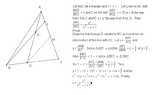
Hi,
The attached solution just uses analytic geometry; it is in many respects similar to your vector solution, but it is different. I tried unsuccessfully to think of a synthetic solution.

View attachment 1745
 

Attachments

  • MHBgeometry5.png
    MHBgeometry5.png
    11 KB · Views: 132
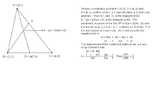
johng said:
Hi,
The attached solution just uses analytic geometry; it is in many respects similar to your vector solution, but it is different. I tried unsuccessfully to think of a synthetic solution.
<image>

Thanks johng for the alternative method. :)
 
HI again,
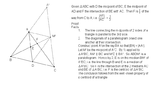
I guess I liked your problem. Attached is a "purely" synthetic proof of the result.

View attachment 1750
 

Attachments

  • MHBgeometry5b.png
    MHBgeometry5b.png
    15 KB · Views: 131
johng said:
HI again,
I guess I liked your problem. Attached is a "purely" synthetic proof of the result.
<image>

Awesome! I could never really think of it. Thanks a lot johng. :)

Can you please share some motivation behind the construction? I am really interested to know how you approach such problems. Thanks!
 
Hi Pranav,

I like geometry a lot, but I'm not very good at it. So my thoughts probably aren't worth much.

I knew the answer for the unknown point. So it occurred to me that maybe it's the centroid of some triangle. I started casting about for such a triangle. Pretty soon the construction became apparent. Not much help, I bet.

Thanks for your kind words.
 
Pranav said:
Hi Opalg!
Thanks a lot, I always forget about comparing the coefficients. Thank you very much. :)

I was wondering if there is a way to solve this problem without the use of vectors? If there is a way, can you please give me a few hints?

Many thanks!
Hey.

Construct a line $l$ passing through point $D$ and parallel to $BF$, and say this line intersects $AC$ at $M$.

Argue that $M$ is the mid-point of $FC$. This gives $AF/FM=2\lambda$

Also, by similarity of $\Delta AEF$ and $\Delta ADM$, we have, $1=AE/ED=AF/FM=2 \lambda$.
 
Last edited:
  • #10
CaffeineMachine, very nice simple proof. I modified your proof slightly to give the attached generalization. I had reached this generalization previously with my more complicated solution, but it got kind of messy.

View attachment 1756
 

Attachments

  • MHBgeometry5c.png
    MHBgeometry5c.png
    12.6 KB · Views: 114
  • #11
johng said:
CaffeineMachine, very nice simple proof. I modified your proof slightly to give the attached generalization. I had reached this generalization previously with my more complicated solution, but it got kind of messy.

https://www.physicsforums.com/attachments/1756
Thanks. :)
What software do you use to make these diagrams?
 
  • #12
I am really sorry, I saw the posts but forgot to reply. :(

Great and short method caffeinemachine, I really like it, thanks! :)

And nice generalisation johng, thanks a lot for the help. :)
 

Similar threads

Replies
18
Views
2K
Replies
8
Views
2K
  • · Replies 3 ·
Replies
3
Views
2K
Replies
11
Views
3K
Replies
3
Views
2K
  • · Replies 25 ·
Replies
25
Views
2K
Replies
12
Views
2K
  • · Replies 5 ·
Replies
5
Views
2K
  • · Replies 1 ·
Replies
1
Views
1K
  • · Replies 2 ·
Replies
2
Views
2K