What is the Spectral Paradox Discussed in PF Insights?

  • Context: Insights 
  • Thread starter Thread starter trilobite
  • Start date Start date
  • Tags Tags
    Paradox
Click For Summary

Discussion Overview

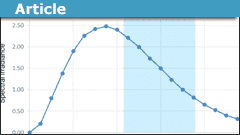
The discussion revolves around the Spectral Paradox, particularly focusing on the interpretation of spectral curves and the implications of plotting power spectral density against wavelength versus frequency. Participants explore the nuances of data analysis in this context, raising questions about general rules to avoid misunderstandings related to spectral interpretation.

Discussion Character

  • Exploratory
  • Technical explanation
  • Debate/contested
  • Mathematical reasoning

Main Points Raised

  • Some participants express surprise at the existence of the spectral paradox and emphasize the importance of careful interpretation of spectral curves, especially their peaks.
  • One participant argues that the paradox arises from a lack of clarity regarding scale units, noting that frequency and wavelength are not directly interchangeable due to their differing scales.
  • Another participant suggests that expressing Power Spectral Density in terms of logarithmic measures could help align the peaks of wavelength and frequency, although this method is noted to lack special physical significance according to some sources.
  • Some contributions highlight that the perceived paradox may stem from psychological or pedagogical issues rather than physical contradictions, with varying opinions on whether the paradox is felt by all participants.
  • Several participants discuss the equivalence of integrals when measuring energy under wavelength and frequency curves, with some seeking mathematical proofs for these claims.
  • There is a suggestion to explore other scientific scenarios where peaks in curves shift based on the units used on the x-axis, indicating a broader interest in the implications of measurement units in scientific analysis.

Areas of Agreement / Disagreement

Participants do not reach a consensus on the nature of the spectral paradox, with multiple competing views on its significance and implications remaining throughout the discussion. Some participants agree on the need for clarity in data representation, while others challenge the characterization of the issue as a paradox.

Contextual Notes

Limitations include the dependence on specific definitions of spectral density and the unresolved nature of the mathematical proofs regarding the equivalence of integrals under different measures.
trilobite
Insights Author
Gold Member
Messages
13
Reaction score
12
trilobite submitted a new PF Insights post

Exploring the Spectral Paradox
SpectralParadox.png


Continue reading the Original PF Insights Post.
 
  • Like
Likes   Reactions: Demystifier, kith, OmCheeto and 1 other person
Physics news on Phys.org
Nice article! I wasn't even aware that this paradox existed!
 
Wow! Your article was like a good invention; obvious to everyone after being explained by the inventor.

Overall, the key point to remember is that one must be careful when interpreting spectral curves, especially their peaks

Is there a general rule to follow in data analysis that would let us avoid such paradoxes?
 
  • Like
Likes   Reactions: Greg Bernhardt
"rubbish" was my first reaction. haha good start.
But the apparent paradox is only there because such graphs don't have a full explanation of the scale units. Δf Hz is not equivalent to a fixed step size of Δλ m so different powers will be admitted into uniform steps of frequency than in uniform steps of wavelength, as you sweep across the frequency (or wavelength) spectrum.
f=c/λ
so
df/dλ = -c/λ2
and df = -cdλ/λ
That impresses a scale factor of 1/λ across the width of the wavelength spectrum. The peaks cannot coincide. The range covers around an octave so the effect is both significant and annoying.
Thinking about it, it doesn't even surprise me that the peak of our vision is at the peak of frequency sensitivity because it's the energy of the photons the counts and that is hf. (Permission to dump on me about that last point)
Would this paradoxical behaviour show itself in any filter design that's based on wavelength (some delay line filters, perhaps)? We are so used to using frequency analysis of circuits.
 
  • Like
Likes   Reactions: Demystifier and swampwiz
anorlunda said:
Is there a general rule to follow in data analysis that would let us avoid such paradoxes?
Yes: be aware of what is being plotted against what! (Do as I say and not as I do. :wink:)
 
This isn't a paradox; it's simply that the power-spectral-density is being calculated as per unit wavelength differential instead of as per unit frequency unit. To call it a paradox would be like saying that it's paradoxical that an apple is an apple and and orange is an orange. I want my 5 minutes back.
 
We could avoid this dichotomy by expressing Power Spectral Density as Power Log(spectral) density, i.e., instead of

W/(m^2 * delta(nm)),

use

W/(m^2 * delta(log(nm)))

This should give the same shape curve as

W/(m^2 * delta(log(THz)))

because

log(nm) = log(c)-log(THz),

thus removing the nonlinear mapping between the wavelength and frequency based metrics.

As with the original unit, denominator is area times an interval. Here, the interval in the measurement unit would actually be the difference of the logarithms of the ends of the interval, or the log of the ratio of the ends of the interval.

We don't even have to use logarithms if we force the interval in the measurement to be constant on a log scale, i.e., a constant ratio such as a milli-octave.
 
Last edited:
  • Like
Likes   Reactions: anorlunda
NH_EE said:
We could avoid this dichotomy by expressing Power Spectral Density as Power Log(spectral) density, i.e., instead of

W/(m^2 * delta(nm)),

use

W/(m^2 * delta(log(nm)))

This should give the same shape curve as

W/(m^2 * delta(log(THz)))

because

log(nm) = log(c)-log(THz),

thus removing the nonlinear mapping between the wavelength and frequency based metrics.

As with the original unit, denominator is area times an interval. Here, the interval in the measurement unit would actually be the difference of the logarithms of the ends of the interval, or the log of the ratio of the ends of the interval.

We don't even have to use logarithms if we force the interval in the measurement to be constant on a log scale, i.e., a constant ratio such as a milli-octave.
The paper by Soffer and Lynch does make a similar point concerning the alternative of using a logarithmic representation. However, the authors state that this method has "no special physical significance" and should not be "singled out as a preferred physical ... representation" for electromagnetic spectra, even though it does cause the wavelength and frequency peaks to coincide. As a wavelength, that peak for solar radiation is approximately 720 nm, according to the paper. Note that that value is very close to Heald's median point of 710 nm, as I suspect the mathematics imply, although Heald does describe the value as "physically meaningful!"

My own opinion is that, while all of the above points are valid and interesting, they don't directly address the "paradox" at issue here. That's because this kind of paradox is primarily a psychological or pedagogical matter, not a physical or mathematical contradiction. Granted, some people may not feel the paradox, at all. But for those (like me) who do, a detailed exploration into where that sense of paradox is coming from can perhaps be helpful in dispelling it.
 
trilobite said:
a detailed exploration into where that sense of paradox is coming from can
I would think it could be a useful exercise to find other situations in Science where a peak in a curve shifts according to the units on the x axis.
Strangely, (visible) light tends to be specified in terms of wavelength (the fault of history and the result of the prism / diffraction grating). Other members of the EM spectrum tend to be measured in terms of frequency / energy. In my opinion, because frequency is the variable that remains the same, it is a more suitable measure. Using frequency would have prevented a lot of confused questions on PF and other places about the assumed change in frequency at a boundary. (because, they say fλ=c etc.)
 
  • #10
I'm quite confused about this part:
The important point here is that you get that same value whether you measure the area under the wavelength curve (Fig. 1) or under the frequency curve (Fig. 2), even though the two curves have different shapes!

Reference https://www.physicsforums.com/insights/exploring-spectral-paradox/
Check out the formulae in Hyperphysics and WikipediaWe see that:

##B_{\lambda}=\frac{du}{d\lambda}\cdot g \quad ,\quad B_{\nu}=\frac{du}{d\nu}\cdot g##

where: ##\quad g=\frac{hc}{\lambda}\cdot \frac{a}{e^{\frac{h\nu}{kT}}-1}##

a
is some coefficient.How do we show that the two integrals are equivalent?

##\int \frac{du}{d\lambda}\cdot g \quad d\lambda \quad, \quad \int \frac{du}{d\nu}\cdot g \quad d\nu##
 
  • #11
It's the Definite Integral that counts. The Integral between the limits of λ will be equal to the integral between equivalent limits of ν. You have to do the job completely.
There's more to the Definite Integral than just the inverse of Differentiation.
 
  • #12
sophiecentaur said:
The Integral between the limits of λ will be equal to the integral between equivalent limits of ν.
hmm, do you have a link to the mathematical proof?
 
  • #13
tade said:
hmm, do you have a link to the mathematical proof?
Is a proof needed that the energy between the limits of frequency and the corresponding limits of wavelength is the same? It's the same energy and the same conceptual filter letting it through. I know that Maths is usually required here but this constraint comes before the Maths - not after a proof (I would have thought). :smile:
 
  • #14
sophiecentaur said:
Is a proof needed that the energy between the limits of frequency and the corresponding limits of wavelength is the same? It's the same energy and the same conceptual filter letting it through. I know that Maths is usually required here but this constraint comes before the Maths - not after a proof (I would have thought). :smile:
I managed to figure out how it works :smile:
 
  • Like
Likes   Reactions: sophiecentaur
  • #15
tade said:
How do we show that the two integrals are equivalent?

##\int \frac{du}{d\lambda}\cdot g \quad d\lambda \quad, \quad \int \frac{du}{d\nu}\cdot g \quad d\nu##

The proof was basically staring at me right in the face. :DD
 
  • #16
I would like to understand better this paradox. I tried to have a mathematical approach, if I take the distribution function ##f(\lambda)## for ##\lambda## and ##g(\nu)## for distribution function of ##\nu## : then I can apply the transfert theorem :

$$f(\lambda)\text{d}\lambda = g(\nu)\text{d}\nu$$

So, I get : $$g(\nu)=|\dfrac{\text{d}\lambda}{\text{d}\nu}| f(\lambda)=\dfrac{c}{\nu^2}f(\lambda)$$

We can notice that : ##g_{max}=\text{max}(\dfrac{c}{\nu^2}f(\lambda))\neq f_{max}##

I tried to find the relation between ##\lambda_{max}## with ##f_{max}=f(\lambda=\lambda_{max})## and ##g_{max}=g(\nu=\nu_{max})##, more precisely
the relation between ##\lambda_{max}## and ##\nu_{max}## (which is not simply ##\lambda=\dfrac{c}{\nu}##).

For this, starting from ##g(\nu_{max}) = g_{max}##, I took : $$\dfrac{\text{d}g}{\text{d}\nu} = 0$$

Giving also :

$$-2\dfrac{c}{\nu^{3}}f(\dfrac{c}{\nu})-\dfrac{c}{\nu^{2}}\dfrac{\text{d}f(\dfrac{c}{\nu})}{\text{d}\nu}=0$$

Finally, I get, that seems to be wrong, the equation : $$\dfrac{\text{d}f}{\text{d}\nu}=-\dfrac{2}{\nu}f$$

So, have I got to conclude by writing :

$$f(\nu)= \dfrac{\text{A}}{\nu^{2}}$$ with ##A## a constant to determine ?

I don't know how to conclude, the last relation seems to have no sense, doesn't it ?

If I am on the wrong track, please let me know. Any help is welcome

Regards
 
  • #17
Firstly there is no paradox. ;)
The apparent problem relates to the Definite Integral and the different limits when you choose to integrate wrt f or wavelength. This has already been dealt with. I can't think how to resolve it without introducing integration. But why avoid that when it's the whole basis of Energy Density.
 

Similar threads

  • Sticky
  • · Replies 9 ·
Replies
9
Views
7K
  • · Replies 7 ·
Replies
7
Views
3K
  • · Replies 35 ·
2
Replies
35
Views
15K
  • · Replies 6 ·
Replies
6
Views
3K
Replies
2
Views
2K
  • · Replies 5 ·
Replies
5
Views
2K
  • · Replies 28 ·
Replies
28
Views
5K
  • · Replies 19 ·
Replies
19
Views
3K
  • · Replies 28 ·
Replies
28
Views
4K
  • · Replies 88 ·
3
Replies
88
Views
11K