What Is the Tension in the Rope for a High Wire Walker?

Click For Summary
SUMMARY

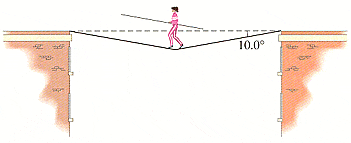
The discussion focuses on calculating the tension in a rope for a high wire walker, specifically Arlene, who is 13.0 meters above the ground with a sag angle of 10.0°. Given her mass of 50.0 kg, the correct approach involves resolving forces acting on her. The tension in the rope can be determined using the equation 2Ty = mg, where Ty represents the vertical component of the tension and mg is the weight of Arlene. The sum of forces acting on her must equal zero, confirming the need for upward forces to balance her weight.

PREREQUISITES
  • Understanding of basic physics concepts, specifically forces and tension
  • Familiarity with trigonometric functions, particularly sine and cosine
  • Knowledge of Newton's laws of motion, especially the equilibrium condition (∑F = 0)
  • Ability to resolve vector components in physics problems
NEXT STEPS
  • Study the derivation of tension in inclined ropes using trigonometric identities
  • Learn how to apply Newton's second law in static equilibrium scenarios
  • Explore examples of tension calculations in various physics problems
  • Investigate the effects of different angles on tension in ropes
USEFUL FOR

This discussion is beneficial for physics students, educators, and anyone interested in understanding the principles of tension and force equilibrium in static systems.

Damie904
Messages
3
Reaction score
0
1.Homework Statement
4-42fig.gif

Arlene is to walk across a high wire strung horizontally between two buildings 13.0 m apart. The sag in the rope when she is at the midpoint is 10.0°. If her mass is 50.0 kg, what is the tension in the rope at this point?
So I know:
Mass=50kg
Acceleration=0 m/s2

Homework Equations


This is the part I need help with because I'm not exactly sure what formula to use to find tension motion. Since F=ma would just give me 0 which would be incorrect.
The only other Formula I can think of is 2cos(theta)Ty=mg, but I'm not too sure if that's correct. Plus, I don't know what Ty is.

The Attempt at a Solution

 
Last edited:
Physics news on Phys.org
Resolving the tension along the vertical axis should not give 2cos(\theta)T_{y}=mg. What do you think it should?
 
You are sort of correct that the F=ma=0. Really, it is that ∑F=0, where ∑F is the sum of all the forces acting on Arlene. I think you see that is her weight pulling down, but what is pushing her up? Something has to be if ∑F=0.

Consider that the point under her feet is being pulled left by one part of the rope and right by the other part of the rope. Those forces are ±Tx.

Each of the two parts of the rope are also pulling her up. The upward force of one part would be Ty.

Do you see why there would be 2Ty? And why that would equal mg?

(Check your notes or your text: I think you'll see that you've mistranscribed 2cos(theta)Ty=mg)
 

Similar threads

  • · Replies 1 ·
Replies
1
Views
3K
  • · Replies 6 ·
Replies
6
Views
2K
  • · Replies 8 ·
Replies
8
Views
2K
  • · Replies 9 ·
Replies
9
Views
1K
  • · Replies 2 ·
Replies
2
Views
3K
  • · Replies 38 ·
2
Replies
38
Views
5K
  • · Replies 3 ·
Replies
3
Views
4K
  • · Replies 9 ·
Replies
9
Views
2K
  • · Replies 1 ·
Replies
1
Views
2K
  • · Replies 4 ·
Replies
4
Views
3K