What is the Transformation of Four-Velocity between Frames?

  • Thread starter Thread starter Kaguro
  • Start date Start date
  • Tags Tags
    Frame Lab Speed
Click For Summary

Homework Help Overview

The discussion revolves around the transformation of four-velocity between different reference frames in the context of special relativity. The original poster presents a problem involving two rods with specified rest lengths and velocities, seeking to understand the implications of their relative motion and the resulting calculations related to velocity and length contraction.

Discussion Character

  • Exploratory, Assumption checking, Mathematical reasoning

Approaches and Questions Raised

  • Participants explore the relativistic velocity addition formula and its implications for the velocities of the rods. There are attempts to reconcile the negative velocity results with physical interpretations. Questions arise regarding the validity of the length contraction expression used and its source, as well as the assumptions underlying the problem setup.

Discussion Status

Several participants engage in clarifying the implications of the equations presented, with some suggesting that the original poster may have overlooked potential solutions. There is acknowledgment of the complexity of the problem, and the discussion reflects a mix of agreement and differing interpretations regarding the equations and their physical meanings.

Contextual Notes

Participants note that the problem is sourced from a book of practice problems, which may not always provide perfect answers. There is also mention of potential assumptions that could affect the interpretation of the results, particularly regarding the behavior of the equations as velocities approach the speed of light.

Kaguro
Messages
221
Reaction score
57
Rod R1 has a rest length `1m and rod R2 has rest length 2m. R1 is moving towards right with velocity v and R2 is moving towards left with velocity v with respect to lab frame. If R2 has length 1m in rest frame of R1, then v/c is what?
-----------------------

I let vel of R1 be u, of R2 be w w.r.t lab and velocity of R2 w.r.t. R1 be w'.
Then u = v, and w = -v.

Then by relativistic velocity addition formula:
w' = (w - u)/(1- (u*w)/c^2)
=> w' = -2v/(1+v^2/c^2) -----------(1)

Now, according to Lorentz contraction:
L/L0 = √(1 - (w'/c)^2 )
But L/L0 = 1/2

Solving, I find w'/c = (√3)/2 ------------(2)

From simplifying (1) and (2):
v^2 + (4/√3) vc + c^2 = 0
So, v = -c/√3 or v = -√3 *c.

But... why is answer negative?
Even if I reject the 2nd one and accept the magnitude of first, I get v = 0.577c...

But the exact answer given is v = 0.6c.

Where did I go wrong?Also, the solution given says:
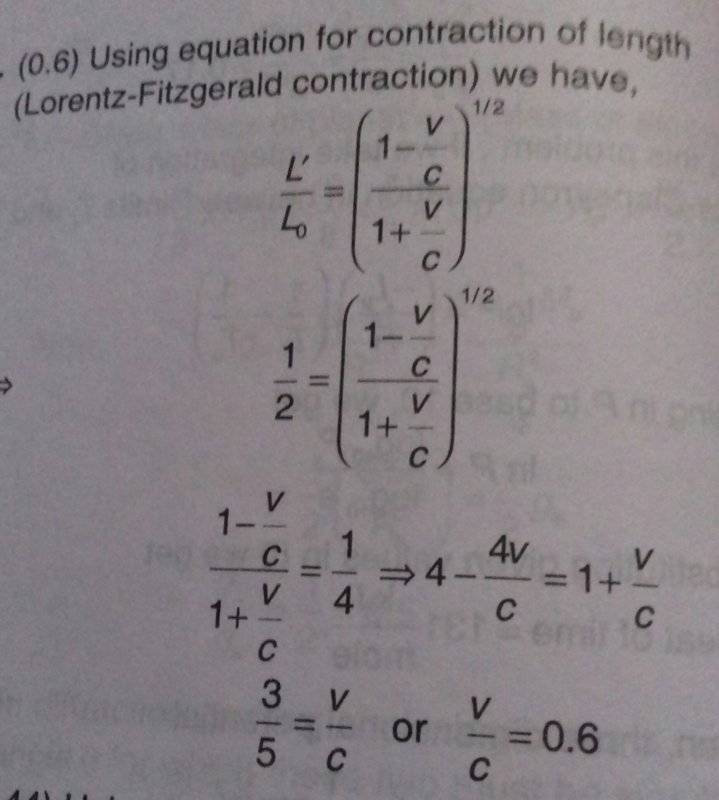
weird_formula.jpg


Where did this one come from??

Any help will be appreciated.

[Moderator's note: Moved from a technical forum and thus no template.]
 
Last edited by a moderator:
Physics news on Phys.org
The negative comes in because you neglected a solution for ##w'##. It could be ##w'=\pm\sqrt 3/2##, and your equation 1 implies that ##w'## is negative if ##v## is positive.

Otherwise I have to say I agree with you.
 
Ibix said:
The negative comes in because you neglected a solution for ##w'##. It could be ##w'=\pm\sqrt 3/2##, and your equation 1 implies that ##w'## is negative if ##v## is positive.
Oh yeah.. You're right!
 
The expression for length contraction in the photo is weird. You get different behaviour as ##v\rightarrow c## and ##v\rightarrow -c##. That's not right, unless it's a specialisation of something with a hidden assumption that ##v>0##. What book did it come from?
 
Ibix said:
What book did it come from?
It is a book for IIT-JAM solved papers.
 
So just a book of practice problems? In that case (unless someone else comes up with something we've both missed) I'd just bear in mind that some of the answers might not be perfect.
 
  • Like
Likes   Reactions: Kaguro
The first equation is not the Lorentz Contraction equation since the right-hand-side is the Doppler factor.
 
Ibix said:
So just a book of practice problems? In that case (unless someone else comes up with something we've both missed) I'd just bear in mind that some of the answers might not be perfect.

Yeah i thought so too...

thanks everyone.
 
Kaguro said:
Yeah i thought so too...

thanks everyone.

You can also do this with rapidities. In this case, in the frame of R1, we have a rapidity of ##2\theta##, where ##\theta## is the rapidity associated with speed ##v##. And:

##2 = \gamma_1 = \cosh 2\theta = 2\cosh^2 \theta - 1##

Hence ##\gamma^2 = \cosh^2 \theta = 3/2##

Then, we have:

##\frac{v}{c} = \tanh \theta = \sqrt{1 - sech^2 \theta} = \frac{1}{\sqrt{3}}##

Or, more generally, we can relate the gamma factor for ##v## to the gamma factor, ##\gamma_1##, in the reference frame of rod 1:

##\gamma^2 = \cosh^2 \theta = \frac{\cosh 2\theta +1}{2} = \frac{\gamma_1 +1}{2}##

And:

##(\frac{v}{c})^2 = 1 - \frac{1}{\gamma^2} = \frac{\gamma_1 - 1}{\gamma_1 + 1}##

In this case, with ##\gamma_1 = 2##, we get:

##(\frac{v}{c})^2 = \frac13##
 
  • #11
Here's another approach, using transformation of the four-velocity between frames.

In the lab frame, R1 has four-velocity ##(\gamma c, \gamma v)##. The time component when transformed to the frame of R2 is:

##\gamma_2 c = \gamma (\gamma c + \frac{v}{c} \gamma v) = \gamma^2 (1 + v^2/c^2) c##

We want ##\gamma_2 = 2##, hence:

##\frac{1 + v^2/c^2}{1- v^2/c^2} = 2## etc.
 

Similar threads

Replies
5
Views
2K
  • · Replies 1 ·
Replies
1
Views
1K
  • · Replies 2 ·
Replies
2
Views
1K
  • · Replies 10 ·
Replies
10
Views
2K
Replies
2
Views
1K
  • · Replies 2 ·
Replies
2
Views
2K
Replies
3
Views
1K
  • · Replies 1 ·
Replies
1
Views
1K
  • · Replies 2 ·
Replies
2
Views
2K
Replies
4
Views
2K