What is the work energy theorem for a car at different distances?

Click For Summary
SUMMARY

The work-energy theorem states that the work done on an object is equal to the change in its kinetic energy. In the case of a 2.0 kg model car subjected to a net force of 2 N, the speed at 3.0 m is calculated to be 2.44 m/s, while at distances of 4.0 m and 7.0 m, the speed remains 0 m/s due to zero work done (0 N force). The calculations demonstrate the importance of understanding the area under the force-distance graph, which varies for constant and non-constant forces.

PREREQUISITES
  • Understanding of the work-energy theorem
  • Basic knowledge of kinetic energy equations
  • Familiarity with force and distance concepts
  • Ability to calculate areas under curves in physics
NEXT STEPS
  • Study the implications of non-constant forces on work done
  • Learn about calculating work using force-distance graphs
  • Explore advanced applications of the work-energy theorem in different scenarios
  • Investigate the relationship between force, mass, and acceleration using Newton's laws
USEFUL FOR

Students studying physics, particularly those focusing on mechanics, as well as educators looking for clear examples of the work-energy theorem in action.

Llacrossedude
Messages
3
Reaction score
0
1. Homework Statement
_>
Suppose the 2.0kg model car is initially at rest at x=0 and F is the net force acting on it. Use the work energy theorem to find the speed of the car at (a) x=3.0m, (b) x=4.0m, and (c) x=7.0m.
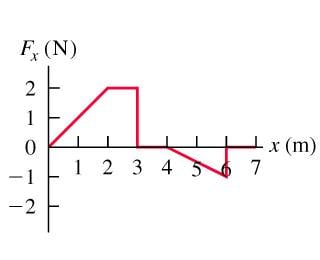
YF-06-32.jpg
2. Homework Equations

Kf-Ki
.5mvf2-.5mvi2
W=DeltaK
W=F*d

3. The Attempt at a Solution

3.0m
W=2N*3m=6J
W=.5(m)(v)2
v2=2W/m
v2=2(6J)/2.0kg
sqrt(6)=2.44m/s

4.0m
W=0N*4m=0J
W=.5(m)(v)2
v2=2W/m
v2=2(0J)/2.0kg
sqrt(0)=0m/s

7.0m
W=0N*4m=0J
W=.5(m)(v)2
v2=2W/m
v2=2(0J)/2.0kg
sqrt(0)=0m/s

Though it seems like the car slowing down there would still be work, so would the speed for both 4m and 7m both be 0m/s?
 
Last edited:
Physics news on Phys.org
3.0m
W=2N*3m=6J
W=.5(m)(v)2
v2=2W/m
v2=2(6J)/2.0kg
sqrt(6)=2.44m/s
--------------------------
that is wrong because W is the area under the curve so for a constant force the height is the same so it is a rectangle with the area F*x
but here it is not a constant force you should take the area of a triangle till x =2 and from 2 to 3 a rectangle
 

Similar threads

Replies
11
Views
3K
Replies
7
Views
2K
  • · Replies 16 ·
Replies
16
Views
1K
  • · Replies 9 ·
Replies
9
Views
4K
  • · Replies 2 ·
Replies
2
Views
1K
  • · Replies 9 ·
Replies
9
Views
2K
  • · Replies 12 ·
Replies
12
Views
3K
  • · Replies 2 ·
Replies
2
Views
3K
Replies
11
Views
3K
Replies
7
Views
2K