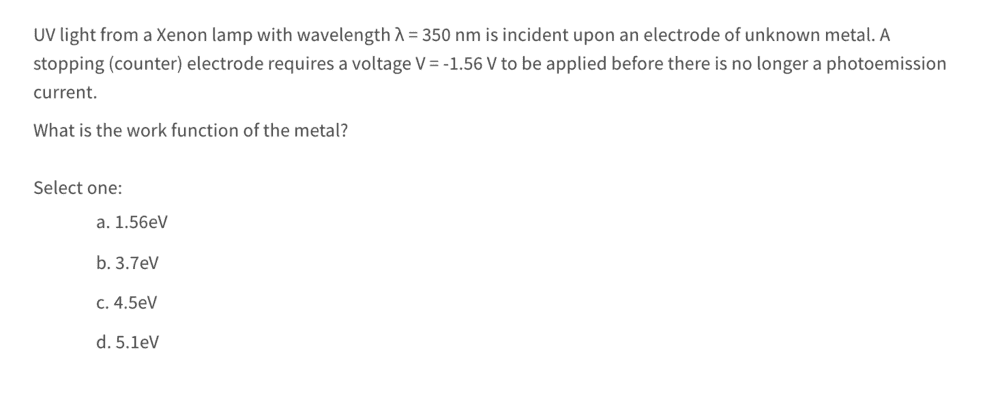
What is the work function of a metal?

Click For Summary

Homework Help Overview

The discussion revolves around calculating the work function of a metal, specifically in the context of photon energy and its relationship to applied voltage. Participants are exploring the implications of sign conventions in their calculations.

Discussion Character

  • Exploratory, Assumption checking, Conceptual clarification

Approaches and Questions Raised

  • Participants are questioning whether to consider the signs of values, such as the charge of an electron, in their calculations. There are attempts to relate photon energy to the work function and applied voltage, with some participants expressing confusion over their results compared to provided options.

Discussion Status

Some guidance has been offered regarding the importance of considering signs in calculations. Participants are actively discussing their results and expressing uncertainty about the correctness of their answers, indicating an ongoing exploration of the topic.

Contextual Notes

There is mention of specific energy values, such as 3.54 eV for photon energy, and concerns about the work function being less than this value. Participants are also noting discrepancies between their calculated work function values and the options available to them.

Bolter
Messages
262
Reaction score
31
Homework Statement
Calculate the metal's work function
Relevant Equations
See below
Question:

Screenshot 2020-03-08 at 14.22.59.png


I have tried this and got work function to e 5.1eV
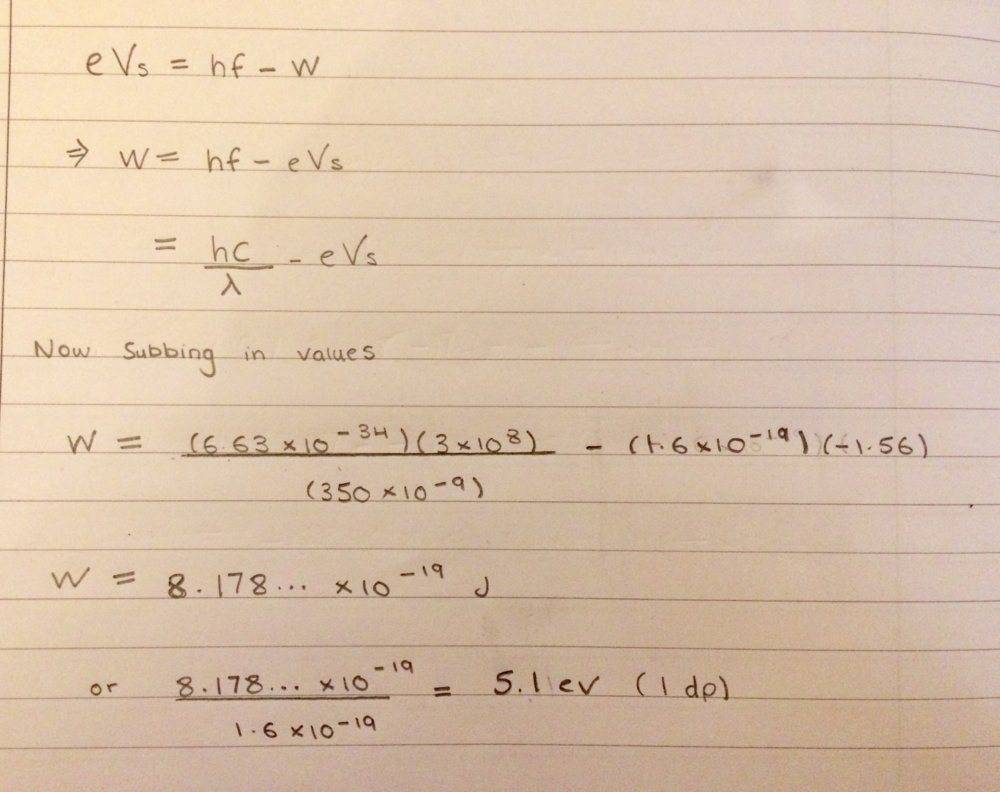
IMG_4062.jpg


My concern is that for these type of questions, do I need to take into account the signs of some values; such as the negative sign for the charge of an electron? Or could I just take the magnitude for all the values

Any help would be appreciated! Thanks
 
Physics news on Phys.org
Bolter said:
Homework Statement:: Calculate the metal's work function
Relevant Equations:: See below

Question:

View attachment 258343

I have tried this and got work function to e 5.1eV

View attachment 258344

My concern is that for these type of questions, do I need to take into account the signs of some values; such as the negative sign for the charge of an electron? Or could I just take the magnitude for all the values

Any help would be appreciated! Thanks
You do need to consider signs. But the easiest way to get it right is to use simple logic. You know that the photon energy is having to overcome both the work function and the applied voltage, so you can write |hf|=[V|+|W|.
 
It doesn't look like any of the possible answers is correct. The energy of the photon is 3.54 eV. If there is a photocurrent, the work function of the metal must be less than this.

You could save yourself a bit of time and reduce the chance of an error by spending a few minutes to learn to work with electron-volts instead of joules.
 
haruspex said:
You do need to consider signs. But the easiest way to get it right is to use simple logic. You know that the photon energy is having to overcome both the work function and the applied voltage, so you can write |hf|=[V|+|W|.

Ok noted. I’ll try to remember this the next time I stumble across a problem similar to this.

When I do use this, I get an answer of 1.99ev? Which doesn’t correlate to any of the options given to me :oldconfused:
 
vela said:
It doesn't look like any of the possible answers is correct. The energy of the photon is 3.54 eV. If there is a photocurrent, the work function of the metal must be less than this.

You could save yourself a bit of time and reduce the chance of an error by spending a few minutes to learn to work with electron-volts instead of joules.

Yep have given this a try when working with electron volts and I get a value of work function to be 1.99ev; which doesn’t match up to any of the options like you have mentioned earlier
 

Similar threads

  • · Replies 3 ·
Replies
3
Views
2K
Replies
21
Views
2K
  • · Replies 25 ·
Replies
25
Views
5K
Replies
3
Views
2K
Replies
6
Views
2K
Replies
6
Views
1K
  • · Replies 11 ·
Replies
11
Views
3K
  • · Replies 10 ·
Replies
10
Views
2K
Replies
3
Views
2K
Replies
2
Views
1K