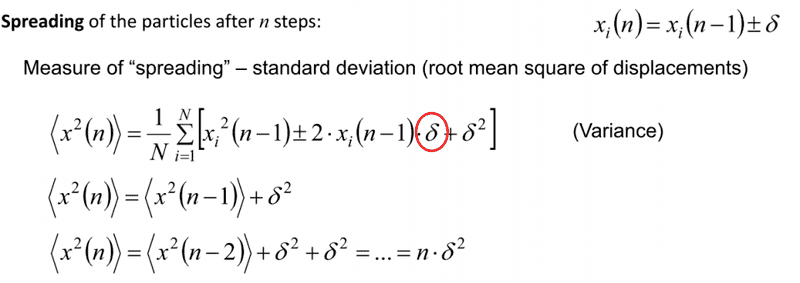
What kind of formula is this and how is it to be retraced?

  • Context: High School 
  • Thread starter Thread starter SansaStark
  • Start date Start date
  • Tags Tags
    Formula
Click For Summary
SUMMARY

The discussion centers on the mathematical principles behind random walk equations, specifically addressing the term "+-2*xi(n-1)*delta" and its cancellation in the context of average displacement. Participants confirm that the term cancels out due to the symmetry of positive and negative displacements, leading to an average of zero. The analogy to the formula (a+b)(a-b) is also explored, highlighting the cancellation of inner terms. Overall, the conversation clarifies the mechanics of random walk processes and their implications in mathematical modeling.

PREREQUISITES
  • Understanding of random walk theory
  • Basic algebraic manipulation
  • Familiarity with displacement concepts in physics
  • Knowledge of mathematical notation and terminology
NEXT STEPS
  • Research the mathematical foundations of random walk theory
  • Explore the implications of average displacement in stochastic processes
  • Study algebraic identities and their applications in probability
  • Learn about particle movement in random systems
USEFUL FOR

Students of mathematics, physicists, and anyone interested in stochastic processes and random walk theory will benefit from this discussion.
SansaStark
Messages
15
Reaction score
0
This is basic maths but I kind of forgot how to retrace such an equation.
My question is: why does "+-2*xi(n-1)*delta" which is in the middle of the first long equation cancle out? I'm thankful for an answer!
upload_2016-1-2_19-2-34.png
 
Mathematics news on Phys.org
The context is missing, but I'll guess that this is random walk?
For a random walk process, what do you think is the average displacement?
Another way to look at it would be to consider the \pm signs - how many particles do you think will move in the + direction and how many in the - direction?
 
Last edited:
Yeah, it is the random walk! :)
Do you mean that the middle part equals zero (all negatives and positive deltas are on average 0) and that's why it can be canceled out?
I thought it was some formula like (a+b)(a-b) where it's a²-ab+ab-b² where the inner parts just cancels out each other.
 

Similar threads

  • · Replies 12 ·
Replies
12
Views
3K
Replies
9
Views
3K
  • · Replies 7 ·
Replies
7
Views
3K
  • · Replies 10 ·
Replies
10
Views
2K
  • · Replies 22 ·
Replies
22
Views
2K
  • · Replies 13 ·
Replies
13
Views
3K
  • · Replies 7 ·
Replies
7
Views
3K
  • · Replies 5 ·
Replies
5
Views
2K
  • · Replies 44 ·
2
Replies
44
Views
5K
  • · Replies 10 ·
Replies
10
Views
3K