What Medium Does Light Travel Through in Space?

  • Context: High School 
  • Thread starter Thread starter rekha1804
  • Start date Start date
  • Tags Tags
    Light Medium Travel
Join the discussion
Registration is free. Ask a follow-up in this thread, or start your own.
103 replies · 4K views
rekha1804
Messages
1
Reaction score
0
What is the difference between space and vacuum?
Since light waves require a medium to travel, then what is the medium in space?
 
Reply
  • Sad
Likes   Reactions: davenn
Astronomy news on Phys.org
rekha1804 said:
Since light waves require a medium to travel,
They don't. Discovering that there's no evidence of a medium was a large part of the work that led to relativity theory.
 
Reply
  • Like
Likes   Reactions: pinball1970, bhobba, Matterwave and 6 others
rekha1804 said:
What is the difference between space and vacuum?
Empty space is a vacuum. Interstellar and intergalactic space are almost empty, but not quite.
 
Reply
  • Like
Likes   Reactions: pinball1970, bhobba and ohwilleke
rekha1804 said:
Since light waves require a medium to travel
This is a faulty assumption and you would do well to get rid of it.
 
Reply
  • Like
Likes   Reactions: AlexB23, pinball1970, bhobba and 4 others
I realize this post is a few years old, but I had a follow-up question.

But first I should say that I'm aware of, understand, and fully accept the null result of the Michelson and Morley experiment that did away with the notion of the luminiferous aether.

However, what then is the source of the electric permittivity (ε₀) and magnetic permeability (μ₀) of free space (i.e. the vacuum)? To my knowledge these measure the extent to which an EM field will 'polarize' the vacuum. However, perhaps these constants correspond to the extent to which propagating light can polarize the EM fields *in* space rather than space itself?

But irrespective of which is true, must there not be *something* through which light propagates given the existence of these two constants? Or to put it another way, if the vacuum of space has these two real, measurable properties associated with it, does that not mean that space must also be something physically real?
 
Last edited:
GRQFT said:
However, what then is the source of the electric permittivity (ε₀) and magnetic permeability (μ₀) of free space (i.e. the vacuum)?
Those are just artifacts of the SI units. They are not part of nature. They don’t even exist in some other unit systems.

GRQFT said:
Or to put it another way, if the vacuum of space has these two real, measurable properties associated with it, does that not mean that space must also be something physically real?
Space is clearly physical, but not because of some unit specific constants. Space, or more precisely, spacetime is the geometry of physics. It does not need to be assigned any material properties to be physical.
 
Reply
  • Like
  • Informative
Likes   Reactions: Klystron, Lord Jestocost, javisot and 3 others
Dale said:
Those are just artifacts of the SI units. They are not part of nature. They don’t even exist in some other unit systems.

Space is clearly physical, but not because of some unit specific constants. Space, or more precisely, spacetime is the geometry of physics. It does not need to be assigned any material properties to be physical.
So then I guess you would disagree with the claims made in this paper?
 
GRQFT said:
So then I guess you would disagree with the claims made in this paper?
I disagree with many claims in any MDPI journal. They are, in my opinion, a predatory publisher with unethical practices.

If you wish to identify a specific claim then I can respond specifically.
 
Reply
  • Like
Likes   Reactions: PeroK and bhobba
Okay, let's put that paper aside for now and try this one instead which makes a similar argument, namely: vacuum fluctuations determine the vacuum permittivity ε₀.

Below is a quick cut-and-paste synopsis.

1786672645516.webp


... then a whole bunch of calculations to arrive at:

1786672726514.webp


... and then:

1786672245997.webp


The last sentence immediately above is key.

The bottom line here, as I understand it, is that ε₀ is a manifestation of vacuum fluctuations, and not just an "artifact". Therefore, ε₀ *is* a part of nature because it has an underlying physical basis. Thoughts?
 

Attachments

  • 1786672109571.webp
    1786672109571.webp
    2.1 KB · Views: 1
Reply
  • Like
Likes   Reactions: Dale
There is what is called the quantum EM field that permeates all space. Heuristically (i.e., not true but adds some intuition), a photon is like a disturbance in that field. That disturbance could act like a particle, or spread out, like a wave. There is no wave-particle duality - only different types of disturbances. Moreover, this field is nothing like a medium here in the classical world. Also, photons do not actually have a position (strange, hey?).

I could provide a link with details on all this, but it is well above HS level. For now, just accept it is all rather strange.

Thanks
Bill
 
Last edited:
Reply
  • Like
Likes   Reactions: weirdoguy
The whole issue of virtual particles and vacuum fluctuations being real is complicated, with many experts (including me, not that I am an expert) thinking they are mathematical fictions:
https://arnold-neumaier.at/physfaq/topics/unstable.html

I do not understand how those at the HS level can study papers that use concepts at the advanced graduate level. It's OK to read them and get a general gist, but I would leave the details until you are more advanced.

Of course you can ask about those details here, but the answer may not satisfy your curiosity.

Thanks
Bill
 
Last edited:
Reply
  • Like
Likes   Reactions: weirdoguy
bhobba said:
There is what is called the quantum EM field that permeates all space. Heuristically (i.e., not true but adds some intuition), a photon is like a disturbance in that field. That disturbance could act like a particle, or spread out, like a wave. There is no wave-particle duality - only different types of disturbances.
Right. That's what I was referring to when I said that "...perhaps these constants correspond to the extent to which propagating light can polarize the EM fields *in* space rather than space itself..."

bhobba said:
Moreover, this field is nothing like the media here in the classical world.
Well, yes, in a strict sense QED is what mediates the propagation of light while QCD mediates classic world media (hadronic/baryonic matter). But in a broader sense, *both* are quantum fields so I'm not sure if I fully understand your point. Perhaps you were making a macroscopic (water waves, sound waves in air, etc.) vs atomic/subatomic level distinction? That makes sense.
 
Last edited:
GRQFT said:
vacuum fluctuations determine the vacuum permittivity ε₀. … then a whole bunch of calculations
Note that their calculations all assume SI units and SI equations. So it is not merely “vacuum fluctuations” -> “vacuum permittivity”. It is “vacuum fluctuations + SI” -> “vacuum permittivity”. You can certainly do QFT in non-SI units. So using SI is an additional assumption. It is only with that additional assumption that the implication follows.

So again, those are just artifacts of the SI units. They are not part of nature.
 
Reply
  • Like
Likes   Reactions: bhobba
bhobba said:
The whole issue of virtual particles and vacuum fluctuations being real is complicated, with many experts (including me, not that I am an expert) thinking they are mathematical fictions:
https://arnold-neumaier.at/physfaq/topics/unstable.html
Okay, I'll read what you referred to, but what about the Casimir effect, the Lamb shift, spontaneous emission, etc.? Surely these are real, yes?
 
Dale said:
Note that their calculations all assume SI units and SI equations. So it is not merely “vacuum fluctuations” -> “vacuum permittivity”. It is “vacuum fluctuations + SI” -> “vacuum permittivity”. You can certainly do QFT in non-SI units. So using SI is an additional assumption. It is only with that additional assumption that the implication follows.

So again, those are just artifacts of the SI units. They are not part of nature.
Okay, I'll have to think about what you said.

But I'm curious what you think about c = 1/√(ε₀μ₀). Are you saying that we should not attach *any* physical interpretation to that equation? I've always thought of it as a relationship between physical properties of a medium (the vacuum of space, or maybe QED fields in space) and the speed of light propagating through it. Is that not correct?
 
What do you think? Can a true “physical property of the vacuum” be something that doesn’t even exist in some units? Can a true “physical property of the vacuum” be something that can be set by an arbitrary human convention, or changed by a committee?
 
Reply
  • Like
Likes   Reactions: bhobba
Dale said:
What do you think? Can a true “physical property of the vacuum” be something that doesn’t even exist in some units? Can a true “physical property of the vacuum” be something that can be set by an arbitrary human convention, or changed by a committee?
Okay. So what then determines the speed of light in a vacuum (or in any medium for that matter)?
 
GRQFT said:
So what then determines the speed of light in a vacuum (or in any medium for that matter)?
Nothing! It's a postulate (but well-founded on empirical evidence!) that our (local) universe is a 4D Minkowski spacetime with an inherent limiting velocity ##c## (which can be set to 1 in appropriate units) that converts units of time-interval to units of space-interval. The specific numerical value ##c## takes in any particular set of human-created units of time and length is irrelevant to fundamental physics. That's why QED most often uses "natural units" where ##\hbar=c=1\,##, leaving that theory with only two parameters to be empirically determined: the dimensionful electron mass ##m_e## (units of energy) and the dimensionless electron charge ##e=\sqrt{4\pi\alpha}\,##, where ##\alpha## is the fine-structure constant. Other dimensionful constants like ##\epsilon_0,\mu_0,Z_0## were created merely to facilitate various practical endeavors by humans in laboratories and in engineering.
 
Last edited:
Reply
  • Like
Likes   Reactions: bhobba, javisot and GRQFT
renormalize said:
Nothing! It's a postulate (based on empirical evidence!) that our (local) universe is a 4D Minkowski spacetime with an inherent limiting velocity ##c## (which can be set to 1 in appropriate units) that converts units of time-interval to units of space-interval. The specific numerical value ##c## takes in any particular set of human-created units of time and length is irrelevant to fundamental physics. That's why QED most often uses "natural units" where ##\hbar=c=1\,##, leaving that theory with only two parameters to be empirically determined: the dimensionful electron mass ##m_e## (units of energy) and the dimensionless electron charge ##e=\sqrt{4\pi\alpha}\,##, where ##\alpha## is the fine-structure constant. Other dimensionful constants like ##\epsilon_0,\mu_0,Z_0## were created merely to facilitate various practical endeavors by humans in laboratories and in engineering.
Thanks. This a nice summary of ideas that I'm aware of but have not fully accepted.

The speed of light (or more appropriately the speed of causality) may be an inherent limiting velocity of our 4D Minkowski spacetime, but it's also a specific value. Why is it not 5% faster or 20% slower? Is it unreasonable to wonder what properties of our universe causes light, gluons, and gravitational waves to all propagate at this specific speed?

To be clear, this is *not* a question about why c is always measured with the same value (and postulated by Einstein as such in Special Relativity), but rather why it's always measured at its specific value as opposed to a different one.
 
GRQFT said:
The speed of light (or more appropriately the speed of causality) may be an inherent limiting velocity of our 4D Minkowski spacetime, but it's also a specific value. Why is it not 5% faster or 20% slower?
...
To be clear, this is *not* a question about why c is always measured with the same value (and postulated by Einstein as such in Special Relativity), but rather why it's always measured at its specific value as opposed to a different one.
It's because ##c## is an inherent fixed characteristic of the geometry of 4D Minkowski spacetime. Consider this 3D spatial analogy: you stand on a flat 2D plane and decide to measure the angle ##\theta_{\bot}## of "straight up", the direction perpendicular to the plane. Depending on the units of measurement you use, you'd find the value ##\pi/2## radians or ##90## degrees or ##100## gradians, etc. Or you could just define "natural angle units" where ##\theta_{\bot}=1##. So just like ##c## you always get the "same value" for ##\theta_{\bot}## but the specific numerical value depends on your choice of units. Would you ask why "straight up" can't be 5% more than ##\pi/2## or 20% less than ##90°##?
Added to belabor the analogy:
##c## = maximum velocity in 4D Minkowski spacetime##\,\Longleftrightarrow\,####\theta_{\bot}## = maximum elevation angle above the horizontal in 3D Euclidean space
 
Last edited:
Reply
  • Like
Likes   Reactions: bhobba, Bandersnatch and javisot
renormalize said:
It's because ##c## is an inherent fixed characteristic of the geometry of 4D Minkowski spacetime. Consider this 3D spatial analogy: you stand on a flat 2D plane and decide to measure the angle ##\theta_{\bot}## of "straight up", the direction perpendicular to the plane. Depending on the units of measurement you use, you'd find the values ##\pi/2## radians or ##90## degrees or ##100## gradians, etc. Or you could just define "natural angle units" where ##\theta_{\bot}=1##. So just like ##c## you always get the "same value" for ##\theta_{\bot}## but the specific numerical value depends on your choice of units. Would you ask why "straight up" can't be 5% more than ##\pi/2## or 20% less than ##90°##?
Added to belabor the analogy:
##c## = maximum velocity in 4D Minkowski spacetime##\,\Longleftrightarrow\,####90°## = maximum angle above the horizontal in 3D Euclidean space
Okay, this is a *very* useful analogy. So let's go through it carefully.

However, first I just want to mention that the words "inherent fixed characteristic" (of the geometry of 4D Minkowski spacetime) are a black box. They have no explanatory value, just like the input-output mapping of an artificial neural network that perfectly reproduces an aspect of human behavior but fails to explicate the inner computations involved.

Okay, on to your analogy.

First, in your analogy, you have *chosen* "straight up", and so, no, I would not ask the same questions I asked before. However, in contrast, c was *given* to us by whatever created our universe.

Second, c is a fundamental constant of nature that appears in *numerous* important equations. Indeed, there are so many instances of c in physics that I actually get nervous when I come across an equation that doesn't contain it! Your choice of "straight up", in contrast, is completely arbitrary and thus not fundamental at all.

Third, and crucially, there are an infinite number of directions that you could have chosen (all of which are arbitrary) but only *one* c. And that is the essence of my point. Nature gave us a *specific* value for this promiscuous little constant that has found it's way into so many fundamental equations. As such I would argue that understanding it's physical origin would be quite valuable.
 
GRQFT said:
Third, and crucially, there are an infinite number of directions that you could have chosen (all of which are arbitrary) but only *one* c. And that is the essence of my point. Nature gave us a *specific* value for this promiscuous little constant that has found it's way into so many fundamental equations. As such I would argue that understanding it's physical origin would be quite valuable.
Nope, there is only one, unique maximum elevation angle in 3D geometry, namely ##\theta_{\bot}\,##, just like there's only one ##c##. The analogy ##c \Longleftrightarrow \theta_{\bot}## is one-to-one.
 
Reply
  • Like
Likes   Reactions: bhobba
renormalize said:
Nope, there is only one, unique maximum elevation angle in 3D geometry, namely ##\theta_{\bot}\,##, just like there's only one ##c##. The analogy ##c \Longleftrightarrow \theta_{\bot}## is one-to-one.
Yes, of course there is only one perpendicular angle. That was not my point. What I was arguing is that there are an infinite number of angles to choose from within the 2pi range. In contrast, there is only one c. I could easily choose 180 degrees and argue a one-to-one mapping with c. Or 54 degrees or 235.8765. Right? There's nothing special about *any* of these infinite number of angles. But there's just one speed of causality. It was given to us by nature, it's fundamental, and it's ubiquitous. Certainly you can see the difference.
 
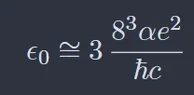
The vacuum permittivity is a measurable quantity, which depends on the fine structure constant ##\alpha##:
##\varepsilon _{0}={\frac {e^{2}}{2\alpha hc}}##
The other values in this equation, ##e##, ##h## and ##c##, are exactly defined constants since the 2019 revision of the SI unit system.

Once ##\varepsilon _{0}## is measured, ##\mu _{0}## follows automatically (or vice versa).

Source:
https://en.wikipedia.org/wiki/Vacuum_permittivity#Revision_of_the_SI
 
Reply
  • Like
Likes   Reactions: GRQFT, Lord Jestocost and Dale
GRQFT said:
Okay. So what then determines the speed of light in a vacuum (or in any medium for that matter)?
The invariant speed is determined by the geometry of spacetime. The speed of light is determined by the fact that the photon is massless.

GRQFT said:
To be clear, this is *not* a question about why c is always measured with the same value (and postulated by Einstein as such in Special Relativity), but rather why it's always measured at its specific value as opposed to a different one.
That goes back to units again. In other units it is measured to be a different value.

What is physically more interesting is the dimensionless ratio of c to other speeds. That usually comes down to the fine structure constant or some of the other dimensionless coupling constants.
 
Reply
  • Like
Likes   Reactions: GRQFT
GRQFT said:
c is a fundamental constant of nature that appears in *numerous* important equations.
In SI units it does show up in numerous important equations. But in each of those important equations I could get rid of c by changing units, eg to geometrized units. Or the BIPM committee could get rid of c in all those important equations even in SI units simply by voting to do so.

Is something that can disappear by personal choice or by a committee vote really a “fundamental” thing?

GRQFT said:
Nature gave us a *specific* value for this promiscuous little constant that has found it's way into so many fundamental equations. As such I would argue that understanding it's physical origin would be quite valuable.
This is not true of c. It is true of the fine structure constant.
 
Reply
  • Like
Likes   Reactions: GRQFT
Maybe to clarify a bit, we can step back.

There are constants of the universe which we do not know how to explain. They are called "fundamental" constants in our current theories. The fine structure constant, which has been mentioned several times, is one of them. But there are quite a few more. These constants we simply observe via experiments and plug them into our theories. Asking why these constants take the numbers they do is beyond our current theories. It doesn't mean they will always be beyond theoretical explanation, but they are beyond current theoretical explanation.

The speed of light is not one of these constants. Its value, as others already commented, is a unit convention. If one demands an explanation for the particular value of the speed of light, one gets only answers based on unit convention.

The fact of nature that the speed of light points to, as others and indeed you yourself have mentioned, is the geometry of spacetime. The fact that we live in a world well modeled by a spacetime with Lorentzian signature means c serves as a "conversion factor" between space and time.

To do actual physics involving space and time and speeds we "have to choose some units". Ignoring other parts of physics for now, one at least has to choose a unit for measuring time and one for measuring space. Once those units are chosen, c is just how we convert between them. Exactly how these units are chosen is arbitrary, but we do have to choose units. For example, if we chose Planck units, c becomes 1.
 
Reply
  • Like
Likes   Reactions: GRQFT, berkeman and Dale
Dale said:
The invariant speed is determined by the geometry of spacetime.

So, presumably we can obtain a value for c from GR. Do you happen to know the relevant equation?

Dale said:
The speed of light is determined by the fact that the photon is massless.

And so how would we calculate c by this approach?
 
GRQFT said:
So, presumably we can obtain a value for c from GR. Do you happen to know the relevant equation?
In SR the invariant speed is finite.

The value of ##c## is defined by the SI definition of "1 meter".
https://en.wikipedia.org/wiki/Metre

GRQFT said:
And so how would we calculate c by this approach?

##0={E \over c^2} \sqrt{1 - v^2/c^2} \Rightarrow v=c##
 
Reply
  • Like
Likes   Reactions: bhobba