What Surprising Discoveries Can Be Made from Decapsulating Phone Chips?

  • Thread starter Thread starter Andy Resnick
  • Start date Start date
Click For Summary

Discussion Overview

The discussion revolves around the identification and analysis of components found in decapsulated phone chips, particularly focusing on various integrated circuits (ICs) and their substrates. Participants explore the characteristics and potential functions of these components, including thin-film circuits and silicon blocks, while sharing insights and suggestions for further investigation.

Discussion Character

  • Exploratory
  • Technical explanation
  • Debate/contested

Main Points Raised

  • One participant describes their experience decapsulating chips and finding complex circuits on substrates that may be quartz or sapphire, seeking help in identifying these components.
  • Another participant suggests that some of the circuits might be RF-related and speculates about the nature of the first circuit, likening it to an ASIC.
  • A different participant provides various hypotheses about the components based on their observations, suggesting possibilities such as a RISC processor core, direct digital synthesizer, and RF front end, while noting the difficulty in identifying them without clearer markings.
  • One participant emphasizes the importance of numbering the photos for clarity and offers their guesses about specific components, including a T/R switch and a CPU.
  • Another participant suggests that many IC datasheets can be found online, indicating a potential resource for further identification.
  • One participant shares images of a MEMS gyro, indicating a separate but related topic of interest.

Areas of Agreement / Disagreement

Participants express a range of hypotheses and guesses about the components, but there is no consensus on their exact identities or functions. Multiple competing views and interpretations are present throughout the discussion.

Contextual Notes

Some participants note the difficulty in identifying components due to the lack of clear markings and the need for additional photographic details. There are also suggestions for chemical tests and measurements that could aid in analysis, indicating limitations in the current understanding.

Who May Find This Useful

Individuals interested in electronics, integrated circuit design, and decapsulation techniques may find this discussion relevant, particularly those exploring the identification of components in mobile technology.

Andy Resnick
Science Advisor
Education Advisor
Insights Author
Messages
7,754
Reaction score
3,991
During winter, when I can't take pictures of the stars, I tend to take pictures of decapsulated computer chips. As my technique improves, I'm able to find things that had been destroyed in earlier attempts- for example, I can now decapsulate MEMS devices leaving intact the suspended Si membrane, which makes for some good in-class discussions. Most recently, while processing an old iPhone, I've uncovered a bunch of 'things' that I hope PF-ers here can help identify.

First up are small ICs that seem to be printed as thin films on quartz or sapphire- not sure which:
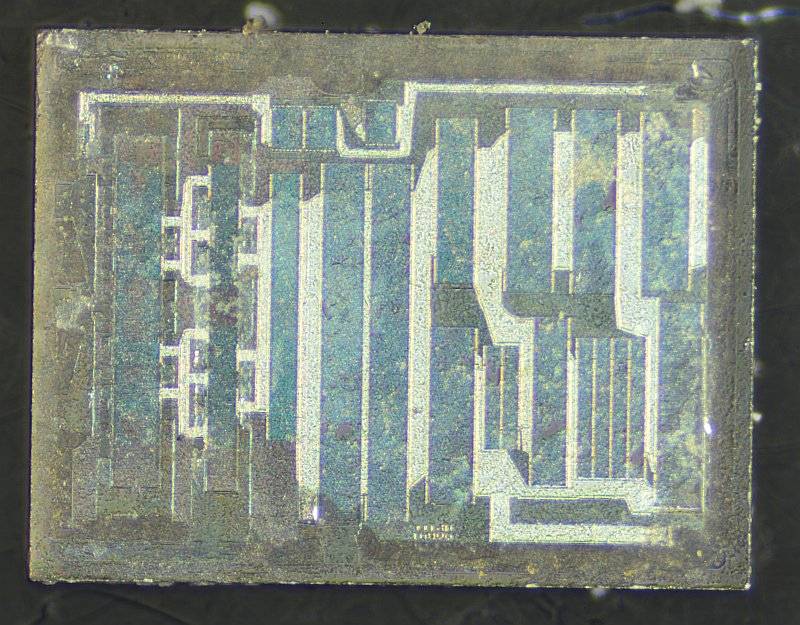
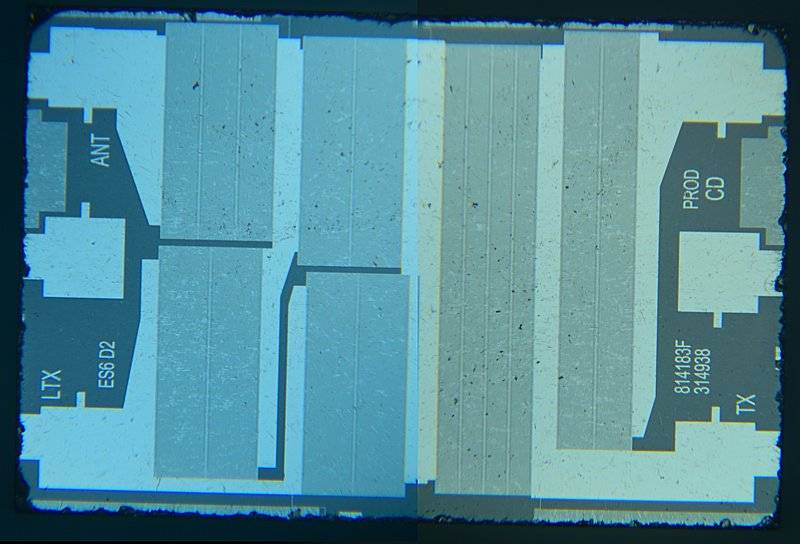
c447edfc-6a3e-4d7a-8230-1ce3372dcf3e-original.jpg


76d71adf-4741-4bec-b8a9-d8704beb1e6f-original.jpg


Some of these circuits are fairly complex:

e97f171a-5e84-45b0-8c27-217620400c98-original.jpg


Does anyone know what the substrate material is and what the function of these circuits are? They are typically located within ceramic enclosures.

Next are small blocks of Si (again, located within ceramic enclosures) that have Au traces on them, and there seems to be a thin film between the traces and the Si. Not sure what these are for:

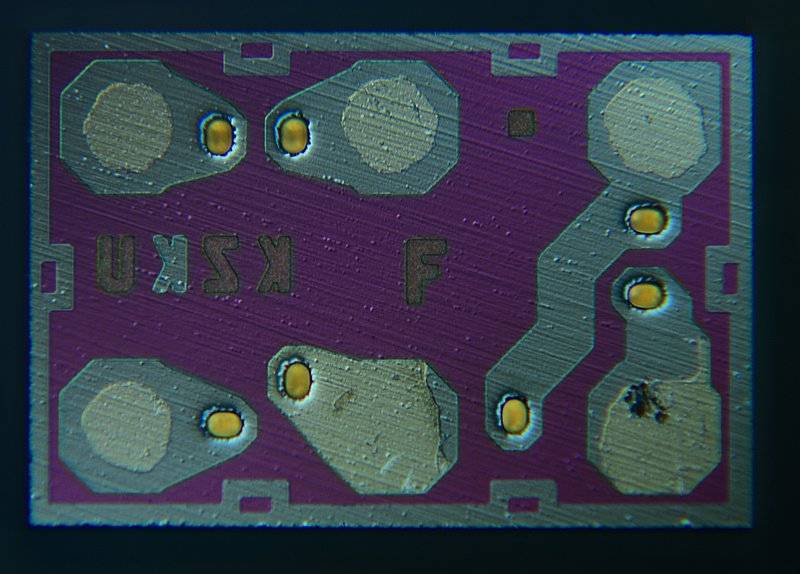
4a7e4662-614a-4cb4-9344-c90f3c94ec57-original.jpg


d09ecda5-2717-46f1-bb11-1de8fbb290e5-original.jpg


The traces came off of these during the final Nitric Acid wash.

Last are some more complex thin-film circuits, and again the substrate is not Si (maybe Ge?). These are incredibly fragile and little bits regularly break off whenever I try to handle them:
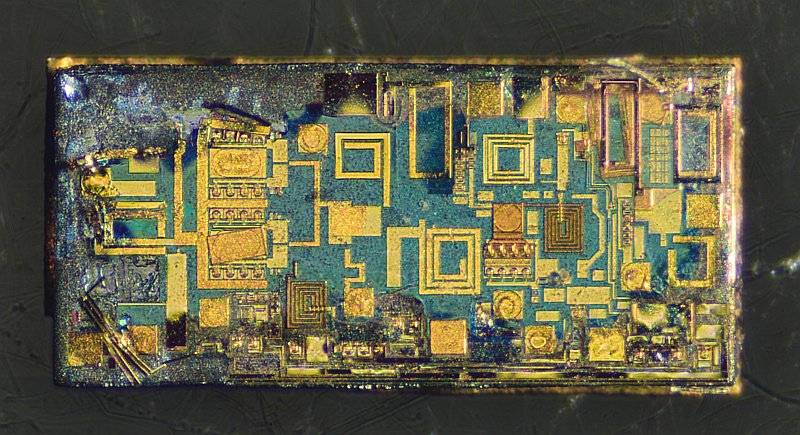
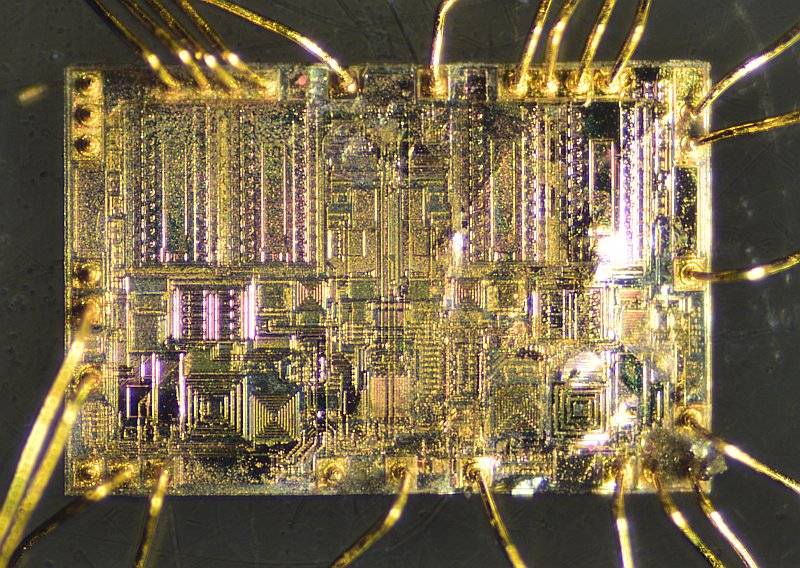
b4e23cdb-f135-4de0-823a-da69a13bfb7c-original.jpg


b8f18b76-3b5d-49b0-ab0f-c76d65632597-original.jpg


Any info/guidance about these would be most appreciated! Thanks in advance...
 

Attachments

  • c447edfc-6a3e-4d7a-8230-1ce3372dcf3e-original.jpg
    c447edfc-6a3e-4d7a-8230-1ce3372dcf3e-original.jpg
    108.5 KB · Views: 619
  • 76d71adf-4741-4bec-b8a9-d8704beb1e6f-original.jpg
    76d71adf-4741-4bec-b8a9-d8704beb1e6f-original.jpg
    52.6 KB · Views: 481
  • e97f171a-5e84-45b0-8c27-217620400c98-original.jpg
    e97f171a-5e84-45b0-8c27-217620400c98-original.jpg
    130.3 KB · Views: 601
  • 4a7e4662-614a-4cb4-9344-c90f3c94ec57-original.jpg
    4a7e4662-614a-4cb4-9344-c90f3c94ec57-original.jpg
    87.7 KB · Views: 449
  • d09ecda5-2717-46f1-bb11-1de8fbb290e5-original.jpg
    d09ecda5-2717-46f1-bb11-1de8fbb290e5-original.jpg
    61.4 KB · Views: 467
  • b4e23cdb-f135-4de0-823a-da69a13bfb7c-original.jpg
    b4e23cdb-f135-4de0-823a-da69a13bfb7c-original.jpg
    89.4 KB · Views: 555
  • b8f18b76-3b5d-49b0-ab0f-c76d65632597-original.jpg
    b8f18b76-3b5d-49b0-ab0f-c76d65632597-original.jpg
    121.6 KB · Views: 532
  • Like
Likes   Reactions: davenn, AlexCaledin, artis and 4 others
Engineering news on Phys.org
I have no idea what they are. Some look like RF.

The top one is cool though, it almost looks like some kind of ASIC, love what I can only assume are data busses fanning out between who knows what they do blocks!
 
  • Like
Likes   Reactions: Andy Resnick
Andy Resnick said:
Any info/guidance about these would be most appreciated! Thanks in advance...
It would help if you photographed the chip markings and terminals before disassembly, and provided a scale on the photos.
You have asked too many unnumbered questions.

The analysis of the substrate is difficult but you might be able to do a chemical spot test, or analyse / recognise the flame spectrum colour when it is burnt, maybe by an electric arc. You could measure a PN junction voltage, with a fragment in a curve tracer, like in a crystal set receiver.

Picture 1. Looks a bit like a RISC processor core, but with few control circuits, so I guess is probably a direct digital synthesizer. Digital inputs on the left, phase accumulator in the middle, then IQ, sine and cosine DACs on the right.
Picture 2. Could be huge arrays of small output transistors in parallel.
Picture 3. Too many possibilities. Hard to identify the terminals and connection points.
Pictures 4, 5. Maybe mosfet transistors.
Picture 6. Clearly an RF front end. Probably an IQ mixer. Built from tuned transmission lines above a ground plane, with transistors and mixer diodes.
Picture 7. The square spirals are inductors so it is an RF wireless interface. Maybe with arrays of RF transistors.
 
  • Like
Likes   Reactions: davenn, tech99 and Andy Resnick
PLEASE, number at least the photos.

My guesses, for whatever they're worth.
Picture 2: Possibly a T/R Switch
Picture 3: A CPU
Picture 6: Now that @Baluncore mentions it, yeah, it fits
Picture 7: Agree again that the lower half is RF. The upper half could be Encoder/Decoder for the modulation. The two busses of 4 wires each at the top edge would be either Power/Ground, or RF output. (IIRC, Phones these days have multi-band capability.)
 
Andy Resnick said:
Any info/guidance about these would be most appreciated! Thanks in advance...
Baluncore said:
It would help if you photographed the chip markings and terminals before disassembly, and provided a scale on the photos.

This, above all else, would have been great

Many IC datasheets can be found by simple googling the part number :smile:D
 
Don't know where else to post these images of the MEMS gyro:

613dfca6-f243-4df4-8de9-087051045bb5-original.jpg


5d10fb9d-6ca0-4cc7-8d93-e49bfe030a36-original.jpg
 

Attachments

  • 613dfca6-f243-4df4-8de9-087051045bb5-original.jpg
    613dfca6-f243-4df4-8de9-087051045bb5-original.jpg
    141.2 KB · Views: 407
  • 5d10fb9d-6ca0-4cc7-8d93-e49bfe030a36-original.jpg
    5d10fb9d-6ca0-4cc7-8d93-e49bfe030a36-original.jpg
    64.8 KB · Views: 423
  • Like
Likes   Reactions: davenn
amazing technology :)