SUMMARY
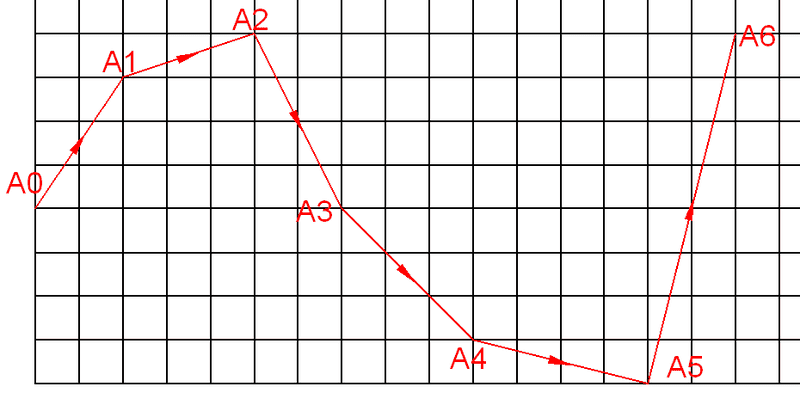
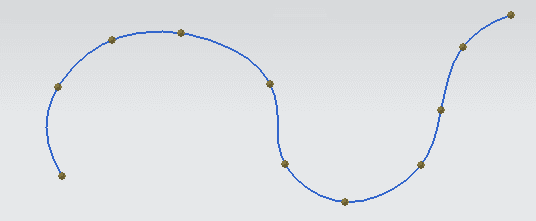
The discussion centers on the construction of curves using sequential control points, specifically identifying Bezier curves and splines. A Bezier curve is defined by points A0, A3, with A1-A2 and A4-A5 serving as control points. In contrast, a spline is formed by connecting points A0 through A6, incorporating A1, A2, A4, and A5 as intermediate control points. The fitting of splines typically requires solving a band-diagonal system of equations and involves calculus concepts. Tools like gnuplot are recommended for spline fitting.
PREREQUISITES
- Understanding of Bezier curves and their control points
- Familiarity with spline theory and types, particularly cubic splines
- Basic knowledge of solving band-diagonal systems of equations
- Proficiency in using gnuplot for data visualization and curve fitting
NEXT STEPS
- Research cubic spline interpolation techniques and their applications
- Explore libraries for spline fitting, such as SciPy in Python
- Learn about the mathematical foundations of Bezier curves and their equations
- Investigate advanced features of gnuplot for curve fitting and data analysis
USEFUL FOR
This discussion is beneficial for mathematicians, software developers, and engineers involved in computer graphics, data visualization, and numerical analysis, particularly those working with curve fitting and interpolation techniques.