What Variables Must X̅ Have in Order to be Considered a Partial Molar Quantity?

  • Thread starter Thread starter physicisttobe
  • Start date Start date
  • Tags Tags
    Partial quantities
Click For Summary

Homework Help Overview

The discussion centers around the concept of partial molar quantities in thermodynamics, specifically focusing on their definitions and the types of variables associated with them. Participants are exploring the characteristics of partial molar properties, particularly in relation to extensive and intensive variables.

Discussion Character

  • Conceptual clarification, Assumption checking

Approaches and Questions Raised

  • Participants are attempting to define partial molar quantities and question what types of variables must be associated with them. There is a focus on understanding the distinction between extensive and intensive properties, as well as the implications of these definitions in the context of chemical systems.

Discussion Status

The discussion is ongoing, with participants seeking clarification on the nature of partial molar quantities and their associated variables. Some have provided definitions and examples, while others express confusion and request further explanation. Multiple interpretations of the question are being explored, indicating a productive dialogue.

Contextual Notes

Participants are navigating the complexities of thermodynamic definitions and properties, with specific reference to the phase rule and the requirements for specifying a system at equilibrium. There is mention of relevant equations and properties that may influence the understanding of partial molar quantities.

physicisttobe
Messages
56
Reaction score
13
Homework Statement
partial molar quantities
Relevant Equations
...
Hi everyone!

It's about the following task.

Partial molar quantities
a) How are partial molar quantities defined in general?
b) If X is an extensive state variable and X̅ is the associated partial variable, what types of variables must X̅ have?
c) Is the chemical potential of component i in a mixture a partial molar quantity? Why?
d) Is the chemical potential of component i in a mixture a partial molar quantity? Why? Justification?

I have some difficulties in answering some questions, especially the question b) If X is an extensive state variable and X̅ is the associated partial variable, what types of variables must X̅ have?
Unfortunately, I don't have a clue how to answer it. I only know that partial molar quantities are intensive variables like pressure, temperature and so on. But what types of variables must X̅ have? Can you explain me that please?
 
Physics news on Phys.org
physicisttobe said:
Homework Statement: partial molar quantities
Relevant Equations: ...

Hi everyone!

It's about the following task.

Partial molar quantities
Partial molar properties apply to solid, liquid, and gaseous solutions of chemical constituents.

physicisttobe said:
a) How are partial molar quantities defined in general?
A partial molar property for species "i" is defined as $$\bar{X}_i=\left(\frac{\partial X}{\partial n_i}\right)_{T,P,n_j,\ all\ j\neq i}$$where the n's are numbers of moles of the various species in the solution.

physicisttobe said:
b) If X is an extensive state variable and X̅ is the associated partial variable, what types of variables must X̅ have?
##\bar{X}_i## is an intensive property that depends on T, P, and the mole fractions of all chemical constituents
physicisttobe said:
c) Is the chemical potential of component i in a mixture a partial molar quantity? Why?
The partial molar Gibbs free energy of a chemical species is defined as its chemical potential.
 
@Chestermiller, thank you so much for your reply. So the answer to that question "If X is an extensive state variable and X̅ is the associated partial variable, what types of variables must X̅ have" is: the variables are T,p, and the mole fraction ni because they are all intensive?
 
And I noticed that I forgot to post all the relevant equations for that task.
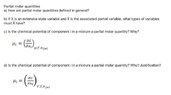
The complete task looks like this (see below).
The question d) is false because V and S are not constant, they are not intensive, V and S are extensive properties. Therefore, they can not be considered as constant. Is my consideration correct?
 

Attachments

  • 69A65A40-C4D2-43CD-8703-CA4F9741F777.jpeg
    69A65A40-C4D2-43CD-8703-CA4F9741F777.jpeg
    28.2 KB · Views: 134
physicisttobe said:
@Chestermiller, thank you so much for your reply. So the answer to that question "If X is an extensive state variable and X̅ is the associated partial variable, what types of variables must X̅ have" is: the variables are T,p, and the mole fraction ni because they are all intensive?
I don't quite understand this question. Can you rephrase it? The phase rule tells us that for a single phase system containing N chemical components, the number of intensive variables required to specify the system at chemical equilibrium is N +1: T, P, and N-1 mole fractions.
 
The question is: If X is an extensive state quantity and X̅ is the associated partial quantity, what types of variables must X̅ have?
I think we should explain the properties of partial molar quantities. Which characteristics do they have? We shoul count the different variables of these partial quantities.
 
physicisttobe said:
And I noticed that I forgot to post all the relevant equations for that task.
The complete task looks like this (see below).
The question d) is false because V and S are not constant, they are not intensive, V and S are extensive properties. Therefore, they can not be considered as constant. Is my consideration correct?
Consider this. The definition of G is $$G=U+PV-TS$$So we have $$dG=dU+PdV+VdP-TdS-SdT$$In addition, we have: $$dG=-SdT+VdP+\sum{\mu_i dn_i}$$What do you get if you eliminate dG from these equations and solve for dU?
 
  • Like
Likes   Reactions: Lord Jestocost
I think dU= TdS - PdV + sum of ... dni ?
But what does that equation have to do with the question above? Should we not explain what types of variables X̅ must have? Please apologize, I'm a lil bit confused.
 
physicisttobe said:
I think dU= TdS - PdV + sum of ... dni ?
But what does that equation have to do with the question above? Should we not explain what types of variables X̅ must have? Please apologize, I'm a lil bit confused.
Sorry. I have no idea what "what types of variables X̅ must have" means. Can you provide an example of what you mean.
 

Similar threads

  • · Replies 9 ·
Replies
9
Views
2K
  • · Replies 4 ·
Replies
4
Views
4K
  • · Replies 2 ·
Replies
2
Views
2K
  • · Replies 2 ·
Replies
2
Views
2K
Replies
8
Views
1K
Replies
5
Views
4K
  • · Replies 4 ·
Replies
4
Views
2K
  • · Replies 4 ·
Replies
4
Views
4K
  • · Replies 14 ·
Replies
14
Views
2K
  • · Replies 9 ·
Replies
9
Views
2K