Possible Causes for Hole in Radiator Tank

Click For Summary

Discussion Overview

The discussion centers around identifying potential causes for a hole in the top aluminium tank of a radiator used in an earthmoving machine. Participants explore various hypotheses related to corrosion, deposits, and mechanical wear, while considering the implications of the tank's design and operational conditions.

Discussion Character

  • Exploratory
  • Technical explanation
  • Debate/contested
  • Experimental/applied

Main Points Raised

  • One participant notes the presence of bubbles around the hole, suggesting possible pitting corrosion or thermal damage.
  • Another participant proposes that chemical corrosion, potentially influenced by biological factors, might have initiated the damage.
  • There is uncertainty regarding a tan deposit found inside the tank, with some suggesting it could be glue residue while others speculate it may relate to coolant additives.
  • Some participants raise the possibility of galvanic corrosion, possibly due to inclusions in the aluminium or external factors like vibration wear.
  • A later reply introduces the idea of erosion corrosion caused by high-velocity water from a breather pipe impacting the tank wall.
  • Concerns are raised about the coolant's condition, including the potential presence of sediment, rust, or improper antifreeze use, which could exacerbate corrosion.
  • One participant suggests that the tank's design may need modification to prevent water from hitting the tank wall directly.
  • Another participant questions whether the water could be acidic due to combustion products, which might contribute to the corrosion observed.

Areas of Agreement / Disagreement

Participants express multiple competing views regarding the causes of the hole, with no consensus reached on a singular explanation. Various hypotheses about corrosion types and contributing factors remain under discussion.

Contextual Notes

Participants acknowledge limitations in their understanding of the tank's operational conditions and the specific coolant used, which may affect their assessments. There is also uncertainty regarding the implications of the observed deposits and their relationship to the hole.

Who May Find This Useful

Individuals interested in mechanical engineering, materials science, or maintenance of heavy machinery may find the discussion relevant, particularly those dealing with corrosion issues in aluminium components.

Joe591
Messages
56
Reaction score
34
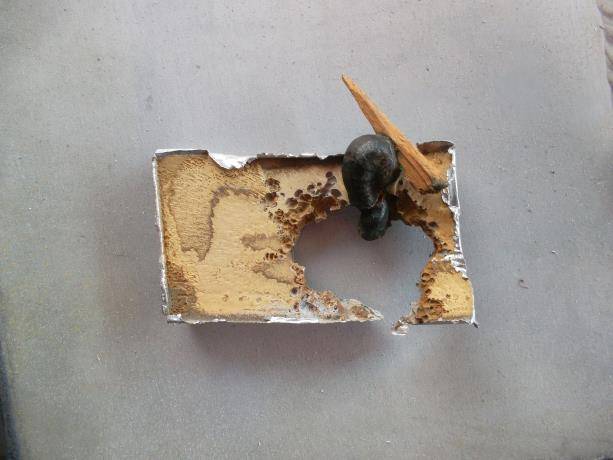
What would cause a hole to form in the top aluminium tank of a radiator of an earthmoving machine. The tank material is 6mm thick and is made from 1050 aluminium plate. The material around the hole has bubbles almost like pitting corrosion or like somebody went and took a flame to it. The rest of the tank is clean and smooth on the inside, no signs of corrosion at all. I know it's basically impossible to say for certain, but what could be possible causes?

The piece of plate was cut out of the tank and the attached picture shows the inside of the area where the hole formed. The black piece that is stuck to it is a type of glue that the guys used to do a field repair
of the tank until they could get it repaired properly.

The second picture shows the general condition of the tank on the inside.
Hole.jpg
Hole2.jpg
 

Attachments

  • Hole.jpg
    Hole.jpg
    29.9 KB · Views: 668
  • Hole2.jpg
    Hole2.jpg
    44.7 KB · Views: 586
Last edited by a moderator:
Engineering news on Phys.org
That top picture looks like it is taken from the inside tank side of the hole.
What is the tan material - is it part of the tank, or just a deposit?
The hole looks like it is corrugate aluminum - is that so?

Off hand, I would say it is chemical corrosion - perhaps assisted by some sort of biology.
It may have started at a small puncture point that allowed air and moisture in.
 
Yes, that's the inside of the hole area after it was cut out. The "tan"material is a deposit on the inside of the tank. It only seems to be on that spot. It might be residue of the glue that they used to patch the hole up. I'm not sure to be honest. You can see a bit of it on top of the tank on the second picture as well. If it was a steel tank I'd say it was rust, but it's aluminium. Maybe rust from the engine that comes and sits in the radiator top tank?
 
That deposit is not the cause of the hole - although it may be a contributor.
It also does not look like any aluminum salt - which would be white, and probably chalky.
So it's just a deposit, most likely created from the antifreeze or other coolant additives.

The dents in the deposit may have bee created in the attempt to patch the hole.

What does this hole look like from the front?
 
Joe591 said:
Maybe rust from the engine that comes and sits in the radiator top tank?
What does that mean? There is something heavy sitting on top of the tank? Is that at a contact point that could get worn by vibration?
 
Seems like some galvanic corrosion for me...
 
  • Like
Likes   Reactions: Tom.G
Anything resting on the top of the tank like an unused filler cap or ?? I've seen vibration wear holes in things quite quickly.
 
Joe591 said:
Maybe rust from the engine that comes and sits in the radiator top tank?

berkeman said:
What does that mean?
A rust-colored foam sometimes found floating in the upper expansion tank, especially if there is a leak of combustion gasses into the cooling system. I also agree with @Rive that it looks like galvanic corrosion, which could also be from an inclusion in the original Aluminium. I suggest that compression and leak-down tests be done on the engine, just in case.

Cheers,
Tom
 
  • Like
Likes   Reactions: CWatters
Where cracks form, corrosion is greatly accelerated by vibration.
 
  • #10
Update:
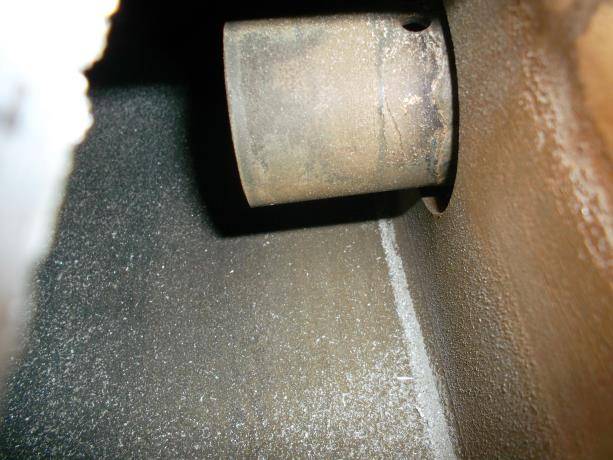
We welded a new piece of plate into the tank and I wanted to inspect the repair area from inside the tank. To this end I wanted to shove our little endoscope into the tank. A quick look at the best fitting to use to this end led me to the breather pipe that is directly opposite where the hole formed. It seems so obvious now. We now think that water is coming through the breather at high velocity and hitting the opposite wall of the tank. I now think this is erosion corrosion.

Evidence for this is that the "corrosion" only seems to be in the area opposite this breather pipe. The rest of the tank is "clean", with no evidence of the pits at all. Recommended courses of action this side are to redesign the tank with a deflector plate that will prevent high velocity water from hitting this wall and deflect it downward into the water instead. We believe that during use some people are either not installing the 4mm orifice that is meant to prevent this from happening or they run the radiator too low on water and the jet hits the tank before it hits the surface of the water in the radiator. Either way it's causing crap. That's my best guess so far anyhow.
Scan.jpg
 

Attachments

  • Scan.jpg
    Scan.jpg
    10.4 KB · Views: 605
  • Like
Likes   Reactions: Tom.G, berkeman and Nik_2213
  • #11
Bit surprised that water alone is doing this. Is there something circulating in the water like rust or sand? Could it be acidic as a result of combustion products getting into it? Perhaps check it's got the right anti freeze/corrosion inhibitor in it. If the system also has a slow leak I can imagine workers regularly topping it up with water only causing it to be over diluted.
 
  • #12
Judging from the condition of the radiator the tank the coolant has sediment in it. I'm not sure that they are using antifreeze, can only advise and hope that they are. They say the unit has been in use for 6 months. I can't really say anything for certain. It's used outside of our control. We design them and build them...
Actual specifics of use are a mystery...and obviously I cannot rule out exhaust gas making things acidic... But then why only that piece of the tank?
Can't say I'm completely convinced of what I said earlier, only that it's my best guess so far.
Sounds like we need a sample of water from the radiator next time, I'll make the suggestion for next time.
 
  • #13
Makes sense. Aluminum in an application like this is primarily protected from corrosion by the formation of an oxide layer. Keep blasting it away...
 
  • Like
Likes   Reactions: Joe591

Similar threads

  • · Replies 23 ·
Replies
23
Views
3K
  • · Replies 8 ·
Replies
8
Views
3K
  • · Replies 19 ·
Replies
19
Views
9K
  • · Replies 9 ·
Replies
9
Views
8K
  • · Replies 1 ·
Replies
1
Views
3K
  • · Replies 5 ·
Replies
5
Views
5K
  • · Replies 4 ·
Replies
4
Views
4K
  • · Replies 1 ·
Replies
1
Views
10K
  • · Replies 8 ·
Replies
8
Views
5K
  • · Replies 1 ·
Replies
1
Views
3K