Discussion Overview
The discussion centers on the concept of a 2-torus when considered in the context of four-dimensional space. Participants explore the implications of embedding a torus in a dimension beyond the conventional three, comparing it to other topological surfaces like the Klein bottle.
Discussion Character
- Exploratory
- Technical explanation
- Debate/contested
Main Points Raised
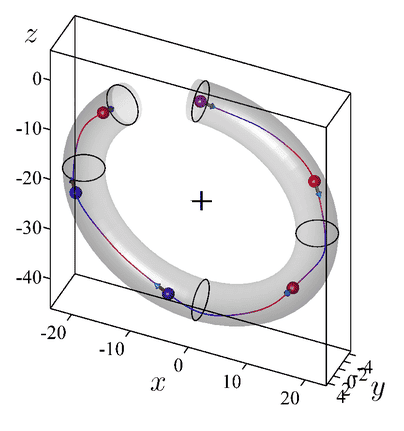
- Some participants describe a 2-torus formed by bending a tube into a loop in four-dimensional space, questioning the appropriate terminology for this object.
- Others argue that the original description lacks a clear topological specification, suggesting that a standard torus can be embedded in 4D space without altering its topology.
- A participant requests clarification on the implications of embedding a torus in 4D space, leading to discussions about the nature of the embedding and its representation in three-dimensional space.
- Some participants propose that a flat torus can exist in three dimensions without stretching or compressing, while others discuss the conditions necessary for such a representation in higher dimensions.
- There is mention of Hilbert's theorem regarding the curvature of smoothly embedded surfaces in three-dimensional space, which could relate to the discussion of toroidal shapes.
- A participant references a specific paper that discusses the embedding of flat compact surfaces in three-dimensional space, suggesting that the simplest torus in four-dimensional space might be represented as the Cartesian product of two circles.
Areas of Agreement / Disagreement
Participants express differing views on the nature of the torus in four-dimensional space, with no consensus reached on the terminology or the implications of the embeddings discussed. The discussion remains unresolved regarding the specific naming and properties of the toroidal object in question.
Contextual Notes
Participants note that the original description of the torus does not provide sufficient information for a definitive topological classification. There are also discussions about the implications of embedding surfaces in various dimensions, which may depend on specific mathematical definitions and assumptions.