What's the use of unit vectors?

Click For Summary

Homework Help Overview

The discussion revolves around the concept and significance of unit vectors in vector representation, particularly in the context of three-dimensional vectors. The original poster questions the necessity of unit vectors in describing a vector, specifically in relation to a given equation.

Discussion Character

  • Conceptual clarification, Assumption checking

Approaches and Questions Raised

  • Participants explore the role of unit vectors in distinguishing direction and magnitude in vector representation. Some question why unit vectors are necessary when scalar values can describe vectors. Others discuss the implications of using unit vectors in terms of clarity and dimensionality.

Discussion Status

The discussion is ongoing, with participants providing insights into the relationship between magnitude and direction in vectors. There is an exploration of different representations of vectors, but no consensus has been reached regarding the necessity of unit vectors.

Contextual Notes

Participants are examining the implications of using scalar quantities versus vector notation, and there may be assumptions about the understanding of vector components and their representations that are being questioned.

Odette
Messages
9
Reaction score
0
Homework Statement
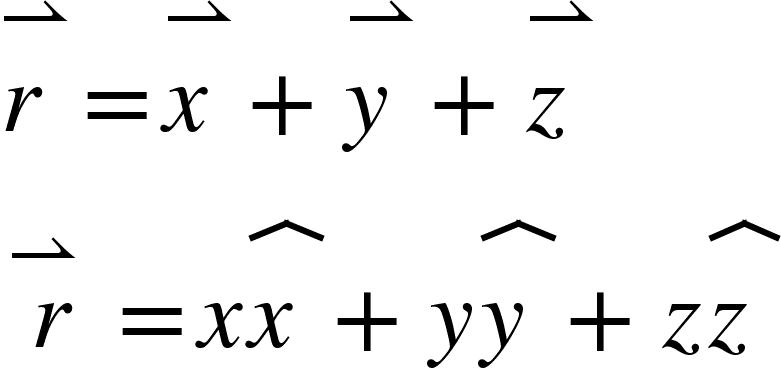
Hallo. Can somebody explain to me what's the importance-use of unit vector in the below (second) equation? Why isn't the first equation just enough to describe r? What's the reason for unit vector to even exist?
Relevant Equations
in the photos
Homework Statement: Hallo. Can somebody explain to me what's the importance-use of unit vector in the below (second) equation? Why isn't the first equation just enough to describe r? What's the reason for unit vector to even exist?
Homework Equations: in the photos

Χωρίς τίτλο.png
IPMCav9xV9YK7s2-YTfUt9-57ZQ91wTRj-8uIXZYwULZmkp3o7.png
 
Physics news on Phys.org
##x, y, z## are numbers. E.g. if ##x =1, y =2, z=3##, then ##r =6##. Which doesn't mean a lot in terms of 3D vectors.

##\vec{r} = (x, y, z)## is an alternative that doesn't use unit vectors explicitly, although they are implied in terms an orthonormal basis.
 
Suppose I want a constant vector of length a that points in the x directton?
$$\vec{a}=a\hat{x}$$
Or a variable vector of size y that points in z direction? $$\vec{b}=y\hat{z}$$
You really need all the symbols.
 
Every vector has both a direction and a magnitude. For example, the "x" is the scalar quantity that tells you the magnitude of the x component of r, and the x with the ^ tells you the scalar points in the x direction. So, for a vector r, it has a magnitude of "r" multiplied by the r with the ^ to tell you the direction "r" points in.

ieafhjkdj.jpg
 

Similar threads

Replies
26
Views
2K
  • · Replies 2 ·
Replies
2
Views
3K
  • · Replies 8 ·
Replies
8
Views
3K
  • · Replies 4 ·
Replies
4
Views
2K
Replies
13
Views
2K
  • · Replies 3 ·
Replies
3
Views
1K
  • · Replies 2 ·
Replies
2
Views
2K
  • · Replies 4 ·
Replies
4
Views
2K
  • · Replies 8 ·
Replies
8
Views
2K
  • · Replies 1 ·
Replies
1
Views
1K