What's wrong with this wind turbine concept?

Click For Summary

Discussion Overview

The discussion revolves around the viability of a "translational turbine" concept for harvesting wind power, as proposed by a participant's friend. The conversation explores various aspects of the design, including its efficiency, mechanics, and comparisons to traditional wind turbines.

Discussion Character

  • Debate/contested
  • Technical explanation
  • Conceptual clarification

Main Points Raised

  • Some participants argue that the design is flawed because the sails downwind will be in the lee of the first sail, rendering them ineffective.
  • Concerns are raised about the lack of a mechanism to keep the turbine oriented into the wind, which could hinder its performance.
  • It is noted that traditional three-bladed wind turbines are more efficient as they do not screen each other and can be raised to capture wind at higher altitudes.
  • Some participants suggest that while the design may technically "work," its efficiency is questionable, and they provide reasons for this skepticism.
  • One participant emphasizes the need for more information about the design's control and orientation to make a definitive assessment.
  • Another participant mentions a different wind turbine design that uses vertical blades and is successful for small generators, suggesting it addresses some of the issues raised about the proposed design.
  • There is a discussion about the optimal number of blades for wind turbines, with some suggesting that it may vary based on the size of the turbine.

Areas of Agreement / Disagreement

Participants express multiple competing views regarding the effectiveness and efficiency of the proposed turbine design. There is no consensus on its viability, and various concerns are raised without resolution.

Contextual Notes

Participants highlight limitations in the information provided about the design, particularly regarding its control mechanisms and orientation to the wind. There are also unresolved questions about the optimal number of blades for different turbine sizes.

FermatPell
Messages
21
Reaction score
0
Hello,

a friend of mine has a "revolutionary" idea about harvesting wind power by using a "translational turbine". however, it all sounds silly to me. this is what it should look like:

is this a good idea for a wind "turbine"?
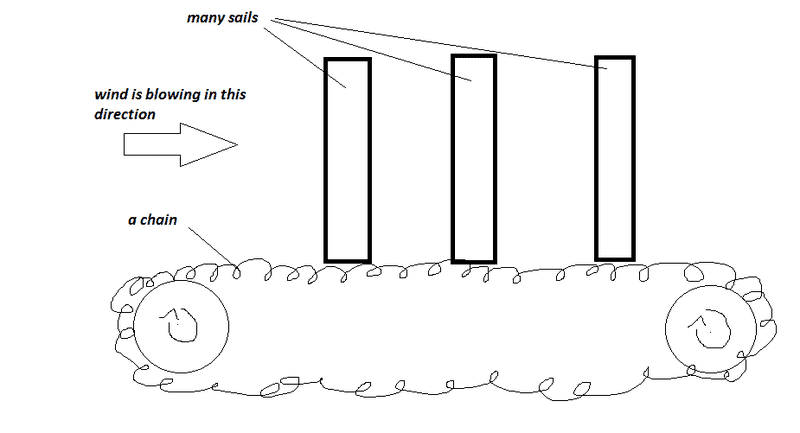
344sap2.png
 
Physics news on Phys.org
It looks like a very poor idea,
The sails downwind of the first sail are in the lee of the first sail so will do no work.
Unless there is a mechanism (not shown) to furl the sails on the underside of the chain they will be opposing the sails on top.
There is no mechanism to keep the device heading into the wind.
Colin Chapman (founder of Lotus cars) is quoted as saying "simplify and add lightness" this idea is the reverse of CCs philosophy.
 
If your friend knew something about sailing, he would know that a sailing boat will go faster at a beam reach (perpendicular to the wind) than directly downwind.

The sails will be screening each other.

The sails will have to go back upwind and will have to fold or be screened somehow.

Youl'll need two masts to raise the whole contraption off the ground.

An ordinary 3 bladed wind turbine is just 3 sails, that go in the optimal direction, don't screen each other, are active all the time, and can be raised off the ground much easier to catch more wind at a higher altitude.
 
The design will "work" in the sense that sticking any large surface into the wind and linking it to the axle of a generator will "work" - the question is: is it efficient?

It isn't. Just a few reasons why have been listed.

Having come up with a different idea doesn't mean one has come up with a good idea.
 
willem2 said:
If your friend knew something about sailing, he would know that a sailing boat will go faster at a beam reach (perpendicular to the wind) than directly downwind.

The sails will be screening each other.

Frankly, we don't know what angle the wind is to the sails in the OP's example. For all we know, it could be on a Broad Reach. But without any details as to how it's controlled and oriented, it's impossible to say.

We should keep in mind that the OP's interpretation of the design is not the inventor's design. The inventor could well have answers to all these problems, for all we know. The only thing we can really say is that there is not enough information given in the diagram.
 
FermatPell said:
344sap2.png
A wind powered tank?
 
I think your friend could look at the http://www.planetarysystems.com/productD.php?PtID=13 idea. It uses vertical blades, mounted around a vertical spindle. It is very successful for small generators and pumps but I haven't seen the design used for large scale power.
It is not unlike his idea except that it nicely takes care of the problem of getting each blade back to the beginning again (they go round the back and push in the appropriate / opposite sense) and works with the wind from any direction.

A chain drive like he proposes would be very inefficient, too, compared with a rotary motion on a single bearing.
 
willem2 said:
If your friend knew something about sailing, he would know that a sailing boat will go faster at a beam reach (perpendicular to the wind) than directly downwind.

The sails will be screening each other.

The sails will have to go back upwind and will have to fold or be screened somehow.

Youl'll need two masts to raise the whole contraption off the ground.

An ordinary 3 bladed wind turbine is just 3 sails, that go in the optimal direction, don't screen each other, are active all the time, and can be raised off the ground much easier to catch more wind at a higher altitude.

Do you think the optimal number of blades is always three, independent of the wind speed?
 
The optimal number will depend upon the size of the turbine, I think.
Many small turbines have more than three - certainly, the classic designs for water pumps in Western Movies has up to eight (?). I have (a modern) one on my boat with six blades.
 

Similar threads

  • · Replies 4 ·
Replies
4
Views
2K
  • · Replies 9 ·
Replies
9
Views
3K
  • · Replies 3 ·
Replies
3
Views
2K
  • · Replies 22 ·
Replies
22
Views
2K
  • · Replies 7 ·
Replies
7
Views
4K
Replies
13
Views
7K
  • · Replies 26 ·
Replies
26
Views
14K
  • · Replies 72 ·
3
Replies
72
Views
11K
  • · Replies 14 ·
Replies
14
Views
8K
  • · Replies 4 ·
Replies
4
Views
1K