When can a separable ODE be solved for x explicitly?

  • Level: Graduate 
  • Thread starter Thread starter SchroedingersLion
  • Start date Start date
  • Tags Tags
    Book Ode Separable
Join the discussion
Registration is free. Start your own thread to ask a follow-up.
8 replies · 3K views · last reply
SchroedingersLion
Messages
211
Reaction score
56
TL;DR
A question to a statement in a book.
Greetings,

I have a question to the following section of the book https://www.springer.com/gp/book/9783319163741:
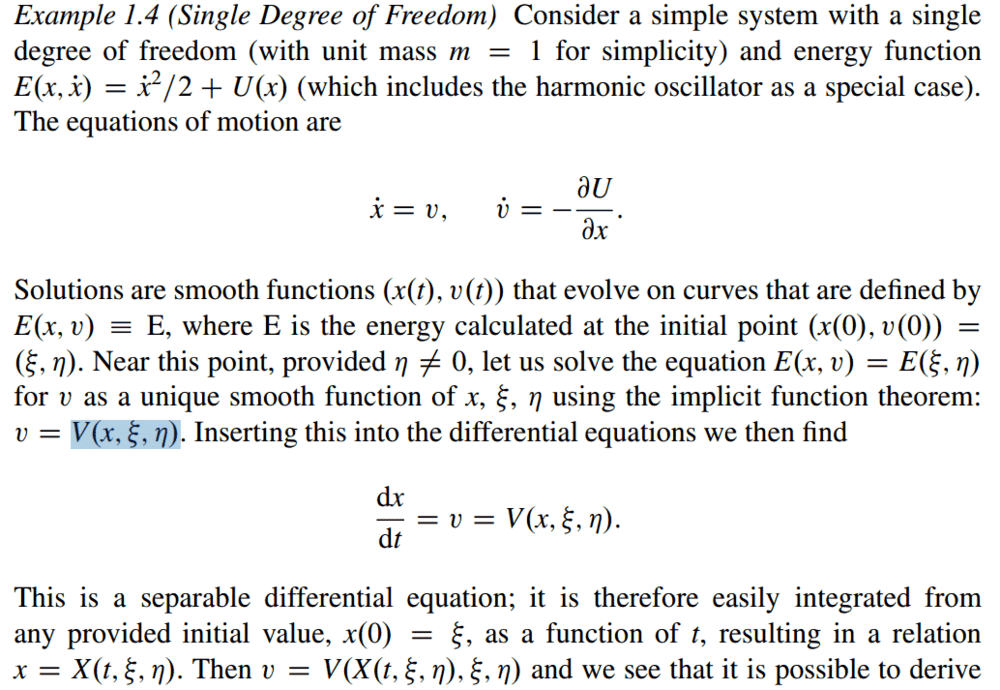
Printed text from a textbook: Example 1.4 (Single Degree of Freedom) on separable differential equations, with equations of motion, the implicit function theorem step v = V(x, ξ, η) highlighted, and the separable equation dx/dt = V(x, ξ, η).


I understand that the equation is separable, since I can just write
$$ \int_{x_0}^{x} \frac {1}{V(x', \xi, \eta)}dx' =\int_{0}^{t}dt' .$$
However, without knowing the exact shape of the function ##V##, how can I know that I can bring the resulting formula into the shape ##x=X(t, \xi, \eta)##? Am I missing something or is the author a bit too imprecise here?SL
 
Last edited:
Physics news on Phys.org
From your equation, say
[tex]\int^x_C \frac{1}{V}dx'=G(x,\xi,\eta),[/tex]
[tex]G(x,\xi,\eta)-G(x_0,\xi,\eta)=t-t_0[/tex]
[tex]x=G^{-1}(t-t_0+G(x_0,\xi,\eta))=X(t,\xi,\eta,t_0,x_0)[/tex]
where ##G^{-1}## is a inverse function of G as for x with ##\xi,\eta## and ##x_0##,##t_0=0## given.
 
  • Like
Likes   Reactions: SchroedingersLion
Thanks!

What is the prerequisite for the integral function having an inverse?
 
Integral should be monotonous and not diverge so V does not change sign in the region.
 
I find the formula ##v=V(x,\xi,\eta)## strange. I would write ##E(x,v)=h(=const)##. Assume that for some ##x_0,v_0,\quad E(x_0,v_0)=h## we have ##\frac{\partial E}{\partial v}(x_0,v_0)\ne 0## then for some small enough ##|x-x_0|## there is a unique function ##v=V(x)## such that ##E(x, V(x))\equiv h,\quad v_0=V(x_0).##
 
Last edited:
anuttarasammyak said:
Integral should be monotonous and not diverge so V does not change sign in the region.
How can you tell?

wrobel said:
I find the formula ##v=V(x,\xi,\eta)## strange. I would write ##E(x,v)=h(=const)##. Assume that for some ##x_0,v_0,\quad E(x_0,v_0)=h## we have ##\frac{\partial E}{\partial v}(x_0,v_0)\ne 0## then for some small enough ##|x-x_0|## there is a unique function ##v=V(x)## such that ##E(x, V(x))\equiv h,\quad v_0=V(x_0).##
But this is the same as the text says, your ##(x_0, v_0)## corresponds to its ##(\xi, \eta)##.
 
SchroedingersLion said:
But this is the same as the text says,
I have reread the text and yes, it is practically the same. Regarding your initial question I think that these formulas should be taken formally, in concrete examples everything is as usual clear. You have just been shown that the system is solvable in quadratures. This integral does not actually play a crucial role. Phase diagrams play
 
SchroedingersLion said:
How can you tell?
We can divide the region in order to keep unique correspondence.
 
Attachments
  • Handwritten notes: dx/dt = v, dt = dx/v, and t - t0 = integral from x0 to x of dx/v; below, a hand-drawn graph of x against t divided into regions I, II and III by vertical lines, with t0 and x0 marked and a brace labelled according to sign of v.
    2020-06-13 07.04.47.jpg
    40.9 KB · Views: 371
  • Like
Likes   Reactions: SchroedingersLion