When exactly does error -> zero in calculus-based mechanics?

6 replies · 2K views · last reply
EddiePhys
Messages
144
Reaction score
6
I've come across many instances where sometimes the error tends to zero but other times it does not. Let me give you a few examples.

1.
When I calculate the volunme of a sphere summing up discs of height dy from -R to +R, the error in volume tends to zero as Delta y->0 but when I'm calculating the surface area using rings of height dy, this error does not tend to zero.
Same with a hollow cone vs a solid cone.

2.
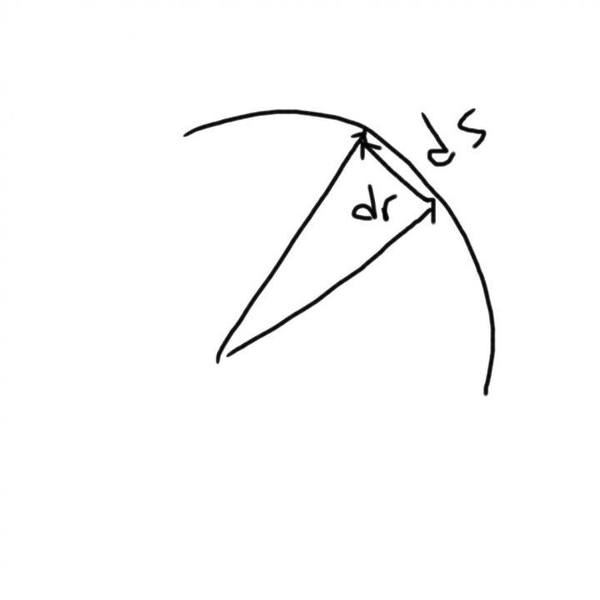
Hand-drawn diagram of a curve with a small triangle: two sides labelled dr and ds, where ds is the arc along the curve and dr is the chord between its endpoints.

ds is the arc length. We know ds/dt = speed = |dr/dt| since the error tends to zero.

However, in another case, particularly from Irodov's problems:
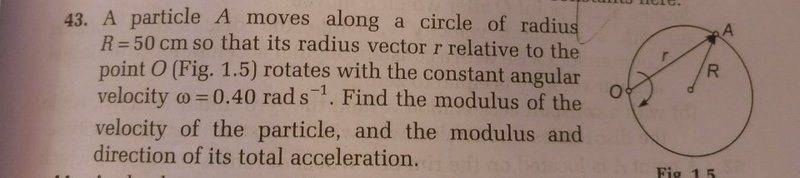
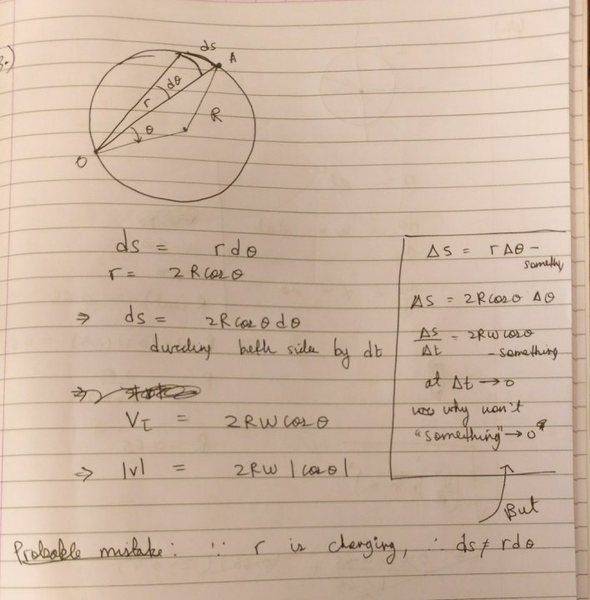
Textbook problem 43: particle A moves on a circle of radius R = 50 cm, radius vector r from point O rotates at angular velocity 0.40 rad/s; find speed and total acceleration. Fig 1.5 diagram shows circle with O on the edge, A on the circle, r and R marked.

Handwritten notes on lined paper: a circle with centre and point O on its edge, arc ds subtended by angle dθ, and derivation ds = r dθ, r = 2R cos θ, leading to v = 2Rω cos θ and |v| = 2Rω|cos θ|, with a boxed side note on Δs = 2R cos θ Δθ and a 'probable mistake' remark that r is changing so ds ≠ r dθ.


3.
I'm trying to find the work done by the spring as the block moves from one end to the other(Yes' I'm aware there are easier ways of going about it)
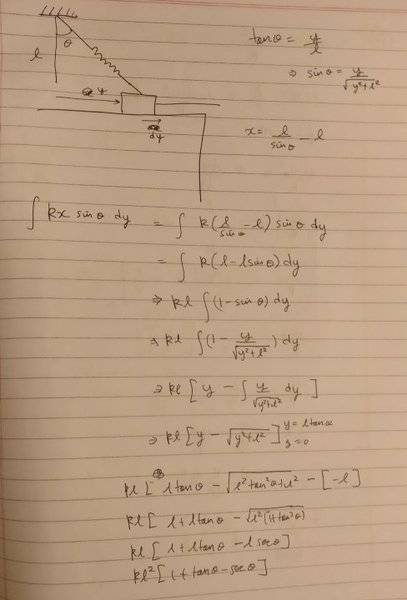
Handwritten physics derivation: a sketch of a block on a surface attached to a spring from a pivot, with angle theta, and the integral of Rx sin theta dy evaluated step by step to R l [y - sqrt(y^2 + l^2)] with limits.


Here, where I think I'm going wrong is assuming the spring force to be constant in the interval dy when it can only remain constant during an infinitesimal displacement along the spring.

However, here we assume pressure to be constant in the interval Rdtheta when it really only is constant in the interval dH since it's a function of h
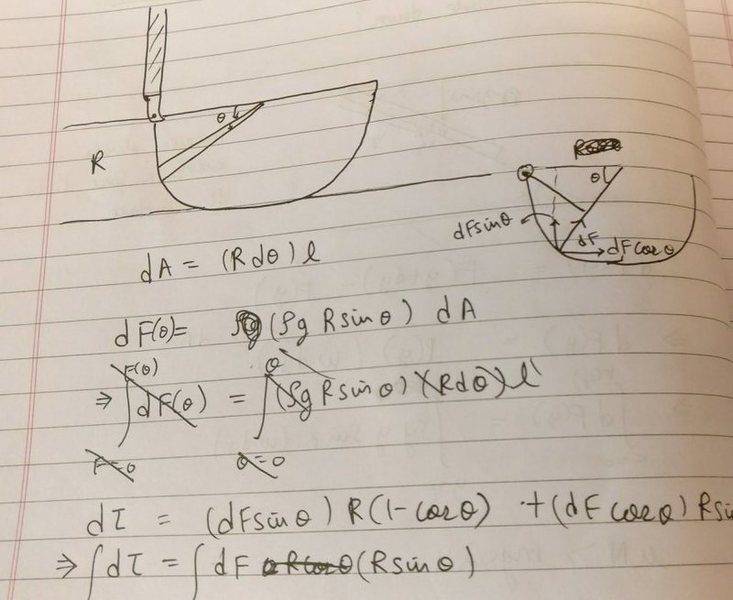
Handwritten derivation on lined paper: a semicircular bowl partly filled with liquid, with a differential strip at angle theta, and force components dF sin theta and dF cos theta labelled on a small inset diagram.


And here, we assume the potential energy of the chain to be constant in the interval Rdtheta when it should be only constant in dh yet in these two cases the error tends to zero but it doesn't in the first case.
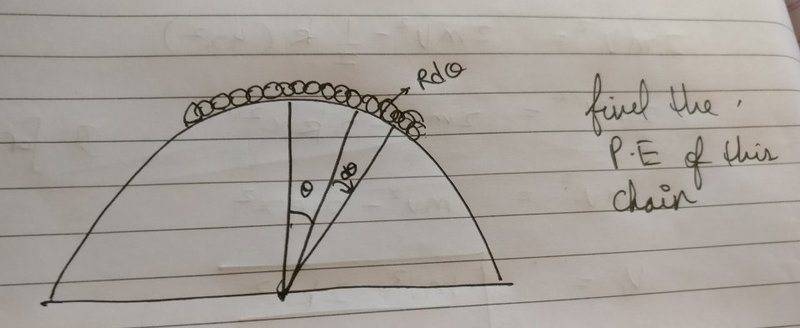
Hand-drawn sketch of a chain draped over the outside of a circular arc, with a vertical radius and angle theta marked from the top, a small element of length R dθ labelled at one end, and the text 'find the P.E of this chain' written beside it.
 
Last edited:
A lot of questions. Post as separate threads. For now: number 1 looks like an error in the calculation. Can you show post it ?
 
This doesn't seem to be getting any replies. Have I posted in the wrong subsection?
 
EddiePhys said:
This doesn't seem to be getting any replies. Have I posted in the wrong subsection?
Well, as I see it, it may be better placed in the homework section and one question per thread. (And don't forget to use the template.) I understand that the photos are helpful for your drawings, but usually people don't appreciate handwriting very much. So maybe you could type it in LaTeX instead, and use photos only if really needed.
 
Last edited:
  • Like
Likes   Reactions: BvU
For calculating surface area, or similarly the arc length, you need to find an infinitesimal shape that approximates the slope of the surface, not just the position.
Consider a simple diagonal line from (0,1) to (1,0). It has length ##\sqrt(2)##. If you approximate it as a staircase, and take the stair height ->0, then you get something that looks like the diagonal line. It matches the position of the diagonal line, so it gives you the correct area under the curve. But it gives you an arc length of 2. It is because you have not matched the slope anywhere. The approximate curve has a slope of 0 and infinity alternating infinitely often, whereas the original curve has a slope of -1.
 
  • Like
Likes   Reactions: EddiePhys
EddiePhys said:
This doesn't seem to be getting any replies. Have I posted in the wrong subsection?
Strange. On my screen I do see a reply. It's called post #2 and it asks you to elaborate on your statement:
EddiePhys said:
when I'm calculating the surface area using rings of height dy, this error does not tend to zero
where I suspect it will be rather easy to point out your mistake
 
  • Like
Likes   Reactions: fresh_42
Khashishi said:
For calculating surface area, or similarly the arc length, you need to find an infinitesimal shape that approximates the slope of the surface, not just the position.
Consider a simple diagonal line from (0,1) to (1,0). It has length ##\sqrt(2)##. If you approximate it as a staircase, and take the stair height ->0, then you get something that looks like the diagonal line. It matches the position of the diagonal line, so it gives you the correct area under the curve. But it gives you an arc length of 2. It is because you have not matched the slope anywhere. The approximate curve has a slope of 0 and infinity alternating infinitely often, whereas the original curve has a slope of -1.

Thanks a lot! :D Could you also please answer the other questions?