When Should Gravity's Potential Energy Be Negative in Energy Calculations?

Click For Summary

Homework Help Overview

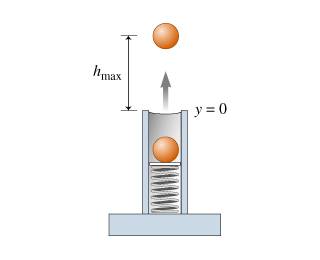
The discussion revolves around the concept of gravitational potential energy and its sign in energy conservation calculations, particularly in the context of a ball being pushed into a barrel and compressing a spring. Participants are exploring how to define the reference point for potential energy and the implications of that choice on calculations involving both gravitational and spring potential energy.

Discussion Character

  • Conceptual clarification, Assumption checking, Mathematical reasoning

Approaches and Questions Raised

  • Participants discuss when to assign negative values to gravitational potential energy based on the chosen reference point. There are questions about how to incorporate spring potential energy in the calculations, particularly regarding its sign when the spring is compressed. Some participants share their attempts to calculate the velocity of the ball as it exits the barrel, raising concerns about the correctness of their equations and values used.

Discussion Status

The discussion is active, with participants providing insights into the definitions of potential energy and how they affect calculations. Some participants have identified errors in their previous calculations and are refining their approaches based on feedback. There is a recognition of the importance of correctly setting initial and final energy states.

Contextual Notes

Participants are working under the constraints of a homework assignment, which may impose specific requirements for defining potential energy reference points. There is an ongoing exploration of the implications of these definitions on the calculations being performed.

rsala
Messages
39
Reaction score
0
my question is, when using energy conservation when do i put the potential energy of gravity negative? if its under where it set my potential energy to 0? or am i wrong, is gravity's potential energy always positive (except at my set u=0 point) ?

can someone explain this to me, having trouble getting ANYthing done because i do not understand how to set up these homework questionsfor example, this is a ball pushed into a barrel, compressing the spring, ball has initial velocity 0
here are the values,
k = 667 N/m
mass of ball = 1.5kg
ball is pushed into tube .25 meters
1004948.jpg

if u=0 is set at the mouth of the barrel, then the initial potential energy is mgh+.5kx^2?
or is it -mgh+.5kx^2? -mgh-.5kx^2?
 
Last edited:
Physics news on Phys.org
You get to define where the potential energy is 0. Everything above that is positive, below that negative.
 
what about the springs energy is that negative as well?
meaning if i set the muzzle of the gun to be potential energy 0,, is the total potential energy at the compressed initial part
-mgh-.5kx^2?
 
Yup, because you also defined the springs 0 potential energy mark at y=0
 
im trying to find the velocity once it is at y=0 (once it leaves the gun)
i am setting

[tex]-mgh - \frac{1}{2}kx^{2} = \frac{1}{2}mv^{2}[/tex]

i solve this for v and i receive

[tex] \sqrt{\frac{2(-mgh-\frac{1}{2}kx^{2})}{m}}[/tex]

i do not receive the correct answer, i get 5.72

here are the values,
k = 667 N/m
mass of ball = 1.5kg
ball is pushed into tube .25 meters

i am placing -.25 into the formula since it is below the muzzle, anyone see where i went wrong?
 
Last edited:
U = mgh+.5kx^2

You get the negatives from the the springs compression and the height, you didn't use
-mgh-.5kx^2 THEN also set x=-.25 did you?
 
yes i did, i just tried again with correct negatives i think (i see where i went wrong last time)
and i got answer: 3.38m/s, wrong still though

[tex]mgh + \frac{1}{2}kx^{2} = \frac{1}{2}mv^{2}[/tex]
 
Last edited:
That would be the problem:

[tex]\sqrt{\frac{2(mgh+\frac{1}{2}kx^{2})}{m}}[/tex]

Where x=-.25
 
Feldoh said:
Yup, because you also defined the springs 0 potential energy mark at y=0

The potential energy of the ball is +mgh. If the ball is below th etop of the barrel, h is negative, so mgh will then be negative. The elastic energy of the spring is always equal to +kx^2/2 if its unstretched position is at the top of the barrel.
 
  • #10
jesus wrong again, i got 22.89166 m/s this time, lol

i have used
[tex]\sqrt{\frac{2(mgh+\frac{1}{2}kx^{2})}{m}}[/tex]
---
[tex]\sqrt{\frac{2((1.5)(9.8)(-.25)+\frac{1}{2}(667)(-.25^{2}))}{1.5}}[/tex]

o nvm i forgot the sqrt, i got correct answer now! 4.784

thank you feldoh, kamerling
 
Last edited:
  • #11
4.784 m/s once it leaves muzzle
solved now though, i didnt know how to properly set any of the initial and final energies, so i couldn't solve it initially, i got it now though.
thanks again
 
  • #12
rsala said:
jesus wrong again, i got 22.89166 m/s this time, lol

i have used
[tex]\sqrt{\frac{2(mgh+\frac{1}{2}kx^{2})}{m}}[/tex]
---
[tex]\sqrt{\frac{2((1.5)(9.8)(-.25)+\frac{1}{2}(667)(-.25^{2}))}{1.5}}[/tex]

o nvm i forgot the sqrt, i got correct answer now! 4.784

Ah, that's good. I was beginning to think I just made up everything I told you since it's been a while since I've done that lol XD
 

Similar threads

  • · Replies 5 ·
Replies
5
Views
2K
  • · Replies 9 ·
Replies
9
Views
2K
Replies
1
Views
2K
  • · Replies 2 ·
Replies
2
Views
1K
Replies
15
Views
2K
Replies
7
Views
1K
Replies
3
Views
2K
  • · Replies 20 ·
Replies
20
Views
4K
Replies
55
Views
6K