SUMMARY
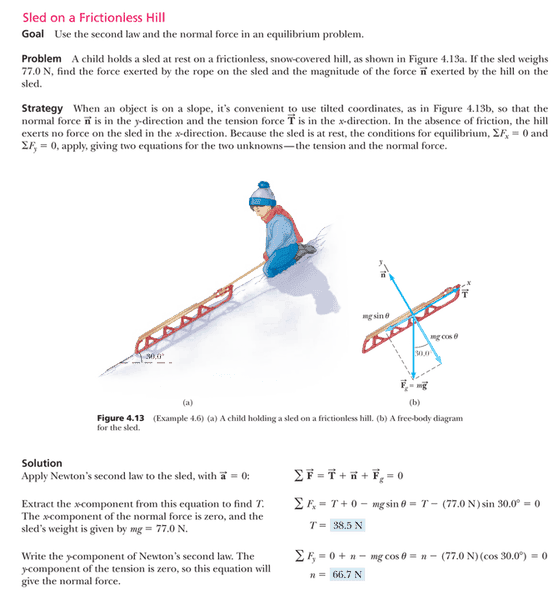
The discussion clarifies the application of sine and cosine functions in physics problems involving forces and angles. Specifically, it establishes that the sine function is used for components of forces acting down a slope (opposite the angle), while the cosine function is applied to normal forces (adjacent to the angle). The reasoning is grounded in the geometric interpretation of trigonometric functions, where sine corresponds to the vertical component and cosine to the horizontal component of a force vector. Understanding these relationships is crucial for accurately resolving forces in physics problems.
PREREQUISITES
- Understanding of basic trigonometry, specifically sine and cosine functions.
- Familiarity with vector resolution in physics.
- Knowledge of forces acting on inclined planes.
- Ability to interpret diagrams related to force components.
NEXT STEPS
- Study vector resolution techniques in physics problems.
- Learn about the role of trigonometric functions in force analysis.
- Explore examples of inclined plane problems in physics textbooks.
- Review graphical representations of forces and angles in physics.
USEFUL FOR
Students studying physics, educators teaching trigonometry and mechanics, and anyone seeking to improve their understanding of force resolution in inclined planes.