When to use cos or sin in physics problems

Click For Summary

Homework Help Overview

The discussion revolves around the application of trigonometric functions, specifically sine and cosine, in physics problems involving forces and angles. Participants are exploring the reasoning behind the choice of these functions in different contexts, particularly in relation to tension and normal force in inclined scenarios.

Discussion Character

  • Conceptual clarification, Assumption checking

Approaches and Questions Raised

  • Participants are questioning the rationale behind using sine for tension and cosine for normal force, with some suggesting that the choice depends on the components of the vectors involved. Others discuss the behavior of these functions as angles approach zero and how that relates to the forces acting on an object.

Discussion Status

The discussion is active, with various interpretations being explored regarding the use of trigonometric functions. Some participants have offered insights into how the components of forces relate to the angles involved, but there is no explicit consensus on the best approach yet.

Contextual Notes

Participants are working within the constraints of a physics problem that does not provide detailed explanations for the choice of trigonometric functions, leading to a focus on understanding the underlying principles.

Raza
Messages
203
Reaction score
0
Hi, I get really confused when to use the cos function or the sin function. for example, I was looking at this yesterday and thought the other way around of the correct answer. Why did it chose sin function for tension and cos function for the normal force?
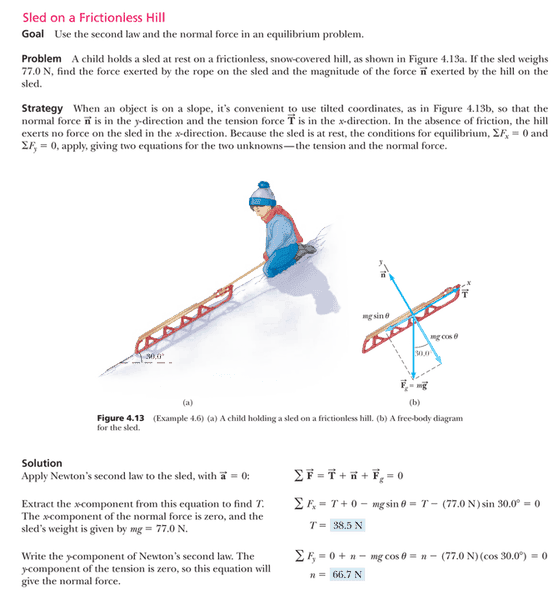
PagesfromSerway-CollegePhysics7t-1.png

This problem doesn't explain why it chose the trigometric function for each question.

Thank You.
 
Physics news on Phys.org
The easy way is to think what happens as the angle goes to zero. As angle->0 sin -> 0 cos->1

In your example, the force along the slope will go to zero as it gets horizontal (so is sin) the force on the runners will increase, until it is the whole weight (so is cos)
 
Whatever function you choose depends on the components of the vectors that you need.

For instance in your problem, you need the gravity component along the slope from a vertical force. This will resolve itself into a normal force that you can easily relate to the angle of the slope itself with the cos function. (Refer to the diagram.)

As pointed out already this then would be the adjacent side to the angle.

In figuring out the acceleration along the slope then you need the other component of the vector down the slope. Since it is the side opposite the angle then sine is what you need to use.
 

Similar threads

  • · Replies 7 ·
Replies
7
Views
902
  • · Replies 3 ·
Replies
3
Views
1K
  • · Replies 19 ·
Replies
19
Views
2K
Replies
8
Views
2K
Replies
4
Views
3K
Replies
55
Views
6K
  • · Replies 6 ·
Replies
6
Views
2K
Replies
28
Views
2K
Replies
2
Views
2K
  • · Replies 24 ·
Replies
24
Views
2K