Where can a third charge +Q be placed so that it experiences a zero force?

Click For Summary

Homework Help Overview

The problem involves determining the position of a third charge +Q in relation to two other charges, +2q at the origin and -q at x=3.0 cm, such that the third charge experiences zero net force. Participants are exploring the implications of charge placement along the line defined by the two existing charges.

Discussion Character

  • Exploratory, Assumption checking

Approaches and Questions Raised

  • Participants discuss potential locations for the third charge, considering positions to the left, right, or between the two existing charges. Questions arise regarding the behavior of forces acting on the third charge based on its position.

Discussion Status

The discussion is ongoing, with participants sharing their interpretations of the forces involved. Some guidance has been offered regarding the direction of forces on the third charge based on its placement, but no consensus has been reached on the exact location for zero force.

Contextual Notes

Participants are considering the mathematical relationships governing electric forces, but specific equations or methods have not been fully developed in the discussion.

shashaeee
Messages
30
Reaction score
0
I'm having a hard time trying to picture the problem:

A charge of +2q is placed at the origin and a second charge of -q is placed at x= 3.0cm. Where can a third charge +Q be placed so that it experiences a zero force?

Here is how I picture the problem:
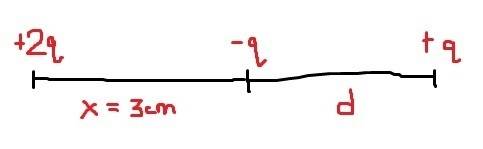
physics4.jpg
 
Physics news on Phys.org
shashaeee said:
I'm having a hard time trying to picture the problem:

A charge of +2q is placed at the origin and a second charge of -q is placed at x= 3.0cm. Where can a third charge +Q be placed so that it experiences a zero force?

Here is how I picture the problem:

View attachment 49498

The 3rd charge could end up anywhere on the line, left, right or between the first 2 charges. What is the equation for the electric field E generated by a charge at some distance...?
 
For Force its, F = KQQ/r2

The way I understand the problem is it could either be on the left or right of those two charges. Because if it was in the middle, the third charge will experience a net force directed to the right. Right?
 
shashaeee said:
For Force its, F = KQQ/r2

The way I understand the problem is it could either be on the left or right of those two charges. Because if it was in the middle, the third charge will experience a net force directed to the right. Right?

Yes, that is correct. It's good that you see that.
 

Similar threads

Replies
9
Views
2K
  • · Replies 19 ·
Replies
19
Views
2K
Replies
5
Views
1K
  • · Replies 21 ·
Replies
21
Views
3K
Replies
23
Views
5K
Replies
4
Views
1K
Replies
21
Views
2K
  • · Replies 10 ·
Replies
10
Views
2K
Replies
4
Views
2K
Replies
8
Views
1K