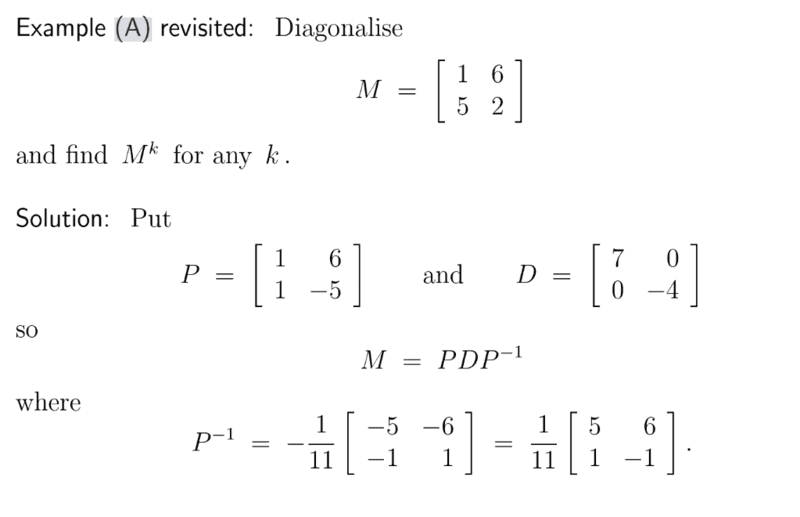
Where do P and D come from when diagonalizing a matrix?

4 replies · 2K views · last reply
member 731016
Homework Statement
Please see below
Relevant Equations
Please see below
For this,
Worked matrix diagonalisation: M = [1 6; 5 2], with P = [1 6; 1 -5], D = [7 0; 0 -4], M = PDP^-1, and P^-1 = (1/11)[5 6; 1 -1].

Dose someone please know where they get P and D from?

Also for ##M^k##, why did they only raise the the 2nd matrix to the power of k?
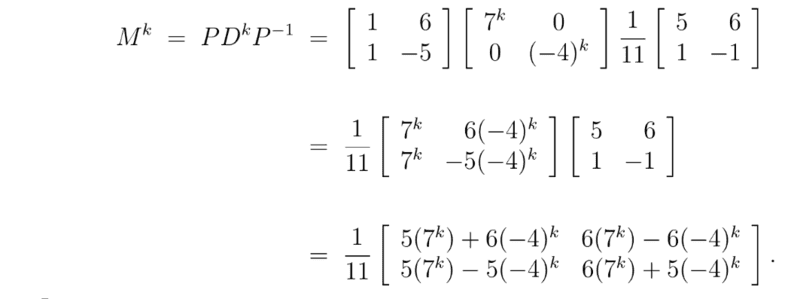
Matrix algebra showing M^k = PD^kP^(-1) expanded: P and D^k are multiplied and combined with 1/11 and P^(-1) to give a final 2x2 matrix with entries involving 7^k and (-4)^k.

Many thanks!
 
  • Like
Likes   Reactions: chwala, DrClaude, member 731016 and 1 other person
ChiralSuperfields said:
Also for ##M^k##, why did they only raise the the 2nd matrix to the power of k?
Just add, that they are raising the whole thing to power ##k##, but you didn't notice that many things cancel.
##M^k=(PDP^{-1})^k=PDP^{-1}PDP^{-1}\dots PDP^{-1}=PDD\dots DP^{-1}=PD^kP^{-1}##
 
  • Like
Likes   Reactions: member 731016, DaveE, chwala and 1 other person
ChiralSuperfields said:
Dose someone please know
I'm trying to train you to know the difference between "dose" and "does" but have been unsuccessful so far.
 
  • Like
  • Haha
Likes   Reactions: member 731016, chwala and SammyS
Mark44 said:
I'm trying to train you to know the difference between "dose" and "does" but have been unsuccessful so far.
Is there no antidote (or perhaps - antidose) for this?
 
  • Like
Likes   Reactions: member 731016