Which basis-forms are pseudo-tensors?

  • Level: Undergrad 
  • Thread starter SiennaTheGr8
  • Start date
  • Tags Tags
    Basis
3 replies · 4K views · last reply
SiennaTheGr8
Messages
525
Reaction score
229
TL;DR
I understand that the Hodge dual takes "true" forms to pseudo-forms, and vice versa. I'm confused about how this works with basis forms; how can we tell which basis forms are pseudo-tensors?
My understanding is that the Hodge dual of a pseudo-form is always a "true" pseudo-form, and vice versa. However, I'm a little confused about how this applies to basis-forms in general.

I believe I understand how it works for the ##0##-form case: the basis ##0##-form is the scalar ##1## (obviously a true tensor), and its Hodge dual is the basis ##n##-form (for an ##n##-dimensional manifold), which then must be a pseudo-tensor (equal to the volume form in an orthonormal system, if I'm not mistaken).

But what about for other situations? For example, here is an excerpt from Frankel's The Geometry of Physics (3rd edition, p. 363), where the context is ##4##-dimensional Minkowski spacetime:

##*## takes ##p##-forms into pseudo (##4 - p##)-forms. [...] Since the coordinates are orthonormal and ##\sqrt{ | g | } = 1##, we can probably avoid the use of (14.3) [Frankel's general definition for the Hodge dual]. ##*(dx^2 \wedge dx^3)## has the property that ##(dx^2 \wedge dx^3) \wedge *(dx^2 \wedge dx^3) = \| dx^2 \wedge dx^3 \|^2 \, dt \wedge dx^1 \wedge dx^2 \wedge dx^3##. Since the ##dx^\alpha## are orthonormal and ##\| dx^\alpha \|^2 \, = +1## for ##\alpha = 1, 2, 3##, we see that ##\| dx^2 \wedge dx^3 \|^2 \, = \| dx^2 \|^2 \, \| dx^3 \|^2 \, = +1##, and so ##*(dx^2 \wedge dx^3) = dt \wedge dx^1##.

What confuses me is: if ##*(dx^2 \wedge dx^3) = dt \wedge dx^1##, then either ##dx^2 \wedge dx^3## or its Hodge dual ##dt \wedge dx^1##—both of which are basis ##2##-forms—must be a pseudo-form, and the other must be a true tensor. How would one know which is which? And this is of course just an example; my question is more general. I feel that something simple is going right over my head!
 
I should add that in the case of Minkowski spacetime, I'd guess that the basis ##2##-forms involving ##dt## are all of the same "type" (either the pseudo-tensors or the true tensors). But again, my question is more general: how to tell in the general case which basis forms are pseudo-tensors and which are true tensors.
 
I'm wondering if ultimately it boils down to the chosen "canonical" ordering of the basis ##n##-form (for an ##n##-dimensional space).

For example, in ##4##-dimensional Euclidean space (so we don't get side-tracked by the "different" nature of time), half of the basis ##2##-forms must be true tensors, and the other half must be pseudo-tensors (because the Hodge dual takes ##2##-forms to ##2##-forms). Say we have ##*(dx \wedge dy) = dz \wedge dw##. One of these basis ##2##-forms must be a true tensor and the other a pseudo-tensor, and it seems to me that it can only be a matter of convention which is which. This must be connected with how one defines the basis ##4##-form, right? If, for instance, the basis ##4##-form is defined like ##dx \wedge dy \wedge dz \wedge dw##, and if in that case ##dx \wedge dy## is a true tensor so that ##*(dx \wedge dy) = dz \wedge dw## is a pseudo-tensor, then my suspicion is that changing the definition of the basis ##4##-form to ##dx \wedge dz \wedge dy \wedge dw## would render ##dx \wedge dy## a pseudo-tensor and ##dz \wedge dw## a true tensor. Or something like that.

Does anyone know whether I'm on the right track?
 
I don't have the full story... I think the following points are relevant.

With pseudo-forms (odd-forms, twisted-forms), there is an orientation in its definition (see p.86),
that is not captured by the notation you are using [not using the general definition used by Frankel].
Definition: A pseudo-p-form ##\alpha## on a vector space ##E## assigns,
for each orientation ##o## of ##E##,
an exterior p-form ##\alpha_0## such that if the orientation is reversed the exterior form is replaced by its negative
[tex]\alpha_{-o}=-\alpha_o[/tex]

Have a look at Burke's unfinished document
https://people.ucsc.edu/~rmont/papers/Burke_DivGradCurl.pdf
See
  • 18 Twisted Differential Forms, especially the notations at the top of 18.2
    and the "##\widehat{dx} dy## hat notation for missing basis forms" at the bottom of 18.2, spilling into 18.3

    Scanned book page on twisted differential forms with a hat notation for missing basis forms, listing rules (1) to (5) and an example of x and y fluxes, continued below a dashed rule.
  • 27. The Star Operator, especially the notation in 27.2
    Typeset page from a differential forms text giving the Hodge star rules for a positive definite metric, with examples in Euclidean 3-space and 2D polar coordinates.


Do a Google-Books search for
"twisted differential forms" "28.10" burke
https://www.google.com/search?q="twisted+differential+forms"+"28.10"+burke&tbm=bks
and notice the orientation that is included geometrical figure.

Page 189 from a textbook on twisted differential forms showing Figures 28.10 to 28.12: pairs of symbols equated to a single symbol, with a vector and orientation arrow, a parallelogram and two-dimensional form, and a box with arrows representing a three-dimensional form.


and
"twisted differential forms" "hodge star" burke
Textbook page excerpt titled Hodge star defining a twisted star operator, with Figure 28.18 showing a 2-form (parallelogram-like prism with orientation arrow) mapped by an arrow to a twisted 1-form (sheet with a circle and orientation arrow).


The figures with orientations are likely based on figures in

On ordinary quantities and W-quantities. Classification and geometrical applications
J. A. Schouten; D. Van Dantzig
Compositio Mathematica (1940)
Volume: 7, page 447-473
ISSN: 0010-437X
https://eudml.org/doc/88752
http://archive.numdam.org/article/CM_1940__7__447_0.pdf

Table 1 comparing tensor and pseudo-tensor notations across rows labelled none, arrow, wedge-plane, circle-arrow, hatched-box and screw, with columns for Figure, Notation 1, Notation 2, number of independent components and orientation.


Table 2 from Schouten and van Dantzig comparing W-quantity notations, with columns for Figure, Notation 1, Notation 2, Components and Orientation, and rows showing icons for screw, outside, inside and none orientations.


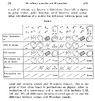
Table 3 from Schouten and van Dantzig's paper showing arrow and loop symbols for polar vector, polar bivector, axial bivector and axial vector under five stages: unit of volume, screw-sense, both, metric, and screw-sense with metric.


See also https://www.amazon.com/Tensor-Analysis-Physicists-Second-Physics/dp/0486655822?tag=pfamazon01-20
 
Attachments
  • Table 3 from Schouten and van Dantzig's paper, showing arrow and loop diagrams for polar vector, polar bivector, axial bivector and axial vector under five cases: after introduction of unit of volume, screw-sense, both, metric, and screw-sense with metric.
    1723525834313.png
    34.8 KB · Views: 130
Last edited:
  • Like
Likes   Reactions: SiennaTheGr8