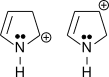
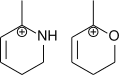
Which ions exhibit greater stability: N vs O, P vs N, or S vs N?

Click For Summary
SUMMARY

The discussion centers on the stability of ions in various comparisons: N vs O, P vs N, and S vs N. Key insights include that nitrogen (N) can easily donate its lone pair, while oxygen (O) can influence negative charge density through inductive effects. Phosphorus (P) demonstrates a greater ability to stabilize positive charges compared to nitrogen. Additionally, sulfur (S) can engage in pπ-dπ backbonding, enhancing its stability. Ultimately, the consensus is that options 3, 4, and 5 are the most stable configurations.

PREREQUISITES
  • Understanding of ion stability and charge delocalization
  • Familiarity with inductive and backbonding effects
  • Knowledge of resonance structures and canonical forms
  • Basic concepts of pπ-dπ interactions
NEXT STEPS
  • Research the role of resonance in ion stability
  • Learn about inductive effects in organic chemistry
  • Explore pπ-dπ backbonding and its implications
  • Study the differences in stability between various ions and their resonance forms
USEFUL FOR

Chemistry students, organic chemists, and anyone interested in understanding ion stability and resonance effects in molecular structures.

AGNuke
Gold Member
Messages
455
Reaction score
9
We have to determine in which of the following options, the first ion is more stable than the second.

1.

Q1.png


2.
Q2.png


3.
Q3.png


4.
Q4.png


5.
Q5.png


6.
Q6.png


Attempt at the question

1. Since in the first one, +ve charge is due to bonding, not deficiency of electrons.

2. First one can get lone pair from N.

3. N can easily donate its lone pair as opposed to O.

4. O can easily affect the -ve charge density by inductive effect.

5. P can handle +ve on itself more appreciably than N.

6. Backbonding is possible in 2nd case.

The problem is that I have marked 4 options but only 3 options are right as per the answer key. Is it that the answer key is wrong?
 
Last edited:
Physics news on Phys.org
Changed Image Host. Now should be able to see the pics.
 
AGNuke said:
We have to determine in which of the following options, the first ion is more stable than the second.

1.
Q1.png


2.
Q2.png


3.
Q3.png


4.
Q4.png


5.
Q5.png


6.
Q6.png


Attempt at the question

1. Since in the first one, +ve charge is due to bonding, not deficiency of electrons.
Draw all of the resonance structures for the second choice and see if your reasoning holds up.

2. First one can get lone pair from N.

So can the second one. Which one is most stable?

3. N can easily donate its lone pair as opposed to O.

4. O can easily affect the -ve charge density by inductive effect.

5. P can handle +ve on itself more appreciably than N.
Is that a methyl group instead of double bonded methylene on the nitrogen? If not, it looks like an ylide but you haven't drawn the carbanion. Right answer, BTW.
 
1.
A1.png


I've blundered up big time. I now think the second one is more stable. :cry:

2.
A2.png


Second one can also donate. (What's happened to me? :confused:).
 
Keep working on that delocalization for 1 and 2. You haven't show them all yet. Good work so far! Remember, the more delocalized the charge the more stable.
 
chemisttree said:
Is that a methyl group instead of double bonded methylene on the nitrogen? If not, it looks like an ylide but you haven't drawn the carbanion.

My Bad. Its carbanion. So, its possible that P can form pπ-dπ back bond.

As for 1 and 2, the latter case seems to have 3 canonical structures, which should increase their stability. Therefore, 1 and 2 are out of answer.

I noticed that the season of back bonding is showering over 4. S can also form pπ-dπ back bond to accommodate that -ve charge. And they say Electromeric effect is more effective in shifting electron density than Inductive effect.

So, the answer boils down to 3,4,5. I really need to take sleeping pills... :bugeye:
 

Similar threads

  • · Replies 1 ·
Replies
1
Views
2K
  • · Replies 1 ·
Replies
1
Views
2K
  • · Replies 2 ·
Replies
2
Views
5K
  • · Replies 3 ·
Replies
3
Views
6K
Replies
1
Views
11K
Replies
1
Views
3K
  • · Replies 1 ·
Replies
1
Views
10K
  • · Replies 2 ·
Replies
2
Views
29K
  • · Replies 5 ·
Replies
5
Views
5K
Replies
2
Views
3K