Which Triangle Experiences Greater Force in a Water Tank?

  • Context: High School 
  • Thread starter Thread starter Ikastun
  • Start date Start date
  • Tags Tags
    Force Triangles
Click For Summary
SUMMARY

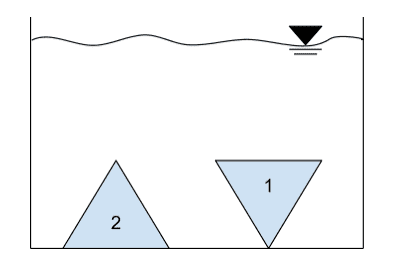
The forum discussion centers on a mechanical aptitude test question regarding the forces exerted on two identical triangles submerged in a water tank. The consensus is that triangle 2 experiences a greater hydrostatic force due to its centroid being deeper than that of triangle 1. Participants highlight the ambiguity in the question, debating whether it refers to net force, hydrostatic force, or the force exerted by the tank's bottom. The discussion emphasizes the importance of clarity in problem statements, particularly in educational contexts.

PREREQUISITES
  • Understanding of hydrostatic forces and pressure calculations
  • Familiarity with buoyancy principles
  • Knowledge of force equilibrium in static systems
  • Basic geometry of triangles and centroids
NEXT STEPS
  • Research hydrostatic pressure calculations in fluid mechanics
  • Study buoyancy and Archimedes' principle in depth
  • Explore the concept of force equilibrium in static structures
  • Learn about centroid calculations for various geometric shapes
USEFUL FOR

Students preparing for mechanical aptitude tests, educators designing assessment questions, and professionals in engineering and physics fields seeking to clarify concepts of fluid dynamics and force analysis.
Ikastun
Messages
10
Reaction score
0
Two identical triangles are placed inside a water tank as shown in the diagram below. The triangles are fixed in position. On which triangle will a greater force be exerted?

mechanical-challenge-2.png


1
2
Equal on both.
Cannot say

The question is part of a mechanical aptitude test. The correct answer is 2, but there is no explanation.

I do not understand why is 2, and not "equal on both". Can anyone give me some clues?.
 
Physics news on Phys.org
The only way that can see is to not allow liquid access on (2) body base.
 
Ikastun said:
The question is part of a mechanical aptitude test. The correct answer is 2, but there is no explanation.

I do not understand why is 2, and not "equal on both". Can anyone give me some clues?.

The author of the question deserves a big FAIL. It could be another one of those copy and paste with parts left out and thus becomes ambigious, or non-sensical.

Anyways,do you know anything about hydrostatic forces, bouyancy, pressure? which is probably what the question was supposed to get at.

What is your reasoning, or calculations, that the answer should "be equal"?
 
  • Like
Likes   Reactions: Ikastun
256bits said:
The author of the question deserves a big FAIL. It could be another one of those copy and paste with parts left out and thus becomes ambigious, or non-sensical.

Anyways,do you know anything about hydrostatic forces, bouyancy, pressure? which is probably what the question was supposed to get at.

What is your reasoning, or calculations, that the answer should "be equal"?

I have a scant knowledge of hydrostatics, to say the least.

My answer is just a guess, given that they are identical triangles and they are at the same depth. The only difference is their position, but the basic formulas of pressure and force do not consider the position:

p=dgh
F=PA

Am I wrong?, what else should I consider?.

Thank you in advance.
 
Yes. A big fail for the author of the question, or cut-and-paste squad. Pressure on a "triangle", something with zero thickness?
 
  • Like
Likes   Reactions: Ikastun
Perhaps the best (most interesting, most educational) question to ask is: What is the force exerted by the bottom of the pool on the triangle? It's different for the two triangles, and when you can see why you'll have nailed this class of problems.
 
  • Like
Likes   Reactions: Ikastun and rootone
My answer is just a guess, given that they are identical triangles and they are at the same depth.

Are they? The centroid of a triangle is 1/3rd of the way up from the base. So isn't 2 slightly deeper than 1 ?
 
  • Like
Likes   Reactions: Ikastun
Could you guys who think it is a bad question explain why you think so?
 
russ_watters said:
Could you guys who think it is a bad question explain why you think so?

It's not clear which force the question is asking for. The net force on the triangle? The hydrostatic force on the triangles? Or the force exerted by the bottom the container on the triangles?
 
  • #10
Nugatory said:
It's not clear which force the question is asking for. The net force on the triangle? The hydrostatic force on the triangles? Or the force exerted by the bottom the container on the triangles?
I think the hydrostatic force is being implied. Secondly, the question does not ask for a numerical answer - there is no need to know the 3rd spatial dimension features of the triangles or the pool to answer this question. No offense to anyone, but I think the question is obviously talking about prisms of equal depth into the page (so one only needs to concentrate upon the 2 dimensional view), since the answer cannot otherwise be determined with the given information (unless there were some omissions while posting the question).
 
  • #11
russ_watters said:
Could you guys who think it is a bad question explain why you think so?

My objection is that the author seems to not have considered the following simple analysis:
Since the triangles are fixed in position, there is no acceleration, and according to Fnet = ma, with acceleration a being 0, the net force Fnet = 0.
In which case, " On which triangle will a greater force be exerted?" has the answer "equal on both".

Of course,
Fnet = Fmg + Fbouyancy + Fbottom = 0
which he/she thought would be a nice tricky question.
But really, Is it?
 
  • Like
Likes   Reactions: Ellispson
  • #12
there is no need to know the 3rd spatial dimension features of the triangles
Normally the 3rd dimesnion is taken as a thickess of unit 1.
 
  • #13
Nugatory said:
It's not clear which force the question is asking for. The net force on the triangle? The hydrostatic force on the triangles? Or the force exerted by the bottom the container on the triangles?
In the absence of qualification, isn't "all" implied (all forces we can see in the diagram)? I don't think we have a grammar issue like in the last thread.

Also, in question's like this, lack of information requires the student to use the process of elimination. Is it just the hydrostatic force or also the normal force? Is triangle 2 sealed to the bottom? Turns out, with a bit of logic, those two issues cancel each other out.
 
  • #14
Agree the question is worded too vaguely. But I think the intent of the question is hydrostatic forces. Although as correctly pointed out, the net force must be 0 since acc = 0. The magnitude of the hydrostatic forces on the individual faces is relevant. The question could have been worded, as you fill the container with more and more water, which triangle will crush first? The answer would certainly be 2. The centroid of the 2 triangle is lower than 1's, thus 2's hydrostatic pressure will be greater. One thought experiment you can do is imagine the tank is only filled to a depth just equal to the height of the triangles. Triangle 1 would have virtually no force on one entire sides. While triangle 2 would have no force only at a vertex.
 
  • Like
Likes   Reactions: Ikastun
  • #15
256bits said:
Normally the 3rd dimesnion is taken as a thickess of unit 1.

The question could have used "triangular prisms" or is this too much to ask of middle school(?) science students?
 
  • #16
I took the small black triangle pointing down at the 2 horizontal lines just below the surface as a pictorial indication of hydrostatic force.
 
  • #17
russ_watters said:
In the absence of qualification, isn't "all" implied (all forces we can see in the diagram)? I don't think we have a grammar issue like in the last thread.

Also, in question's like this, lack of information requires the student to use the process of elimination. Is it just the hydrostatic force or also the normal force? Is triangle 2 sealed to the bottom? Turns out, with a bit of logic, those two issues cancel each other out.
My interpretation is that the question asks for a comparison of the sum of the magnitudes of the forces on the three sides on each triangle.

Since it is rarely meaningful to add the magnitudes of forces while ignoring their directions, the question seems a poor one.
 
  • #18
OK its not a perfectly worded question, but:
  1. this is a mechanical aptitude test, and to my mind making sense of imperfect information is a relevant part of assessing mechanical aptitude;
  2. the question states that the "triangles" are identical, so their 3rd dimension is irrelevant - in fact you can even assume they ARE triangles with zero thickness;
  3. one possible answer is "the net force on each triangle is zero because they are fixed in position", but that is not the best answer because it doesn't make use of all the information provided in the question; a better answer is "the force of water pressure on triangle 2 is greater because the mean depth of its surface area is greater".
 
  • Like
Likes   Reactions: Merlin3189 and Ikastun
  • #19
jbriggs444 said:
My interpretation is that the question asks for a comparison of the sum of the magnitudes of the forces on the three sides on each triangle.

Since it is rarely meaningful to add the magnitudes of forces while ignoring their directions, the question seems a poor one.
So don't - it doesn't change the answer if you include the directions. In fact, solving that (if we had the numbers) provides the buoyant force (if not sealed to bottom).
 
  • #20
russ_watters said:
So don't - it doesn't change the answer if you include the directions. In fact, solving that (if we had the numbers) provides the buoyant force (if not sealed to bottom).

If it's not sealed to the bottom, the buoyant forces are clearly equal. As is the weight of the triangles and the force required to fix them in place. No reasonable vector sum fits the "correct" answer.

If it is sealed to the bottom, one can still find a state of affairs where both triangles have zero net force. So that still fails to produce the "correct" answer.
 
  • #21
jbriggs444 said:
If it's not sealed to the bottom, the buoyant forces are clearly equal.
Why?
 
  • #22
MrAnchovy said:
Why?
Equal volumes submerged in fluid of equal density. Unless you are going for second order effects where the fluid is more dense when deeper.
 
  • #23
jbriggs444 said:
My interpretation is that the question asks for a comparison of the sum of the magnitudes of the forces on the three sides on each triangle.
Why are you ignoring the magnitude of the force on the faces of the triangles? If they are triangles (with zero thickness) the force on the sides is zero.
 
  • #24
MrAnchovy said:
Why are you ignoring the magnitude of the force on the faces of the triangles? If they are triangles (with zero thickness) the force on the sides is zero.

Reaching back to the problem definition to rationalize an answer... Because the triangles are "fixed in place". If the triangles are of zero thickness and we are looking at pressure on their faces, that specification is pointless.
 
  • #25
stedwards said:
The question could have used "triangular prisms" or is this too much to ask of middle school(?) science students?
Good point. It may have been an overwhelming state of affairs for both the student, AND the administrators.
 
  • #26
jbriggs444 said:
Reaching back to the problem definition to rationalize an answer... Because the triangles are "fixed in place". If the triangles are of zero thickness and we are looking at pressure on their faces, that specification is pointless.

Okay, I think we will have to agree to differ - you think the question is asking which triangular prism feels the greatest buoyant force (and the clue "the triangles are fixed in position" does point towards this) and I think the question is asking which triangle feels the greatest pressure (and the fact that the shape is described as a triangle, not a prism, points towards this).
 
  • #27
A heuristic that works for me is that if we're 26 posts in and still trying to decide exactly what the question is asking... We may not know what the question is, but we know that it is... ah... shall we say... inartfully drafted :smile:

The discussion of which forces are at play under which conditions is interesting and valuable, but we're probably better off specifying the conditions we're assuming than we are assuming that everyone is readint the problem the same way.
 
  • Like
Likes   Reactions: pbuk
  • #28
DTM said:
Agree the question is worded too vaguely. But I think the intent of the question is hydrostatic forces. Although as correctly pointed out, the net force must be 0 since acc = 0. The magnitude of the hydrostatic forces on the individual faces is relevant. The question could have been worded, as you fill the container with more and more water, which triangle will crush first? The answer would certainly be 2. The centroid of the 2 triangle is lower than 1's, thus 2's hydrostatic pressure will be greater. One thought experiment you can do is imagine the tank is only filled to a depth just equal to the height of the triangles. Triangle 1 would have virtually no force on one entire sides. While triangle 2 would have no force only at a vertex.

That may have been where the question got fouled up, by some faulty logic.
PS - not your logic its OK

Triangle 1 can be made into triangle 2 configuration by just tipping it over and pushing down while rotating about the vertex.
Pushing down means "more" force to produce the torque for the rotation if the triangles are less dense water.

Or vice-versa, release one vertex of triangle 2 and rotate about the other to obtain configuration 1.
 
Last edited:
  • #29
jbriggs444 said:
If it's not sealed to the bottom, the buoyant forces are clearly equal. As is the weight of the triangles and the force required to fix them in place. No reasonable vector sum fits the "correct" answer.
You're right: so total force is the interpretation they were looking for.
 
  • #30
Nugatory said:
A heuristic that works for me is that if we're 26 posts in and still trying to decide exactly what the question is asking... We may not know what the question is, but we know that it is... ah... shall we say... inartfully drafted :smile:
Depends: are we trying to answer the question or break it? I agree that asking for the scalar sum of the forces is a bit unusual, but when a student reads something unusual in a question, the first attempt should be to see if they can utilize that, not see if they can break it. The way I see it, this question was designed to test both hydrostatic force and overthinking.
 
  • Like
Likes   Reactions: pbuk

Similar threads

  • · Replies 6 ·
Replies
6
Views
2K
  • · Replies 2 ·
Replies
2
Views
2K
  • · Replies 9 ·
Replies
9
Views
3K
  • · Replies 16 ·
Replies
16
Views
6K
Replies
24
Views
2K
  • · Replies 6 ·
Replies
6
Views
3K
  • · Replies 6 ·
Replies
6
Views
2K
  • · Replies 15 ·
Replies
15
Views
4K
Replies
50
Views
7K
  • · Replies 35 ·
2
Replies
35
Views
4K