Undergrad Which Unit Normal Vector of a Surface is Correct?

Click For Summary
SUMMARY

The correct unit normal vector of a surface is context-dependent, specifically defined by the orientation of the surface in relation to a closed region. Both vectors presented in the discussion are valid unit normals; however, their designation as "inward" or "outward" relies on the overall orientation of the surface. The sign of the normal vector is crucial, as it determines the directionality of the vector. A continuous normal vector field exists only for orientable surfaces, exemplified by the Mobius Strip, which demonstrates a discontinuous normal vector field.

PREREQUISITES
  • Understanding of unit normal vectors in differential geometry
  • Familiarity with the concepts of surface orientation and integrability
  • Knowledge of gradient and cross product calculations
  • Basic principles of orientability in topology
NEXT STEPS
  • Study the implications of surface orientation in vector calculus
  • Learn about the properties of orientable vs. non-orientable surfaces
  • Explore the application of normal vectors in surface integrals
  • Investigate the mathematical definition and examples of the Mobius Strip
USEFUL FOR

Mathematicians, physicists, and computer graphics professionals who require a deep understanding of surface geometry and normal vector applications in their work.
terryds
Messages
392
Reaction score
13
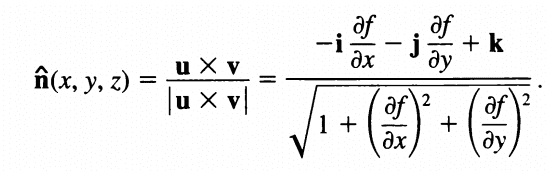
What is actually the unit normal vector of a surface?
Is it this?
34grrt2.png

Or this one?
2hwzpsh.png

I see that those are opposite in direction. But, I want the correct one, which means that it should point outward.
So, which one is correct?
 
Physics news on Phys.org
Both are unit normals. The definition of "inward" and "outward" is dependent on an entire closed region whereas both gradient and cross product are local properties. The meaning of "outward" and can not be defined locally without reference to the larger context.
 
  • Like
Likes WWGD and terryds
FactChecker said:
Both are unit normals. The definition of "inward" and "outward" is dependent on an entire closed region whereas both gradient and cross product are local properties. The meaning of "outward" and can not be defined locally without reference to the larger context.

Is there an easy way to check it inward/outward?
 
Usually these are used in a context of integration over a surface where both the surface and the integration are defined in such a way that keeps track of outward.
 
terryds said:
Is there an easy way to check it inward/outward?

The expressions you gave only determine ##\hat{n}## up to sign, but sign is what determines whether your normal vector is inward- or outward-pointing. If ##u,v## are two independent tangent vectors at a point on your surface, then swapping them gives a minus sign in your first formula for ##\hat{n}##. Similarly, if your surface is the zero set of a function ##g##, then it is also the zero set of ##-g##. But swapping ##g## with ##-g## gives a minus sign in your second formula.
 
A continuous, strictly inward- or outward- normal ( when given the right context, as FactChecker stated) exists only when the surface is orientable; some actually use its existence as the definition for orientability. Notice, e.g., a normal vector field on the Mobius Strip, and how it must make a discontinuous turn at some point.
 
  • Like
Likes FactChecker
Relativistic Momentum, Mass, and Energy Momentum and mass (...), the classic equations for conserving momentum and energy are not adequate for the analysis of high-speed collisions. (...) The momentum of a particle moving with velocity ##v## is given by $$p=\cfrac{mv}{\sqrt{1-(v^2/c^2)}}\qquad{R-10}$$ ENERGY In relativistic mechanics, as in classic mechanics, the net force on a particle is equal to the time rate of change of the momentum of the particle. Considering one-dimensional...

Similar threads

  • · Replies 4 ·
Replies
4
Views
2K
  • · Replies 6 ·
Replies
6
Views
2K
  • · Replies 3 ·
Replies
3
Views
2K
  • · Replies 10 ·
Replies
10
Views
4K
  • · Replies 7 ·
Replies
7
Views
2K
  • · Replies 6 ·
Replies
6
Views
3K
  • · Replies 6 ·
Replies
6
Views
2K
  • · Replies 17 ·
Replies
17
Views
3K
  • · Replies 3 ·
Replies
3
Views
2K
  • · Replies 1 ·
Replies
1
Views
2K