Which wood cross section can carry highest uniform load

Click For Summary

Discussion Overview

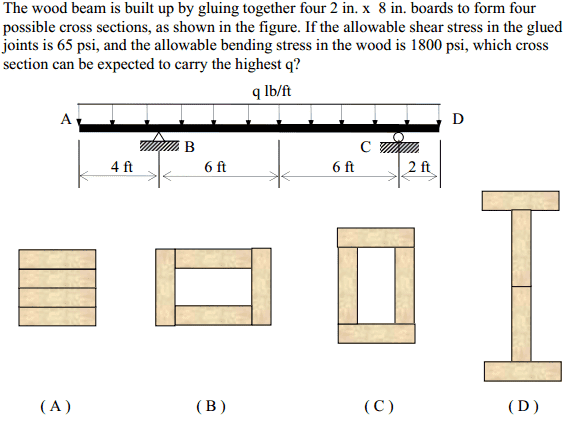
The discussion revolves around determining which wood cross section can carry the highest uniform load. Participants explore the calculations related to moment of inertia, shear stress, and bending stress, while addressing a homework problem involving multiple cross sections.

Discussion Character

  • Homework-related
  • Mathematical reasoning
  • Debate/contested

Main Points Raised

  • One participant presents calculations for the moment of inertia for four different cross sections (A, B, C, D) and concludes that cross section (D) has the highest inertia, suggesting it can carry the largest uniform load.
  • Another participant asserts that in practical applications, cross section (D) is commonly used for strength, although they seek a more mathematical justification.
  • A third participant questions the accuracy of the shear diagram and the calculations, suggesting that the initial assumptions may be incorrect and urging verification of the results.
  • The original poster acknowledges potential errors in their calculations and considers that glued joints might affect the load capacity, indicating a need to re-evaluate their findings.
  • There is a discussion about the appropriateness of seeking help on a take-home quiz, with one participant expressing frustration over the lack of resources available for assistance.

Areas of Agreement / Disagreement

Participants express differing views on the calculations and assumptions made regarding the cross sections. There is no consensus on which cross section can definitively carry the highest uniform load, and the discussion remains unresolved as participants continue to refine their calculations and reasoning.

Contextual Notes

Some calculations and assumptions presented by participants may be based on incorrect values or interpretations, particularly regarding the shear diagram and the maximum bending moment. The discussion highlights the complexity of evaluating different cross sections and the influence of factors like glued joints.

Blugga
Messages
22
Reaction score
0
Which wood cross sectioπ caπ carry hïghest uπiform load
Homework Statement


2m69v1g.jpg


Homework Equations


Moment of inertia for rectangle I=(1/12)bh3
τ=(VQ)/(I*b)
σ=(MV)/I

The Attempt at a Solution


I started by finding reactions at B and C
Then drew the sheer and moment diagrams (to save space i made it a link)
http://oi47.tinypic.com/qsmkxh.jpg
To find which cross section can withstand the biggest q, I found the moment of inertia about the z axis (neutral axis) for each figure.
(A)Iz=2*{((1/12)*8*23)+[(2*8)*32]}+2*{((1/12)*8*23)+[(2*8)*12]}
Iz=341.33 in4

(B)Iz=2*{((1/12)*8*23)+[(2*8)*32]}+2*{((1/12)*2*83)}
Iz=469.33 in4

(C)Iz=2*{((1/12)*8*23)+[(2*8)*52]}+2*{((1/12)*2*83)}
Iz=981.33 in4

(D)Iz=2*{((1/12)*8*23)+[(2*8)*92]}+2*{((1/12)*2*83)+[(2*8)*42]}
Iz=3285.33 in4

Because both of the equations I posted for τ and σ are dependent on Inertia, I figured since that when solving for (q) we would have to multiply by Inertia so whichever cross section has the biggest Inertia will also have a bigger (q). Therefore, cross section (D) was the pick. Was I right to assume this?
τmax=[(6.5q)*Q(0)]/[3285.33*2]=65; where Q(0)=208. not sure about that value
∴q=315 lb/ft
σmax=[(34.125lb-ft)(12in/ft)q*10]/3285.33=1800
∴q=1444.10 lb/ft and so the max q can be is 315 lb/ft

This is my first attempt so any help is appreciated.
 
Last edited:
Physics news on Phys.org
I can't help you with the math but I can tell you that in the real world D is what is always used when strength is needed.
 
phinds said:
I can't help you with the math but I can tell you that in the real world D is what is always used when strength is needed.

I guess it kinda helps prove my point, but I was kinda looking for a more mathematical response :)
 
Blugga: Is this a take-home test question? I currently cannot match your x1 = 10.5, on your shear diagram, yet. Are you sure x1 is correct? Try again. Therefore, I cannot match your bending stress equation yet.

Your shear stress equation looks fine. Your moments of inertia look fine. How will you know which cross section can carry the highest q if you do not check them? You will just guess?
Blugga said:
Was I right to assume this?
No, I do not think so.
 
It's a sort of take home quiz. The book doesn't go into depth into how to find this sort of info for these shapes. It just explains briefly for 1 or 2 wood boards, and i have 4.

I think you may be right about the X1 being off. I think x1 will just be 10.5ft - 4ft. So x1=6.5ft.
Therefore, Mmax=13.125q.
Also, i guess my reasoning was that from the bending stress alone cross section (D) would be greatest. But i didn't count that the glued joints would make all the difference. I did try to find qmax for each cross section (but with the wrong Mmax) and ended up with cross section (C) carrying the highest q. I'll rework the new figures in the morning. Thanks for the help.
 
nvn said:
Blugga: We usually should not help on quiz or test questions. The PF Rules link at the top of each page says, "Do not ask for answers to exams."

I understand that, but this isn't an exam. It's a take home quiz/assignment. It's worth a very small percentage of the overall grade, about 0.7% and I already had half right so you were only helping with 0.35%. Only reason I asked was because the book was of no help and there was no one else I could ask (TA's and professors never have time). I guess it's best to get things wrong and never figure out how to do them then to bend the "rules" a little... :rolleyes:

But thanks for the help you did provide.
 

Similar threads

  • · Replies 2 ·
Replies
2
Views
3K
Replies
33
Views
6K
  • · Replies 1 ·
Replies
1
Views
3K
Replies
1
Views
6K
Replies
48
Views
19K
  • · Replies 1 ·
Replies
1
Views
7K
Replies
6
Views
9K
  • · Replies 1 ·
Replies
1
Views
2K
Replies
19
Views
34K
  • · Replies 15 ·
Replies
15
Views
54K