Who will win this running race?

  • Context: High School 
  • Thread starter Thread starter TonyYuan
  • Start date Start date
  • Tags Tags
    Race Running
Click For Summary

Discussion Overview

The discussion revolves around a running race scenario that involves analyzing velocities and time measurements, with a focus on the implications of special relativity. Participants explore various interpretations of the problem, including the definitions of velocity and speed, and how these relate to the race outcomes. The conversation includes elements of homework-related inquiry and technical reasoning.

Discussion Character

  • Homework-related
  • Technical explanation
  • Debate/contested

Main Points Raised

  • Some participants question the clarity of the problem, asking whether velocities are components and if they are measured in the Earth frame.
  • There is a discussion about the definition of velocity, with some asserting it is a vector that can be split into components.
  • Participants express confusion over the relationship between speed and velocity, with attempts to clarify definitions and their implications for the race.
  • One participant mentions that different scholars provided varying answers, indicating a lack of consensus on the interpretation of the problem.
  • Some participants argue that special relativity may not be necessary for analyzing the race if all measurements are in the same reference frame.
  • There is a suggestion that the race outcome could be a draw if both racers have the same y-component of velocity, assuming all data applies to a single reference frame.

Areas of Agreement / Disagreement

Participants express differing views on the definitions and implications of velocity and speed, as well as the relevance of special relativity to the problem. There is no clear consensus on how to interpret the race scenario or the correct approach to solving it.

Contextual Notes

The discussion highlights ambiguities in the original question, including the definitions of terms and the assumptions about reference frames. Participants also note the importance of showing reasoning and effort in homework-related inquiries.

TonyYuan
Messages
18
Reaction score
0
TL;DR
It was a running race between Newton and Einstein. I want to know who gets to the platform first.
Who will win this running race?
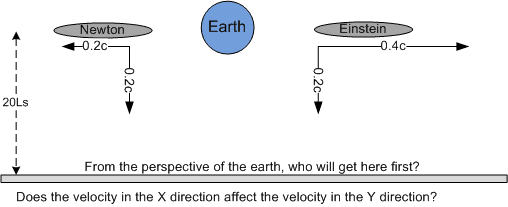
race.png


How many seconds are their scores?
 
Last edited:
Physics news on Phys.org
This looks like a homework question - so, what do you think and why?

Questions I'd ask before even starting:
- are the velocities meant to be velocity components?
- are those components measured in the Earth frame?
- are the 'score' times supposed to be measured in the Earth's rest frame, or proper times, or what?
Hopefully the question specifies all this, since it's rather ambiguous without.
 
Ibix said:
Hopefully the question specifies all this, since it's rather ambiguous without.
- are the velocities meant to be velocity components?
Yes, vx and vy.
- are those components measured in the Earth frame?
Yes.
- are the 'score' times supposed to be measured in the Earth's rest frame, or proper times, or what?
They are measured in the Earth's rest frame.
 
Thank you for the clarification. What is your attempt at this question? PF rules require you to show some effort before we help you - our aim is for you to learn how to do this, not for us to get some practice in.
 
I consulted some scholars and I got different answers, which surprised me because this physical scene is not complicated. There are many physicists here, so I hope I can get the right answer here. Thanks.
 
TonyYuan said:
I consulted some scholars and I got different answers, which surprised me because this physical scene is not complicated. There are many physicists here, so I hope I can get the right answer here. Thanks.
What is "velocity" anyway? How is it defined?
 
PeroK said:
What is "velocity" anyway? How is it defined?
velocity = speed + direction.
velocity is a vector and can be split or combined in any direction. The velocity of the spaceship here is split into the velocity in the x direction vx and the y direction vy.
 
TonyYuan said:
velocity = speed + direction.
velocity is a vector and can be split or combined in any direction. The velocity of the spaceship here is split into the velocity in the x direction vx and the y direction vy.

That's not a definition; that's a description. When you say ##v_y##, how is that defined? What does ##v_y = 0.2c## mean?
 
TonyYuan said:
I consulted some scholars and I got different answers, which surprised me because this physical scene is not complicated. There are many physicists here, so I hope I can get the right answer here. Thanks.
If you asked the question as ambiguously as your original posting, I'm not surprised. It was open to interpretation and they probably interpreted it differently. Note that asking us does not help you - if you have five answers already and you ask us and we give you a sixth, are you any better off? If you're trying to decide the correct answer by popular vote instead of by showing your reasoning and talking it through with us, you will only get the right answer if you are lucky.

What answers did you get, and which one do you think is correct? @PeroK's response will help you to decide if you answer his question. (Edit - if you answer his second question correctly, I mean...
 
  • Like
Likes   Reactions: russ_watters
  • #10
PeroK said:
That's not a definition; that's a description. When you say ##v_y##, how is that defined? What does ##v_y = 0.2c## mean?
vy: The speed of the spacecraft relative to the Earth in the y direction.
vx:The speed of the spacecraft relative to the Earth in the x direction.
 
  • #11
TonyYuan said:
vy: The speed of the spacecraft relative to the Earth in the y direction.
vx:The speed of the spacecraft relative to the Earth in the x direction.
And what is "speed"?
 
  • #12
And what is the definition of speed, without using the word "velocity" in your answer.
 
  • #13
PeroK said:
And what is "speed"?
speed = Displacement/time
 
  • #14
TonyYuan said:
speed = Displacement/time
Well, that's velocity, but anyway it proves the point. The y-component of velocity is, by definition, the y-displacement over time.

What can you conclude from this? Say, for example, that Einstein wins the race. What does that tell you about the y-components of velocity?
 
  • #15
PeroK said:
Well, that's velocity, but anyway it proves the point. The y-component of velocity is, by definition, the y-displacement over time.

What can you conclude from this? Say, for example, that Einstein wins the race. What does that tell you about the y-components of velocity?
There are two well-known mathematical formulas in special relativity:
1.w = (u + x) / (1-u * x / c ^ 2)
2.t = sqrt (1-v ^ 2 / c ^ 2)
How do we apply it in this topic. This is also where I am sleepy, who actually arrived at the platform first.
 
  • #16
TonyYuan said:
There are two well-known mathematical formulas in special relativity:
1.w = (u + x) / (1-u * x / c ^ 2)
2.t = sqrt (1-v ^ 2 / c ^ 2)
How do we apply it in this topic. This is also where I am sleepy, who actually arrived at the platform first.
What does special relativity have to do with this question?
 
  • #17
PeroK said:
What does special relativity have to do with this question?
One scholar told me that the vertical velocity component is affected by the time factor.
rate = sqrt (1-v ^ 2 / c ^ 2), so relative to the earth, the speeds of the two spaceships have become
vy1 = 0.2c * rate1, rate1 = sqrt (1- (0.4c) ^ 2 / c ^ 2)
vy2 = 0.2c * rate2, rate2 = sqrt (1- (0.2c) ^ 2 / c ^ 2)
Then he told me that the distance was 10Ls, so the last one to arrive was the one with the smaller vx, which was Newton's first arrival. Do you think his answer is correct? I don't understand.
 
  • #18
TonyYuan said:
One scholar told me that the vertical velocity component is affected by the time factor.
rate = sqrt (1-v ^ 2 / c ^ 2), so relative to the earth, the speeds of the two spaceships have become
vy1 = 0.2c * rate1, rate1 = sqrt (1- (0.4c) ^ 2 / c ^ 2)
vy2 = 0.2c * rate2, rate2 = sqrt (1- (0.2c) ^ 2 / c ^ 2)
Then he told me that the distance was 10Ls, so the last one to arrive was the one with the smaller vx, which was Newton's first arrival. Do you think his answer is correct? I don't understand.

As I said, this goes back to the definition of velocity. Your original diagram shows the velocity in the Earth frame- yes? It shows the distances in the Earth frame - yes? Time is going to be measured in the Earth frame- yes?

Either the y-velocity is ##0.2c## (in the Earth frame) or it isn't. If it is, then that's what you use. If it isn't then your data is wrong. If, let's say the y-velocity of Einstein is less than ##0.2c##, then that's what you should have on your diagram. Surely?

Special Relativity only applies if you want to analyse the race in a different frame. Since you don't, any transformation of lengths, times and velocities is utterly irrelevant.
 
  • Like
Likes   Reactions: russ_watters, DrClaude and Ibix
  • #19
PeroK said:
As I said, this goes back to the definition of velocity. Your original diagram shows the velocity in the Earth frame- yes? It shows the distances in the Earth frame - yes? Time is going to be measured in the Earth frame- yes?

Either the y-velocity is ##0.2c## (in the Earth frame) or it isn't. If it is, then that's what you use. If it isn't then your data is wrong. If, let's say the y-velocity of Einstein is less than ##0.2c##, then that's what you should have on your diagram. Surely?

Special Relativity only applies if you want to analyse the race in a different frame. Since you don't, any transformation of lengths, times and velocities is utterly irrelevant.
ok, this is another answer I got, it looks reasonable.
So as the platform's vision, who will first encounter platform?
 
  • #20
TonyYuan said:
ok, this is another answer I got, it looks reasonable.
So as the platform's vision, who will first encounter platform?

It's a draw by definition of (component of) velocity. Two objects with the same y-component of velocity have the same y-displacement in the same time. By definition. Assuming all data applies to a single reference frame.
 
  • #21
"As I said, this goes back to the definition of velocity. Your original diagram shows the velocity in the Earth frame- yes? It shows the distances in the Earth frame - yes? Time is going to be measured in the Earth frame- yes? "
I think their speed relative to the Earth is definite, because I gave a clear reference, which is the earth. The moment they left the earth, the speed didn't change. If this premise does not hold, then we cannot conduct research.
 
  • #22
PeroK said:
It's a draw by definition of (component of) velocity. Two objects with the same y-component of velocity have the same y-displacement in the same time. By definition. Assuming all data applies to a single reference frame.
The platform is stationary relative to the earth.
 
  • #23
TonyYuan said:
The platform is stationary relative to the earth.
Then it has the same simultaneity.
 
  • #24
A.T. said:
Then it has the same simultaneity.
ok, you mean they will reach the platform at the same time.
Newton thought the same way. I don't know if Einstein thought so too. There was an American astronomer who gave me the answer that they would not arrive at the same time. He has absolute authority in a scientific forum.
 
  • #25
TonyYuan said:
ok, you mean they will reach the platform at the same time.
In the reference frame of the Earth and platform, were both start simultaneously with the same vertical velocity.
 
  • #26
TonyYuan said:
ok, you mean they will reach the platform at the same time.
Newton thought the same way. I don't know if Einstein thought so too. There was an American astronomer who gave me the answer that they would not arrive at the same time. He has absolute authority in a scientific forum.
As A.T. points out, observers at rest or only moving parallel to y in the Earth frame (such as Earth and your platform) will regard this race as a draw. Observers with any motion in the x direction in the Earth frame (such as Newton and Einstein in your example) will get different results for who won.

It isn't clear from what you've said which frame your astronomer was using. He may have made a mistake, or interpreted your question differently, or he may be using a different frame from the one you think he is.

I must say that the use of Newton and Einstein as characters in this is potentially confusing. It isn't clear in your last sentence whether you refer to the historical figures and their theories or to the characters in your scenario.
 
  • #27
A.T. said:
In the reference frame of the Earth and platform, were both start simultaneously with the same vertical velocity.

Can you answer this question:
What is the relative speed between AB? va and vb all relative to the earth.
Earth-----------------A---->
|-----------------------va=0.9c
|
|
\/ B vb=0.9c
 
  • #28
TonyYuan said:
ok, you mean they will reach the platform at the same time.
Newton thought the same way. I don't know if Einstein thought so too. There was an American astronomer who gave me the answer that they would not arrive at the same time. He has absolute authority in a scientific forum.

Let's assume that Newton reaches the platform in ##100s## (Earth frame). He has traveled ##20## light seconds in the y-direction in ##100s##. That's ##0.2c## for the velocity component in the y-direction. By definition.

Let's also assume that Einstein reaches the platform in ##50s## (Earth frame). He has traveled ##20## light seconds in the y-direction in ##50s##. That's ##0.4c## in the y-direction.

That's what velocity and components of velocity mean. You calculate them by taking y-displacement over time. If Einstein does not reach the platform in ##100s##, then the y-component of his velocity is not ##0.2c##. There can be no argument about this.
 
  • #29
PeroK said:
Let's assume that Newton reaches the platform in ##100s## (Earth frame). He has traveled ##20## light seconds in the y-direction in ##100s##. That's ##0.2c## for the velocity component in the y-direction. By definition.

Let's also assume that Einstein reaches the platform in ##50s## (Earth frame). He has traveled ##20## light seconds in the y-direction in ##50s##. That's ##0.4c## in the y-direction.

That's what velocity and components of velocity mean.
What is your basis for making 100s and 50s? Their velocity in the y direction relative to the Earth is the same, and their velocity in the x direction is different.
 
  • #30
TonyYuan said:
Summary:: It was a running race between Newton and Einstein. I want to know who gets to the platform first.

Who will win this running race?

View attachment 259882

How many seconds are their scores?
Please post homework type questions in the homework section. It is mandatory to use the template and, in particular, to show your work.

TonyYuan said:
I consulted some scholars and I got different answers
We do not discuss the unpublished opinions of third parties on PF. Private conversations are not valid sources.

Thread closed
 

Similar threads

  • · Replies 12 ·
Replies
12
Views
2K
  • · Replies 1 ·
Replies
1
Views
3K
  • · Replies 8 ·
Replies
8
Views
3K
  • · Replies 17 ·
Replies
17
Views
4K
  • · Replies 27 ·
Replies
27
Views
3K
  • · Replies 10 ·
Replies
10
Views
3K
Replies
2
Views
2K
  • · Replies 1 ·
Replies
1
Views
2K
  • · Replies 24 ·
Replies
24
Views
6K
  • · Replies 6 ·
Replies
6
Views
2K